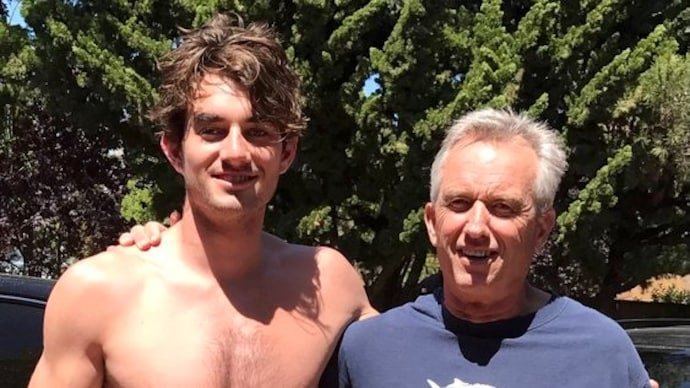
Conor Kennedy was once known largely for his connection to one of the world’s biggest pop stars. In 2012, the grandson of former US senator Robert F. Kennedy briefly dated Taylor Swift, placing him firmly inside the celebrity spotlight.
Fourteen years later, that part of his biography has become almost incidental.
Kennedy, the son of US Health and Human Services Secretary Robert F. Kennedy Jr., is now at the centre of an international legal dispute after Russia placed him on its international wanted list over his reported service with Ukraine’s International Legion during the war against Russia.
The Moscow Basmanny District Court has authorised Kennedy’s arrest in absentia, according to reports citing Russian state Media. Russian authorities accuse him of acting as a mercenary for Ukrainian forces, an allegation that carries a potential prison sentence of seven to 10 years if he is captured.
Kennedy is not being pursued because of his family name, his former relationship with Swift or his current legal career. The central issue is his own decision to travel secretly to Ukraine in 2022 and join a foreign military formation fighting against Russia’s invasion.
That decision, which Kennedy initially kept hidden from almost everyone close to him, has now become the reason he is wanted by Russian authorities.
Why Russia is seeking Conor Kennedy
The immediate reason for Kennedy’s appearance on Russia’s wanted list is his reported participation in Ukraine’s International Legion.
In October 2022, Kennedy publicly disclosed that he had travelled to Ukraine and enlisted with the legion. He said he had been deeply affected by the invasion and wanted to help Ukrainians resist Russian forces.
He had no previous military experience when he joined. Kennedy acknowledged that he was not an experienced marksman but said he could carry heavy equipment and learned quickly. He also said he was prepared to accept the possibility of dying in Ukraine.
According to Kennedy’s own account, he deliberately kept his deployment secret because he did not want his family and friends to worry and did not want special treatment because of his surname.
That secrecy is one of the most striking elements of the story. Kennedy was not an ordinary volunteer whose decision became public before he left the United States. He travelled without telling his father and stepmother the real reason for his absence and maintained the deception until his family began to suspect something was wrong.
His deployment eventually became public when he described it himself on social media after returning to the United States.
What Kennedy said about fighting in Ukraine
Kennedy’s account provides the clearest explanation of why he went to Ukraine.
He said he had been moved by what he saw happening in the country and decided to enlist after learning about the International Legion. He travelled to the Ukrainian embassy and began the enlistment process shortly afterward.
Rather than remaining in a relatively secure support role, Kennedy said he was eventually sent to the northeastern front.
His description of the experience was unusually personal. He wrote that his time in Ukraine had been frightening but also meaningful, and that he admired the people he served alongside.
The account also made clear that he understood the risks. Kennedy said he was willing to die in Ukraine, a statement that underlined how seriously he viewed his decision despite his lack of military background.
He ultimately spent about two and a half months on the front lines before returning home.
There is an important distinction between Kennedy’s own description of his service and Russia’s legal characterization of it. Kennedy presented himself as a foreign volunteer WHO wanted to support Ukraine. Russian authorities have instead accused him of mercenary activity.
Those descriptions are not interchangeable. The Russian allegation is the legal basis for the arrest order, while Kennedy’s own account describes his motivations and experience. The two sides have fundamentally different interpretations of what his participation represented.
Why Kennedy kept the Ukraine deployment secret from his family
Kennedy’s decision to conceal the trip from his family is particularly striking given the prominence of his surname.
His father, Robert F. Kennedy Jr., is a prominent member of one of America’s most recognisable political families and is now serving as US secretary of Health and Human Services. Kennedy is also the grandson of the late senator and attorney general Robert F. Kennedy and part of the wider Kennedy political dynasty.
According to accounts previously given by his father, Kennedy had initially told his family that he had decided not to take a position at a Los Angeles law firm that summer.
The explanation began to unravel when credit-card activity showed transactions in Poland and Ukraine.
His parents eventually learned that their son had gone to the war zone.
RFK Jr. acknowledged that he was angry and concerned when Kennedy returned. But he also said he was proud of his son’s conviction.
The father and son did not agree politically on the war. Kennedy strongly supported US involvement and believed that standing on the sidelines was unacceptable. His father’s views on foreign policy have been different, making the son’s decision to volunteer in Ukraine particularly notable within the family.
What began as a secret personal decision therefore crossed several lines at once: family expectations, military risk and a significant political disagreement between father and son.
From the Ukraine front line back to law school
After his deployment ended, Kennedy returned to the United States and resumed his legal Education at Georgetown University.
The contrast between his wartime experience and his subsequent life is striking. Instead of remaining involved in the conflict, he returned to the academic and professional path he had been pursuing before the deployment.
He later established himself as an attorney in Los Angeles and now works as an associate at Wisner Baum.
His professional life makes the Russian arrest order particularly unusual. Kennedy is not currently a public military figure or a politician. His day-to-day career is in law, while his connection to the Ukraine war dates back to a relatively brief period in 2022.
Yet the consequences of that decision have followed him years later.
The case illustrates how participation in a foreign conflict can remain legally significant long after a volunteer has returned home. A short deployment may end for the individual, but the political and legal consequences can continue for years.
The Taylor Swift connection is now a footnote
Before the Ukraine story, Kennedy’s name was widely associated with Taylor Swift.
The two were romantically linked during the summer of 2012. Swift was 22 at the time and Kennedy was 18. Their relationship lasted only a few months and ended later that year.
The romance generated substantial media attention because Swift was already a major pop star and the Kennedy family carried its own extraordinary cultural and political legacy.
Kennedy’s connection with Swift continued to resurface in Entertainment coverage long after the relationship ended. But his life subsequently moved into very different territory, including legal studies, professional work and his decision to volunteer in Ukraine.
The Swift connection is relevant to understanding why Kennedy was once familiar to a mass audience, but it has little bearing on the Russian case itself.
That contrast is precisely what makes the current story so striking. A man once featured in celebrity headlines is now appearing in reports about international warrants, military service and Russia’s prosecution of foreign volunteers.
Why Russia’s use of the “mercenary” accusation matters
The legal terminology surrounding Kennedy’s case is important.
Russia is not simply saying that Kennedy visited Ukraine or supported the Ukrainian government. The allegation is that he acted as a mercenary for Ukrainian forces.
That distinction matters because Russia has sought legal action against foreign nationals who have fought on Ukraine’s side during the conflict.
For Kennedy, the practical consequence is the arrest order issued in absentia. Because he is outside Russia, the immediate significance is not that he is being physically detained. Instead, the ruling creates a legal basis for Russian authorities to seek his arrest if he comes within their reach.
That makes international travel a potentially more complicated issue for him than it was before the case emerged.
The supplied reports indicate that Russian authorities say Kennedy could face seven to 10 years in prison if captured. That is a Russian legal threat, not a sentence imposed by a US court.
It is also important not to confuse Russia’s domestic legal action with an internationally enforceable conviction. An arrest order issued by a Russian court does not automatically mean that authorities in another country will detain or extradite the person involved.
Kennedy is not the only foreign volunteer targeted by Russia
Russia’s action against Kennedy is part of a broader pattern involving foreign nationals who have fought for Ukraine.
Reports have identified other foreign volunteers, including citizens of the United States and United Kingdom, who have also appeared on Russian wanted lists.
The significance of the Kennedy case comes partly from his unusually prominent family background. His identity gives an otherwise obscure legal case much greater international attention.
It also creates a politically sensitive connection between Russia, Ukraine and the United States at a time when the war remains one of the most consequential foreign-policy issues for Washington.
Kennedy’s father holds a senior position in the US government, making the case more politically noticeable than it would have been if the defendant had no prominent family connections.
What this means for Robert F. Kennedy Jr.
The case puts RFK Jr. in an awkward position because his son’s actions during the Ukraine war do not fully align with his own views.
His public comments after discovering what Conor had done nevertheless showed a distinction between political disagreement and parental support. He expressed pride in his son’s willingness to act according to his beliefs, even while acknowledging that they disagreed over the conflict.
That history could make any new public comment from the HHS secretary particularly sensitive.
As a senior US government official, RFK Jr. now occupies a position far removed from the private family circumstances surrounding Conor’s 2022 decision. His son’s legal predicament involves Russia and Ukraine, while his own responsibilities are centred on US domestic health policy.
There is no indication that the Russian action against Conor Kennedy represents a US government dispute with Russia or an official position concerning his son’s military service.
Why the story has resurfaced four years later
Kennedy’s deployment was not new information. He publicly described it in 2022, shortly after returning to the United States.
The new element is Russia’s legal action.
That development transforms an old personal story into a current international-affairs story. The question is no longer simply why a young American from a famous family volunteered for Ukraine. It is what legal consequences can follow from that decision years after he left the battlefield.
The timing also illustrates how the Ukraine war continues to generate consequences beyond the battlefield itself. Foreign volunteers who participated during earlier stages of the conflict may remain subject to legal and political action even after returning home.
For Kennedy, the issue has become especially visible because his identity connects several worlds that rarely overlap: American Politics, the Kennedy family legacy, celebrity culture, the legal profession and the Russia-Ukraine war.
What could happen next?
The most important question is whether Russian authorities will ever gain custody of Kennedy.
He returned to the United States after his deployment and has continued his legal career. Unless he travels to a jurisdiction where Russian authorities can successfully act on the warrant, the arrest order may remain largely a legal threat rather than an immediate physical consequence.
His representatives and Kennedy himself could also face growing media attention as the case develops.
Another important question is whether Russian authorities will continue pursuing other foreign volunteers through similar proceedings. If they do, Kennedy’s case could become part of a broader effort to prosecute or pressure foreign nationals who fought for Ukraine.
For now, the facts are relatively straightforward even though the surrounding politics are complicated: Conor Kennedy secretly joined Ukraine’s International Legion in 2022, spent roughly two and a half months in the country, returned to the United States and resumed his legal studies and career. Years later, Russia has placed him on its international wanted list and authorised his arrest in absentia over allegations that he acted as a mercenary.
The Taylor Swift relationship that once made Kennedy famous is now almost irrelevant to the central story. His family name may explain why the case has attracted so much attention, but it is his wartime decision that has put him in Russia’s crosshairs.
For Kennedy, a decision he once described as a personal act of conviction has become something much more consequential. The battlefield chapter ended in 2022. The legal consequences, however, may only now be entering a new phase.
For breaking news and live news updates, like us on Facebook or follow us on Twitter and Instagram. Read more on Latest World on thefoxdaily.com.

COMMENTS 0