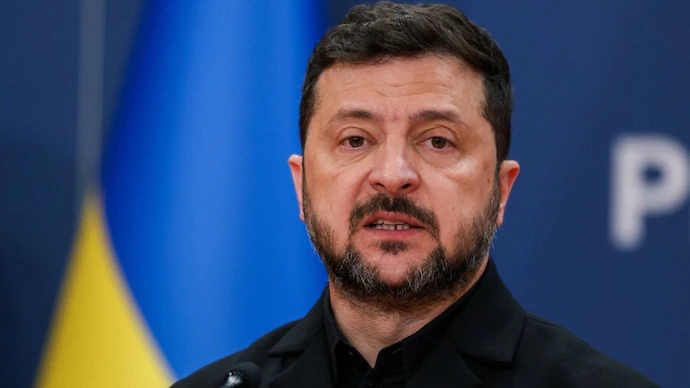
Ukrainian President Volodymyr Zelenskyy has criticised international partners after Ukraine received no advance warning before the first wave of a Russian ballistic missile attack, saying the incident raised fresh questions about intelligence-sharing and cooperation with Kyiv. The overnight assault damaged energy facilities across the country, disrupted electricity supplies and killed civilians, according to Ukrainian officials.
Russia launched 16 ballistic missiles at Kyiv and the surrounding region, alongside more than 200 drones targeting locations across Ukraine. A woman was killed in Kyiv, while two people died in the industrial city of Kryvyi Rih, officials told Reuters.
“Another Russian ballistic missile attack came in several waves overnight, and once again, there was no early warning from our partners,” Zelenskyy wrote on Telegram.
The president’s remarks come amid disagreements over Washington’s efforts to keep Moscow engaged in negotiations, including reported arrangements involving diesel supplies and sanctions relief. The attack also preceded a Kremlin statement that a final settlement of the war was unlikely without Ukraine’s participation, underlining the diplomatic challenges surrounding efforts to end the conflict.
Russian strikes damage energy infrastructure across Ukraine
The attacks affected multiple regions, extending from Kharkiv and Dnipro in eastern Ukraine to Odesa in the south and Volyn and Rivne in the west. Zelenskyy said more than 10 energy facilities were damaged, while Ukrainian Prime Minister Sergii Koretskyi identified energy infrastructure as the main target.
The damage forced Ukraine’s energy ministry to introduce rolling blackouts for households and businesses. Repair crews began working to restore electricity supplies, but the scale and geographical spread of the damage placed additional pressure on the country’s power system.
Energy infrastructure has remained a critical target during the war because damage to power generation and distribution can affect homes, businesses, public services and essential facilities. Disruptions can also complicate heating and other services when electricity supplies are limited, increasing the burden on civilians far from the front lines.
The latest assault was not limited to energy facilities. Koretskyi said railway stations, pharmaceutical warehouses, commercial properties and residential buildings were also damaged.
In Kyiv, a subway station was hit, while a 25-storey residential building sustained damage, according to Mayor Vitali Klitschko. The incidents illustrated how large-scale air attacks can affect both critical infrastructure and civilian areas.
Ukraine reports intercepting missiles and hundreds of drones
Ukraine’s air force said its air defences shot down four cruise missiles and 243 drones. The figures indicate that Ukrainian forces intercepted a substantial number of incoming weapons, although the reported damage shows that the attack still had serious consequences.
Russia’s Defence Ministry described the operation as a “massive strike” against Ukrainian defence-industry facilities, drone and cruise-missile storage sites, and a data centre. Moscow’s stated targets differed in emphasis from Kyiv’s account, which identified energy infrastructure as the principal focus.
These accounts should be distinguished: Russia presented the assault as an attack on military-related facilities, while Ukrainian officials reported extensive damage to the country’s energy network and other civilian infrastructure. The available statements do not independently establish the purpose or full impact of every weapon used.
Why Ukraine says the missing warning matters
Ukraine has relied on intelligence from the United States and other partners to detect incoming Russian ballistic missiles. These weapons travel at high speeds, leaving defenders with limited time to identify the threat, alert civilians and prepare air defences.
Ukrainian Air Force spokesperson Yurii Ihnat said the country received no warning before the first ballistic missile attack overnight, although information arrived before a second attack. He said Ukrainian specialists were investigating why the initial warning had not been received, working alongside international partners.
“For some reason, no information was received the first time, a matter our experts are investigating together with our partners, as this is not the first time such a situation has occurred,” Ihnat told Ukrainian television.
The distinction between the first and second waves is important. Ukrainian officials have not established publicly why the initial warning was missing, and the absence of an alert does not, by itself, prove that a partner deliberately withheld intelligence. The investigation will need to determine whether the incident resulted from a technical problem, a communication failure or another cause.
Even so, the episode has highlighted Ukraine’s dependence on external intelligence for detecting certain missile threats. Any uncertainty over the availability or timing of such information can complicate preparations for attacks and add pressure to an already stretched air-defence system.
Marco Rubio denies that Washington suspended intelligence sharing
US Secretary of State Marco Rubio rejected claims that Washington had paused intelligence-sharing arrangements with Ukraine. His comments contradicted Zelenskyy’s account that some cooperation had been interrupted and later restored.
Speaking to reporters in Uzbekistan on Monday, Rubio said there had been no pause in intelligence-sharing. He also said he did not know exactly what had happened during the latest overnight attack and could not comment on the specific incident.
Rubio has previously referred to software problems affecting an early-warning system, according to reports of his remarks. However, the precise cause of the missing warning before the latest attack remained under investigation on Monday.
The disagreement highlights a gap between Kyiv’s experience of the attacks and Washington’s account of its intelligence support. Zelenskyy has expressed gratitude for the resumption of cooperation, while US officials have denied that intelligence-sharing was suspended in the first place.
For Ukraine, the immediate concern is whether it will receive timely information before future ballistic missile launches. For Washington, the issue has become part of a wider debate over military support, negotiations with Moscow and the conditions under which the war could end.
Zelenskyy criticises US concessions to Moscow
Zelenskyy’s criticism extended beyond the missing warning to broader US policy toward Russia. He objected to arrangements involving Russian diesel imports and the easing or delaying of sanctions, arguing that these measures risked undermining Ukraine’s defence while diplomatic efforts continued.
“When deliveries of missiles for Ukraine’s air defence are blocked while Russia is granted relief or delays in sanctions, this is, unfortunately, a denial of reality on the part of our partners,” Zelenskyy said.
His remarks reflect Kyiv’s concern that concessions intended to keep Moscow engaged in negotiations could provide Russia with economic benefits while Ukraine continues to face attacks on its cities and critical infrastructure.
US President Donald Trump has defended sanctions relief as part of his effort to bring Russia to the negotiating table. He has argued that Washington should avoid measures that could discourage the Kremlin from participating in peace talks.
The two governments therefore have different immediate priorities. Ukraine is seeking reliable air-defence support and pressure on Russia to stop its attacks. The Trump administration has emphasised maintaining diplomatic engagement with Moscow as it pursues a negotiated settlement.
These approaches are not necessarily incompatible in principle, but disagreements over sanctions, weapons deliveries and intelligence support have made coordination more difficult. The latest strikes have brought those differences into sharper focus.
Rubio says ending the war should remain the priority
Speaking in Uzbekistan, Rubio said Ukraine and Russia should concentrate on ending the war. He reiterated Trump’s stated goal of securing a peace agreement and said discussions had taken place about a possible meeting involving Trump, Russian President Vladimir Putin and Chinese President Xi Jinping.
Rubio said he did not know whether such a meeting had been finalised. The comments did not establish that a summit had been scheduled or that the three leaders had agreed on a negotiating framework.
The possibility of further high-level talks comes as the Kremlin has said a final settlement would be unlikely without Kyiv’s involvement. Ukraine has consistently maintained that decisions affecting its territory and security cannot be made without its participation.
Any negotiations would have to address more than an immediate halt to fighting. Questions surrounding territorial control, security guarantees, sanctions and the future of military assistance would remain central to a lasting agreement.
For Ukraine, the challenge is to participate in diplomacy without weakening its ability to defend itself. For the United States, it is to keep negotiations moving while managing disagreements with Kyiv over the balance between pressure on Moscow and incentives for talks.
Rubio warns that the conflict could spread beyond Ukraine
Rubio also warned that continued fighting could draw another country into the conflict. He cited possible incidents such as a failed sabotage operation or drones crossing an international border after being diverted by electronic warfare.
Such scenarios illustrate the risks associated with a prolonged war involving missiles, drones and electronic countermeasures near the borders of other countries. An unintended crossing or an operation whose consequences are misjudged could create a new security crisis, although Rubio did not identify a specific incident as an imminent trigger.
The warning adds to the urgency of efforts to reduce the risk of escalation. At the same time, Ukraine’s latest experience demonstrates the difficulty of protecting infrastructure and civilians while attacks continue and diplomatic disagreements remain unresolved.
What the latest Russian attack means for Ukraine
The overnight assault has left Ukraine facing three connected challenges: restoring damaged energy infrastructure, maintaining effective air defences and resolving uncertainty over the intelligence support needed to anticipate ballistic missile attacks.
More than 10 energy facilities were reported damaged, and hundreds of thousands of households lost electricity. Repair crews must restore supplies while authorities manage rolling blackouts and assess damage to other infrastructure, including railway facilities, commercial properties and residential buildings.
The missing early warning has also created a diplomatic problem. Ukrainian officials want a clear explanation for why the first wave was not preceded by the information they expected, while Washington has denied that it suspended intelligence-sharing. The investigation may clarify whether the incident was caused by a technical fault, a breakdown in communication or another factor.
Meanwhile, disagreements over sanctions relief and military assistance continue to complicate US-Ukraine relations. Washington says it wants to bring the war to an end through negotiations, while Kyiv argues that diplomatic efforts must not come at the expense of its security or give Moscow greater freedom to continue its attacks.
The immediate priorities are restoring power, protecting civilians and establishing why the initial warning did not arrive. Whether the incident leads to changes in intelligence coordination or affects negotiations with Russia will depend on the findings of the investigation and the decisions made by Ukraine and its partners in the days ahead.
For breaking news and live news updates, like us on Facebook or follow us on Twitter and Instagram. Read more on Latest World on thefoxdaily.com.






COMMENTS 0