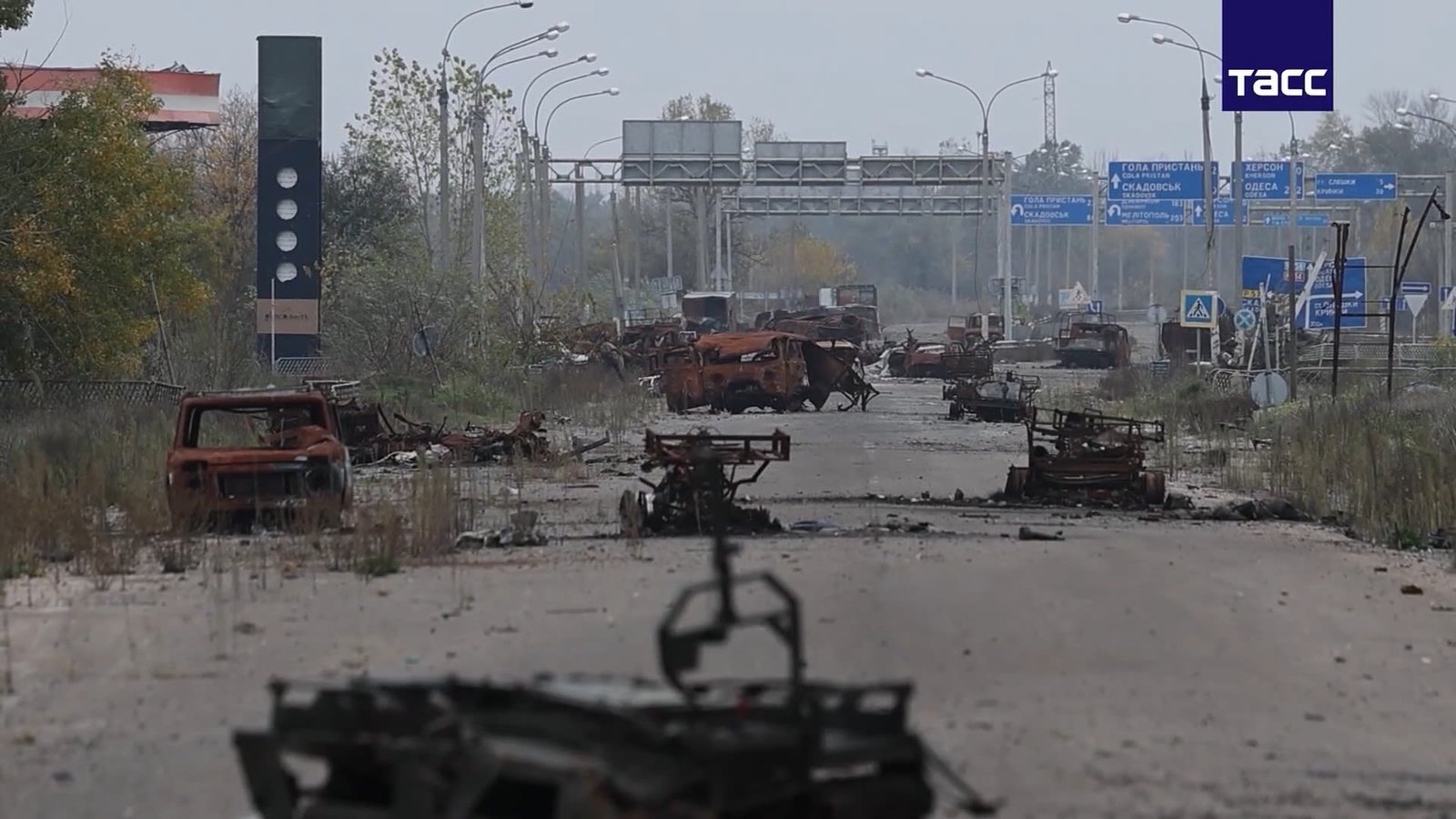
Hundreds of residents have been evacuated from the Russian-occupied Ukrainian city of Oleshky after a temporary ceasefire negotiated with the involvement of US First Lady Melania Trump enabled a major humanitarian operation. The evacuation began on Friday, October 30, allowing civilians who had endured months of severe shortages, damaged infrastructure and dangerous conditions to leave the southern Ukrainian city.
The operation involved Ukrainian and Russian officials, humanitarian workers, buses and ambulances. Residents seeking to reach Ukrainian-controlled territory were transported through Russian-occupied Crimea and southern Russia before travelling by air to Gomel in Belarus. From there, they were expected to continue towards the Ukrainian border.
Ukrainian lawmaker Davyd Arakhamia announced on Saturday that the fourth and final plane carrying evacuees had landed in Gomel. He said the Ukrainian citizens who had left Oleshky, together with the Ukrainian delegation, would reach Ukrainian-controlled territory within hours. :chatgpt-content-reference{index=”0″}
The operation follows months of deteriorating humanitarian conditions in Oleshky, where residents have faced shortages of food, clean water, electricity and medical supplies. The temporary truce has also demonstrated an unusual level of cooperation between Russian and Ukrainian officials despite the continuing war.
WHAT IS HAPPENING IN OLESHKY?
Oleshky is a town in Ukraine’s southern Kherson region, located on the eastern bank of the Dnipro River, opposite the Ukrainian-controlled city of Kherson. Russian forces have occupied the town since April 2022, leaving its remaining residents exposed to the consequences of prolonged fighting and restricted access to essential supplies.
Before Russia’s full-scale invasion, Oleshky had a population of approximately 24,000. Ukrainian authorities and humanitarian observers estimate that around 1,700 to 2,000 people remained in the town before the latest evacuation operation, including approximately 50 children.
The humanitarian situation became increasingly difficult as access routes were damaged, mined or exposed to drone activity. Residents struggled to obtain food, medicine and other basic necessities, while the security situation made independent travel extremely dangerous.
The temporary ceasefire created an opportunity for humanitarian teams and officials from both countries to enter the area, deliver assistance and help civilians who wanted to leave.
Ukraine’s Human Rights Commissioner Dmytro Lubinets travelled to the area to coordinate the operation alongside Russian Human Rights Commissioner Yana Lantratova. Their cooperation was a significant feature of the mission, bringing representatives of the two countries together despite the ongoing conflict. :chatgpt-content-reference{index=”1″}
HOW THE EVACUATION OPERATION WAS CARRIED OUT
The evacuation began on Friday after preparations for humanitarian assistance and civilian transportation were completed. According to Lubinets, 25 buses with a combined capacity of 750 passengers had been arranged, alongside ambulances for people with limited mobility and medical needs.
Humanitarian supplies, including food and medicine, were also delivered to residents. Officials said particular attention was being given to older people, people with disabilities and those who could not look after themselves because of their health conditions.
The operation allowed residents to choose whether they wanted to leave for Ukrainian-controlled territory or travel to Russia. Those who wished to return to Ukraine followed a complicated route because a direct evacuation across the Dnipro River was not considered safe.
According to Ukrainian officials, evacuees travelled through occupied Crimea to Anapa in Russia’s Krasnodar region. They then boarded aircraft bound for Gomel, Belarus, before continuing towards the Ukrainian border.
Arakhamia confirmed that the fourth and final plane carrying the evacuees had arrived in Gomel on Saturday. Ukrainian authorities were preparing to receive the returning citizens and arrange further assistance. Reports indicated that the operation had moved more than 750 residents, although officials had not provided a complete breakdown of how many people travelled to Ukraine and how many chose Russia. :chatgpt-content-reference{index=”2″}
MEDICAL TEAMS PREPARE TO RECEIVE EVACUEES
The condition of residents leaving Oleshky has raised concerns among Ukrainian medical authorities. Many people had spent months facing shortages of food and medicine, while others were living with injuries, chronic illnesses or limited mobility.
Medical teams were preparing to assess the evacuees after their arrival at the Ukrainian border. Andriy Zhydenko, director general of Chernihiv Regional Hospital, said medical personnel were ready to receive people requiring urgent attention.
He said the group included people with injuries, stroke survivors and individuals with limited mobility. Those whose conditions did not require immediate emergency intervention were expected to be transported towards Kyiv for further care.
Zhydenko also warned that some evacuees would need carefully managed food intake because of prolonged hunger and inadequate nutrition.
The medical response is an important part of the operation, as the consequences of prolonged deprivation may continue even after residents reach safer territory. People returning to Ukraine may require medical examinations, rehabilitation, medication and longer-term support.
WHY LIFE IN OLESHKY BECAME SO DIFFICULT
The Humanitarian Crisis in Oleshky worsened as fighting continued around the Kherson region and access to essential supplies became increasingly restricted.
Ukrainian authorities reported that the town was facing severe shortages of food and other necessities by September. Electricity, gas, medicines, clean water and medical services were either unavailable or increasingly difficult to access.
Ukraine’s Foreign Minister Andrii Sybiha previously described the conditions as critical, warning that residents were struggling to find enough food and that some civilians were reportedly surviving on grass and weeds.
Children were among those trapped in the deteriorating conditions. The presence of elderly residents and people with health problems made the situation particularly urgent, as many could not independently navigate dangerous roads or obtain medical assistance.
The town had also suffered extensive damage during the war. One of the most devastating events was the destruction of the Nova Kakhovka Dam in June 2023, which caused widespread flooding across parts of the region, including areas around Oleshky.
Ukraine has blamed Russia for the explosion that destroyed the dam, while Moscow has denied responsibility. The flooding caused extensive damage and contributed to the displacement and suffering of civilians. Subsequent fighting and continued destruction further weakened the town’s infrastructure.
WHY MANY CIVILIANS COULD NOT ESCAPE EARLIER
Although some residents managed to leave Oleshky during the early stages of Russia’s invasion, thousands remained trapped as the occupation continued and escape routes became increasingly dangerous.
According to the Institute for the Study of War, approximately 40 per cent of the town’s pre-war population managed to reach Ukrainian-controlled territory while evacuation was still possible during the earlier phase of the fighting. Others left at different stages, but many residents remained because they were unable or unwilling to abandon their homes.
Oleshky’s location near the Dnipro River has also made it strategically significant. The town lies close to Ukrainian military positions across the river, placing civilians in an area exposed to continuing military activity.
As fighting intensified, routes towards Ukrainian-controlled territory became heavily mined and increasingly exposed to drones. Even travelling deeper into Russian-controlled areas became more difficult as military activity disrupted movement.
Ukrainian officials had previously attempted to secure arrangements for civilian evacuations, but earlier efforts to obtain Russian agreement did not produce the same humanitarian operation.
The latest ceasefire therefore created an important, though temporary, opportunity to move civilians out of the area under coordinated arrangements.
WHY SOME RESIDENTS HAVE CHOSEN TO STAY
Despite the difficult conditions, not everyone in Oleshky wanted or was able to leave. Some residents decided to remain with family members, while others faced practical obstacles that made evacuation difficult.
Older people may be reluctant to abandon their homes and possessions after spending decades in the town. Health conditions and mobility limitations can also complicate long journeys involving buses, aircraft and multiple transfers.
Some residents were concerned about leaving their animals behind. For people who have spent much of their lives in the area, the decision to leave can involve more than finding a safe route out of the conflict zone.
Ukrainian officials said people who chose to remain would not be forced to evacuate and should continue receiving humanitarian assistance. Lubinets also indicated that aid distribution would remain an important part of the mission.
The agreement was designed to provide residents with a choice about their destination rather than require everyone to leave. This was particularly important for civilians who could not undertake the journey or preferred to remain close to their homes.
HOW MELANIA TRUMP HELPED SECURE THE CEASEFIRE
Melania Trump’s involvement became central to the humanitarian operation after her office announced on October 23 that she had helped secure a temporary ceasefire between Russia and Ukraine specifically for Oleshky.
According to the White House, the first lady and her representative worked directly with Russian and Ukrainian leadership to establish the terms of the arrangement. The discussions covered the objectives, timing, technical procedures and coordination required to deliver humanitarian aid and organise civilian evacuations.
The White House described her role as that of an “Exclusive Intermediary”. The arrangement was intended to suspend military activity in the designated area temporarily, allowing civilian representatives from both countries to visit residents, assess their needs and organise transportation for those wishing to leave.
In announcing the agreement, Melania Trump said Oleshky’s remaining population urgently needed food, clean water, medicine and medical attention. She also highlighted the dangers posed by mined roads and regular military activity.
The first lady said she had used communication channels established through earlier efforts to reunite Ukrainian children taken to Russia after the invasion. According to her office, those contacts helped open discussions with both governments about the humanitarian situation.
Ukrainian officials publicly acknowledged her involvement. Lubinets thanked Melania Trump for her mediation and coordination, while the White House said the agreement had been developed through direct engagement with Russian and Ukrainian leadership. :chatgpt-content-reference{index=”3″}
CEASEFIRE ALSO PROVIDES RELIEF TO THE WIDER KHERSON REGION
Although the immediate focus of the agreement was the evacuation and delivery of humanitarian assistance to Oleshky, the temporary truce also brought a period of reduced military activity across parts of the Kherson region.
Kherson, the regional capital controlled by Ukraine, has faced repeated Russian drone attacks and remains exposed to military activity across the Dnipro River. The temporary suspension of fighting connected to the humanitarian mission offered some relief to civilians in the affected area.
The ceasefire began on October 27 and was scheduled to remain in effect until November 1. Ukrainian officials described it as an unusually significant period of cooperation since the beginning of Russia’s full-scale invasion.
However, the arrangement remains geographically limited and temporary. It does not represent a general ceasefire across the entire front line, and fighting elsewhere in Ukraine has continued.
COULD THE OLESHKY CEASEFIRE LEAD TO A WIDER PEACE AGREEMENT?
The successful coordination of the Oleshky operation has raised questions about whether similar local agreements could be negotiated elsewhere along the front line. Humanitarian ceasefires can create opportunities to evacuate civilians, deliver essential supplies and reduce immediate suffering without requiring the two sides to resolve every major political or territorial disagreement.
However, the operation does not necessarily indicate that Russia and Ukraine are close to reaching a comprehensive peace agreement.
Moscow and Kyiv remain divided over fundamental issues, including territory, Ukraine’s sovereignty and its future security arrangements. Russian President Vladimir Putin has continued to maintain demands that Ukraine and its allies regard as unacceptable.
US President Donald Trump’s administration has continued diplomatic efforts to bring the two countries towards negotiations. US envoy Steve Witkoff has held discussions with Ukrainian President Volodymyr Zelensky and Russian leadership as part of efforts to explore possible diplomatic arrangements.
Nevertheless, the Oleshky agreement remains a separate humanitarian initiative rather than a breakthrough in negotiations to end the war.
The Kremlin has also described the cooperation as an isolated case, cautioning against interpreting it as evidence of wider progress towards peace. Reuters reported that the two governments remain far apart on the terms of a settlement, even as they cooperated over the evacuation. :chatgpt-content-reference{index=”4″}
WHAT HAPPENS NEXT FOR THE EVACUATED RESIDENTS?
For residents who have reached Belarus and are preparing to return to Ukraine, the immediate priority is safe passage across the border and access to medical and humanitarian assistance.
Those with serious health conditions will require further assessment, while people who have experienced prolonged shortages may need nutritional support and continuing medical care. Families will also need assistance with accommodation and other basic requirements as they begin rebuilding their lives away from the occupied town.
Meanwhile, civilians who remain in Oleshky will continue to depend on humanitarian assistance and the observance of the temporary ceasefire. Their safety will remain uncertain once the agreement expires unless further arrangements are reached.
The evacuation has offered hundreds of residents an opportunity to leave an area where ordinary life had become increasingly difficult. It has also demonstrated that limited cooperation between opposing sides can make humanitarian operations possible even during an ongoing war.
Whether similar arrangements can be repeated elsewhere remains uncertain. For the people evacuated from Oleshky, however, the immediate achievement is more direct: after months of isolation and insecurity, they are finally getting the chance to return to Ukrainian-controlled territory.
For breaking news and live news updates, like us on Facebook or follow us on Twitter and Instagram. Read more on Latest World on thefoxdaily.com.





COMMENTS 0