Nepal Police has rejected allegations circulating on social media that security agencies hoarded relief materials meant for victims of Nepal’s devastating August floods, calling the claims baseless, fabricated and misleading.
The statement came after CPN (UML) Secretary Mahesh Basnet alleged that relief supplies were being stored inside Army and police facilities instead of reaching people affected by the disaster. Basnet also claimed that some food items, including vegetables, had been left to deteriorate while people in shelters were facing shortages.
Nepal Police said the allegations were unsubstantiated and stressed that personnel from the Nepali Army, Nepal Police and Armed Police Force have been continuously involved in search, rescue, relief distribution and rehabilitation since the catastrophic floods struck on August 26.
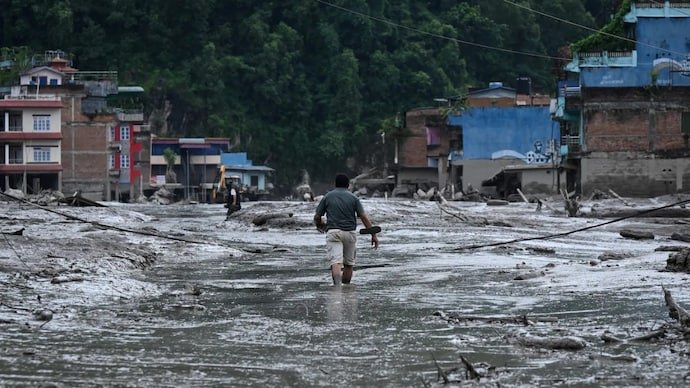
The dispute has emerged while rescue and recovery efforts remain underway following one of the most destructive disasters Nepal has faced in recent years. More than a thousand people have died, thousands remain missing and large sections of northern and central Nepal have suffered damage to homes, roads, bridges and hydropower Infrastructure.
What Nepal Police says about the relief allegations
In a statement issued on September 8, Nepal Police said it had taken serious notice of social media posts accusing security agencies of taking relief materials intended for flood victims and failing to distribute them.
The force specifically rejected claims that relief goods had been stored inside police offices and allowed to spoil. Police said it does not have relief materials stored in its possession and described the allegations circulating online as false.
The police statement also highlighted the role of security personnel in the emergency response. According to the force, personnel have been deployed around the clock to rescue stranded residents, search for missing people, provide medical assistance, manage recovered bodies and distribute humanitarian supplies.
The response was not limited to Nepal Police. The Nepali Army and Armed Police Force have also been heavily involved in operations across the affected districts, particularly in locations where roads and bridges were damaged or washed away.
Why the accusations became politically sensitive
The allegations came from Mahesh Basnet, a senior figure in the opposition CPN (UML). Basnet claimed that people staying in shelters had complained about shortages of food despite relief supplies allegedly being kept inside security installations.
He also criticized what he described as the implementation of a “one-door system” for relief distribution and alleged that food items were being left to rot inside Army and police facilities.
Basnet further questioned aspects of the wider government response, including helicopter operations, and criticized Prime Minister Balendra Shah, the ruling Rastriya Swatantra Party and volunteer group Hami Nepal.
Those accusations have not been established by the police, which instead urged the public not to circulate unverified information at a time when emergency operations remain highly sensitive.
The disagreement illustrates a broader problem that frequently appears during large-scale disasters: genuine failures in relief delivery can quickly become mixed with allegations that are difficult to verify, particularly when information spreads through social media faster than authorities can investigate it.
Nepal is still dealing with the consequences of the August 26 disaster
The controversy comes against the backdrop of an extraordinary humanitarian crisis.
On August 26, an ICE-and-rock avalanche and glacial collapse near Nepal’s border with Tibet unleashed enormous volumes of water, rock, mud and debris into downstream river systems. The resulting flash floods devastated communities along the Bhote Koshi and Trishuli river corridors.
Homes and vehicles were swept away, bridges disappeared beneath floodwaters and roads were cut off. Hydropower projects also suffered severe damage, while workers at some facilities became trapped or went missing.
Rasuwa, Nuwakot and Dhading were among the districts hit particularly hard. The geography of the affected region has made rescue work even more difficult because damaged roads, unstable terrain and blocked routes can prevent emergency teams and supplies from reaching communities quickly.
The disaster has also created a complicated international dimension because the affected region is close to the Nepal-Tibet border and included foreign nationals travelling in the area.
Death toll and missing persons remain exceptionally high
The scale of the disaster has changed as rescue teams continue recovering bodies and authorities update lists of missing people. By September 9, Nepal’s confirmed death toll had risen above 1,300, while thousands remained unaccounted for.
The figures are particularly difficult to establish because some people disappeared in remote locations, while others may have been travelling or working in areas cut off by the flooding.
Among the hardest-hit locations are hydropower sites, where workers may still be trapped inside tunnels or underground facilities. Those operations have required specialized rescue equipment and international assistance.
The continuing uncertainty has added pressure on government agencies, rescue teams and local authorities to demonstrate that every available resource is being used effectively.
Why relief distribution is difficult after a disaster of this scale
Distributing humanitarian supplies after a major flood is considerably more complicated than simply transporting food from a warehouse to a village.
When roads and bridges are destroyed, conventional trucks may not be able to reach communities. Helicopters can help fill the gap, but their capacity is limited and operations can depend heavily on weather, landing areas, fuel and airspace conditions.
In some locations, security personnel must first reach stranded residents, assess immediate needs and establish safe access routes before larger volumes of relief can be delivered.
There is also a coordination challenge. Relief may arrive from governments, humanitarian organizations, local groups, businesses and private donors. Without effective systems for recording supplies, identifying needs and coordinating distribution, shortages can occur in one location while excess materials accumulate elsewhere.
That distinction is important when evaluating allegations of “hoarding.” Supplies being temporarily stored at a secure location does not automatically mean they are being withheld from victims. At the same time, authorities must be transparent enough to show where supplies are stored, who controls them and where they are ultimately sent.
Police warn that rumours can damage disaster response
Nepal Police emphasized that the spread of unverified allegations can have consequences beyond reputational damage.
The force said such claims could lower the morale of security personnel working in dangerous conditions, create distrust between citizens and state institutions and complicate sensitive disaster-management operations.
That warning reflects a genuine challenge during emergencies. Search-and-rescue teams depend on public cooperation, accurate information and confidence in official instructions. Rumours can encourage people to distrust legitimate warnings, interfere with rescue efforts or overwhelm authorities with false reports.
At the same time, public criticism has an important role in disaster response. Authorities should still be held accountable for genuine shortages, delays, logistical failures or poor coordination. The crucial distinction is between documented shortcomings and claims that have not been independently verified.
Social media has become a second front in the disaster
The controversy shows how disaster management now extends beyond physical rescue operations. Authorities also have to respond to the rapid spread of videos, screenshots, allegations and commentary across social media platforms.
Information posted online can reach millions of people before emergency agencies have an opportunity to verify it. A photograph of supplies stored at a facility, for example, can quickly be presented as evidence of hoarding without establishing why those materials were there or whether they were scheduled for distribution.
Similarly, genuine footage from one affected district can sometimes be reposted as though it were from another location, creating a misleading impression of conditions elsewhere.
For disaster agencies, that means communication has become almost as important as logistics. Clear updates about relief stocks, distribution points, rescue operations and confirmed casualties can help reduce the information vacuum in which rumours flourish.
What Nepal Police says its personnel are doing
Nepal Police said its personnel remain committed to protecting lives and assisting affected communities throughout the recovery effort.
The force said officers and other security personnel have been involved in multiple parts of the disaster response, including:
- Searching for missing and stranded people.
- Rescuing people from flood-affected areas and providing emergency assistance.
- Providing medical support to injured victims.
- Recovering and managing bodies.
- Distributing relief materials and supporting humanitarian operations.
- Assisting rehabilitation and recovery activities.
These activities are taking place alongside operations by the Army, Armed Police Force, local authorities and international teams that have joined the broader response.
The real test now is transparency, not just denial
While Nepal Police has firmly denied the allegations, the controversy also points to a deeper issue that will remain relevant throughout the recovery: how authorities demonstrate that aid is reaching the people who need it.
In a disaster involving thousands of missing people and extensive infrastructure damage, public confidence depends on more than statements rejecting rumours. Authorities need reliable systems for documenting incoming supplies, identifying priority communities and reporting where assistance has been delivered.
Transparent information can also protect security agencies from false accusations. If inventories, distribution records and delivery routes are publicly documented where operationally possible, it becomes easier to distinguish legitimate logistical storage from genuine misuse.
That is particularly important as Nepal moves from the immediate rescue phase toward longer-term rehabilitation. The needs will shift from emergency food and medical supplies toward temporary housing, road restoration, reconstruction of bridges and damaged power infrastructure, and support for families whose relatives remain missing.
Political debate is likely to continue during the recovery
The dispute between Basnet’s allegations and the police response is unlikely to be the final political controversy surrounding the disaster.
Natural disasters of this magnitude almost inevitably lead to questions over preparedness, warning systems, rescue capacity, relief coordination and the speed of government action. Nepal has already faced scrutiny over aspects of its response, including delays affecting some hard-to-reach areas and hydropower sites.
Those questions are separate from the specific allegation that security agencies hoarded relief materials. The police have denied that claim, and it should not be treated as established fact without independent evidence.
At the same time, criticism of disaster management should not automatically be dismissed as misinformation simply because it is politically uncomfortable. Claims that can be substantiated through records, photographs, eyewitness evidence or independent investigations should be examined on their merits.
Nepal faces a long recovery after the floods
The immediate search for survivors remains the priority, but the consequences of the August disaster will extend far beyond the emergency phase.
Entire communities have lost homes and livelihoods. Roads and bridges need reconstruction, hydropower facilities require repairs and families continue to wait for news about missing relatives. The economic cost is also expected to be significant, with extensive damage already reported across housing and critical infrastructure.
For authorities, that means the current debate over relief distribution is likely to become part of a much broader examination of how Nepal prepares for and responds to high-impact Himalayan disasters.
The flood also demonstrated the risks associated with sudden glacial and ice-rock events in mountainous terrain, where enormous amounts of water can move downstream with little time for communities to react.
What happens next
For now, Nepal Police has asked the public to avoid spreading information that has not been verified and to allow security and humanitarian teams to continue their work.
The force’s denial addresses the specific allegation that police and Army personnel took relief materials and allowed them to remain undistributed or spoil. That allegation remains disputed rather than established.
The wider disaster, however, is beyond dispute. Thousands have died or remain missing, major infrastructure has been destroyed and rescue teams are still working in difficult conditions.
As Nepal transitions from emergency response to recovery, the quality of information will matter almost as much as the physical distribution of aid. Accurate reporting can help direct assistance where it is needed. False claims can create confusion. And legitimate criticism, when supported by evidence, can help identify weaknesses that need to be corrected before the next disaster.
For Nepal’s security agencies and government authorities, maintaining public trust will therefore require both a strong response on the ground and clear evidence that relief reaches affected communities. For the public, the challenge is equally important: verifying claims before sharing them in the middle of an unfolding humanitarian crisis.
For breaking news and live news updates, like us on Facebook or follow us on Twitter and Instagram. Read more on Latest World on thefoxdaily.com.




COMMENTS 0