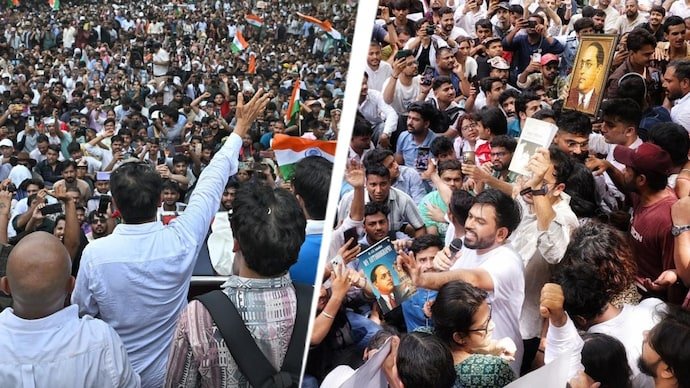
What began as an unconventional Social Media movement has rapidly transformed into one of the most talked-about youth-led protests in India. A day after thousands gathered at Delhi’s Jantar Mantar under the banner of the Cockroach Janta Party (CJP), founder Abhijeet Dipke declared that the demonstration was merely a “trailer” of a much larger campaign that could unfold in the coming weeks.
The protest, centered around allegations of examination irregularities, recruitment delays, and broader concerns regarding the Education system, marked a significant moment in India’s evolving digital-to-street activism landscape. More importantly, it revealed the growing frustration among students, job aspirants, and young professionals who increasingly feel that their concerns are not receiving adequate attention.
Dipke has now given Union Education Minister Dharmendra Pradhan a seven-day deadline, warning that failure to act could trigger a new phase of nationwide mobilization.
How an Online Movement Became a National Protest
The rise of the Cockroach Janta Party is unusual even by modern political standards. Unlike traditional political organizations that build support through party structures, local committees, and long-term campaigns, the CJP emerged primarily through social media.
Initially launched as a satirical response to remarks that sparked debate online, the movement quickly expanded beyond symbolism and memes. It tapped into a growing pool of dissatisfaction among students facing examination controversies, recruitment bottlenecks, and uncertainty about future career opportunities.
The Jantar Mantar gathering demonstrated that digital engagement can translate into physical mobilization when an issue resonates deeply with a large section of the population.
Many participants reportedly attended a public protest for the first time, suggesting that the movement succeeded in bringing politically disengaged youth into civic participation.
Why the Protest Resonated With Young Indians
The success of the demonstration was not solely about one examination issue or a single government ministry.
Instead, it reflected broader anxieties affecting millions of young Indians.
- Exam paper leak controversies.
- Delays in recruitment processes.
- Concerns about transparency in evaluations.
- Growing competition for limited opportunities.
- Uncertainty regarding career prospects.
- Demand for institutional accountability.
For many participants, these issues are interconnected. They view examination systems, recruitment processes, and educational administration as parts of a larger ecosystem that directly affects their future.
The protest therefore became a platform for expressing accumulated frustrations rather than focusing on a single grievance.
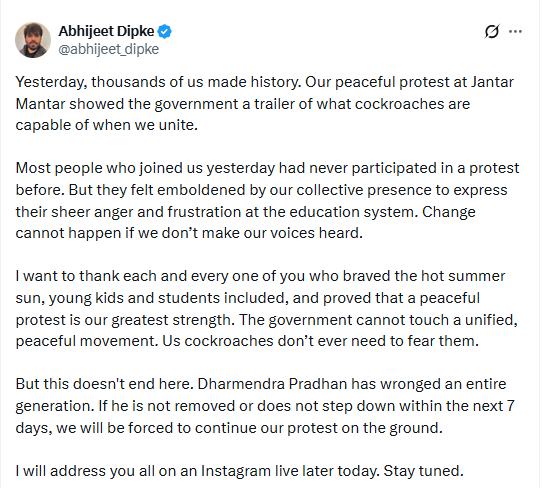
Abhijeet Dipke’s Seven-Day Ultimatum
Following the protest, Dipke publicly thanked supporters and emphasized that the movement’s momentum would continue.
His message was clear: the Jantar Mantar demonstration represented only the beginning of a larger campaign.
According to statements made after the event, he has given the government and Education Minister Dharmendra Pradhan seven days to respond to the concerns raised by protesters.
If no action is taken, Dipke has indicated that further ground-level mobilization may follow.
The ultimatum adds a new dimension to the movement by establishing a timeline and creating anticipation around its next steps.
Inside the Jantar Mantar Protest
The demonstration itself was notable for both its scale and symbolism.
Participants arrived carrying books, flowers, national flags, and the now-familiar cockroach imagery associated with the movement.
Chants demanding accountability echoed through Jantar Mantar as students, parents, activists, and professionals gathered under tight Security arrangements.
Observers noted that many attendees appeared less interested in partisan Politics and more focused on practical concerns affecting education and employment.
This distinction may prove important because issue-based movements often attract support from people across ideological and political lines.
The Evolution of Youth Activism in India
The CJP movement reflects a broader shift in how political and social mobilization occurs in the digital age.
Traditionally, large-scale protests were organized through student unions, political parties, labor organizations, or civil society groups.
Today, social media platforms enable movements to build audiences rapidly and coordinate actions with limited organizational infrastructure.
The Jantar Mantar demonstration illustrates how online communities can evolve into real-world political forces when they connect with widespread public sentiment.
This model has become increasingly common across democracies worldwide.
Security Preparations Highlight Government Concerns
The authorities treated the demonstration as a significant public event.
Reports indicated extensive security arrangements across Delhi, including deployments at transportation hubs and strategic locations.
The scale of the preparations suggests officials anticipated a substantial turnout and sought to ensure public order throughout the event.
Despite concerns about crowd management, the protest remained largely peaceful, allowing organizers to project the image of a disciplined civic movement rather than a confrontational agitation.
That distinction could help the movement maintain public support if future demonstrations occur.
The Political Response: Support and Skepticism
The emergence of the CJP has generated mixed reactions across the political spectrum.
Some opposition leaders have expressed support for the protesters’ concerns regarding education and recruitment systems.
Others have questioned aspects of the movement while acknowledging the legitimacy of student frustrations.
Meanwhile, government supporters have argued that reforms and improvements are already underway in various sectors.
The debate highlights a recurring feature of democratic politics: while stakeholders may disagree on solutions, issues affecting education and employment often attract broad public attention.
Why Education Has Become a Major Political Issue
Education is increasingly becoming one of India’s most politically significant issues.
Several factors explain this trend.
| Issue | Why It Matters |
|---|---|
| Competitive Exams | Determine access to higher education and jobs |
| Recruitment Delays | Affect career planning and financial stability |
| Transparency Concerns | Impact trust in institutions |
| Youth Unemployment | Influences economic and social mobility |
| Skill Development | Shapes long-term economic growth |
As India’s youth population remains one of the largest in the world, policies affecting students and job seekers naturally become politically influential.
The Unique Branding Strategy Behind the Movement
One of the most unusual aspects of the CJP is its branding.
The use of the term “cockroach” was initially viewed as controversial and unconventional. However, supporters argue that it symbolizes resilience, survival, and the ability to endure adversity.
From a communications perspective, the branding has undeniably succeeded in generating attention.
In a crowded digital environment where countless campaigns compete for visibility, memorable symbolism can play a significant role in building recognition.
Even critics acknowledge that the movement’s name has contributed to its rapid online growth.
The Bigger Story Most Coverage Is Missing
Much of the discussion surrounding the protest has focused on personalities, slogans, and political reactions.
However, the more important story may be the changing relationship between young citizens and public institutions.
The protest revealed a generation that is increasingly willing to organize independently, use digital tools for mobilization, and demand direct accountability from decision-makers.
This trend extends beyond one movement or one issue.
It reflects a broader transformation in how civic participation occurs in modern India.
Whether the CJP itself expands or eventually fades, the underlying frustrations it has highlighted are likely to remain significant topics in public discourse.
What Happens Next?
The coming days could prove critical for the future of the movement.
If organizers perceive the government’s response as inadequate, larger demonstrations may follow. Conversely, meaningful engagement with student concerns could reduce tensions and shift the conversation toward policy reforms.
The seven-day deadline announced by Dipke creates a clear political timeline that both supporters and critics will closely monitor.
The movement’s ability to sustain momentum beyond a single high-profile protest will likely determine whether it evolves into a lasting force or remains a symbolic moment in youth activism.
Conclusion
The Cockroach Janta Party’s Jantar Mantar Protest represents more than a one-day demonstration. It reflects growing concerns among students and young professionals regarding education, recruitment, transparency, and institutional accountability.
Abhijeet Dipke’s warning that the event was “just a trailer” signals that organizers are preparing for a longer campaign. Whether that campaign gains further traction will depend on public support, government responses, and the movement’s ability to maintain focus on issues that resonate with millions of young Indians.
Regardless of what happens next, the protest has already achieved one significant objective: it has forced a national conversation about the challenges facing students and job aspirants. In an era where youth voices increasingly shape public discourse, that alone makes the movement a development worth watching closely.
For breaking news and live news updates, like us on Facebook or follow us on Twitter and Instagram. Read more on Latest India on thefoxdaily.com.






COMMENTS 0