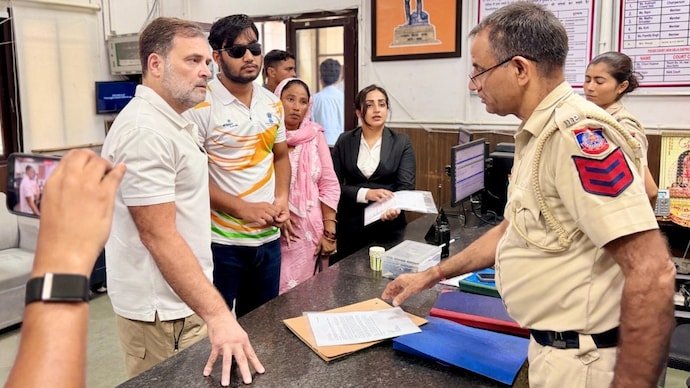
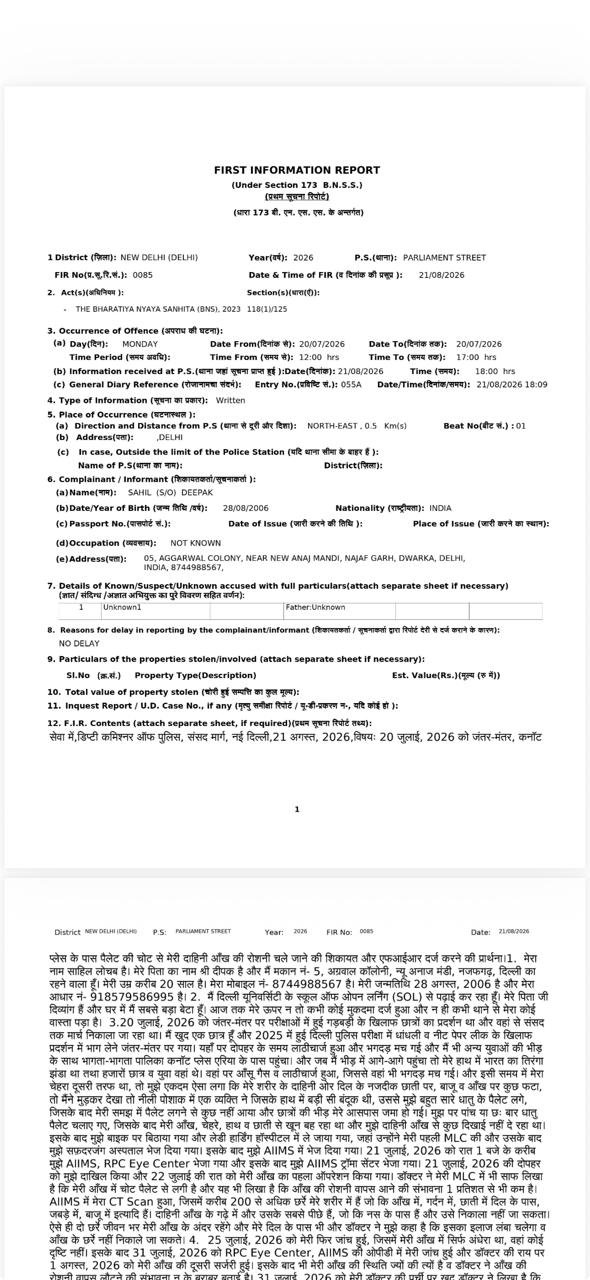
The Delhi Police on Friday registered an FIR on the complaint of 19-year-old Sahil Lochab, WHO allegedly suffered serious pellet injuries during a protest in the national capital on July 20. The development came after Leader of the Opposition in the Lok Sabha Rahul Gandhi spent more than six hours staging a dharna outside the Parliament Street Police Station and demanding that the complaint be formally registered.
The FIR has been registered against unidentified persons, meaning no individual has been named as an accused at this stage. Police have invoked Sections 118 and 125 of the Bharatiya Nyaya Sanhita, provisions dealing with voluntarily causing hurt or grievous hurt using dangerous weapons or means and acts that endanger life or personal safety.
The case is likely to intensify scrutiny of the events surrounding the July 20 protest organised by the Cockroach Janta Party, or CJP. The demonstration, which involved a march towards Parliament over the NEET issue, descended into clashes between protesters and security personnel.
Lochab’s injuries became a major point of contention after his family alleged that he was struck by pellets, including in his right eye. Delhi Police initially denied using pellet guns during the protest. Subsequent reports citing official records, however, indicated that the Rapid Action Force had used non-lethal munitions, including plastic pellets, during crowd-control operations at one location.
Why Rahul Gandhi staged a dharna at the police station
Gandhi’s protest on Friday followed an attempt to get an FIR registered on Lochab’s complaint.
Gandhi arrived with Lochab and several congress leaders and initially approached the Mandir Marg police station. After being informed that New Delhi Deputy Commissioner of Police Sachin Sharma was at the Parliament Street police station, the group moved there.
At Parliament Street, Gandhi pressed officials to register the complaint. When the process did not immediately move forward, he began a sit-in outside the station.
Gandhi said he would not leave until an FIR was registered.
The confrontation quickly attracted other senior Congress leaders. Priyanka Gandhi Vadra, Jairam Ramesh, Kumari Selja and Randeep Surjewala joined Gandhi, while Congress president Mallikarjun Kharge and other party leaders publicly supported the demand.
The protest eventually ended after the Delhi Police registered the FIR.
What happened to Sahil Lochab during the July 20 protest?
Lochab, a 19-year-old from Delhi, was among those participating in the CJP-led “Sansad Chalo” protest on July 20.
According to reports from the time, he suffered multiple pellet-like injuries during the confrontation between protesters and security personnel. His most serious injury involved his right eye.
Doctors treating Lochab reported a severe eye injury, while reports also said pellets were found in other parts of his body. He subsequently underwent treatment at AIIMS Trauma Centre.
His injuries became politically significant because the circumstances in which he was wounded remained disputed.
Congress leaders accused security personnel of using pellet guns against protesters. Delhi Police denied that it had fired pellet guns at the demonstrators.
That denial became increasingly difficult to reconcile with later reports about official records documenting the use of plastic pellets by the Rapid Action Force during the protest.
What the police records reportedly revealed
Reports published in late July said a police record relating to the July 20 operation documented the use of non-lethal munitions, including plastic pellets, by the Rapid Action Force.
One report citing the official record said RAF personnel fired two rounds of plastic pellets at one location near Jantar Mantar while dealing with protesters. The record reportedly attributed the firing to directions issued by a senior Delhi Police officer.
This information is important because it changes the central question surrounding the incident.
The issue is no longer simply whether pellets were used somewhere during the protest. The investigation now has to establish what happened to Lochab specifically, who fired the ammunition that injured him, under whose instructions, and whether the force used was lawful and proportionate to the circumstances.
The new FIR provides a formal legal mechanism through which those questions can potentially be investigated.
What sections have been included in the FIR?
The Delhi Police registered the case under Sections 118 and 125 of the Bharatiya Nyaya Sanhita.
Section 118 deals with voluntarily causing hurt or grievous hurt by dangerous weapons or means. Section 125 concerns acts that endanger the life or personal safety of others.
The inclusion of these provisions indicates that the complaint is being treated as a criminal matter rather than simply as a dispute over crowd-control procedures.
However, an FIR is the beginning of a Criminal Investigation, not a finding of guilt.
The investigation will have to establish the identity of the person or persons responsible, the circumstances in which the pellets were fired and whether the alleged conduct satisfies the legal requirements of the offences invoked.
No accused named yet
One of the most important details in the development is that no individual has been named as an accused in the FIR at this stage.
This means the registration of the case should not be interpreted as a determination that a particular police officer, RAF member or other individual caused Lochab’s injuries.
Investigators may now examine available evidence, including medical records, police documents, CCTV footage, videos recorded during the protest, eyewitness accounts and the ammunition or pellets recovered from the victim.
The investigation could also have to establish whether the projectile recovered from Lochab can be scientifically linked to the type of ammunition used during the police operation.
That distinction could prove important if responsibility for the injury becomes contested.
Rahul Gandhi says FIR is the first step towards justice
After the FIR was registered, Gandhi described it as the first step towards justice for Lochab.
He said the teenager continued to have pellets lodged in his body and alleged that three pellets were in his eye, leaving him unable to see properly from it.
Gandhi also questioned how an injured young protester could face difficulty getting an FIR registered at a police station in the heart of the national capital.
He argued that if a citizen faces such difficulty in Delhi, the situation could be even more difficult for an ordinary person attempting to register a complaint in a smaller town or village.
His comments turned the episode from an individual injury case into a broader political argument about access to justice and police accountability.
Gandhi targets Amit Shah over the delay
Gandhi also alleged that the delay in registering the case reflected instructions coming from the highest levels of the government.
He claimed that the final approval for registering the FIR had to come from Union Home Secretary and Home Minister Amit Shah.
These are political allegations made by Gandhi. The material available does not establish that the Union Home Minister personally intervened in the registration of the FIR.
Gandhi also claimed that police officers at the station were willing to register the complaint but that “the brakes on justice were being applied from the top.”
The allegations are likely to become part of the wider political dispute surrounding the July 20 protest, particularly as Congress continues to question the government’s handling of the incident.
Congress escalates pressure on the government
The protest quickly expanded beyond Gandhi and Lochab.
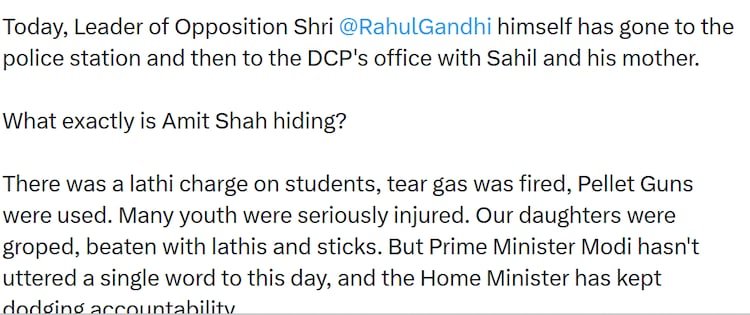
Priyanka Gandhi Vadra joined her brother at the police station, while several other senior Congress leaders arrived in support. Congress president Mallikarjun Kharge also criticised the government’s handling of the episode.
Kharge questioned why the circumstances surrounding the use of pellet ammunition had not been clearly explained and raised concerns about the treatment of injured protesters.
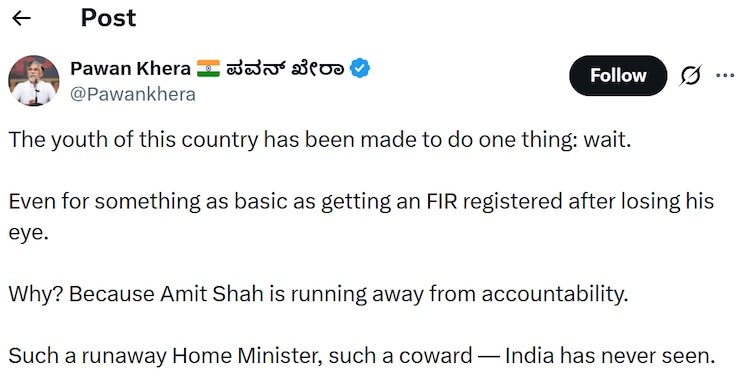
Congress leader Pawan Khera separately accused the government of avoiding accountability and argued that an injured young person should not have to struggle to get a police complaint formally registered.
The language used by Congress leaders reflects the party’s effort to make the alleged pellet firing part of a broader political narrative about accountability, police conduct and the treatment of young protesters.
The July 20 protest remains under scrutiny
The original demonstration was organised by the Cockroach Janta Party over the NEET issue and involved a march towards Parliament.
The protest became tense as demonstrators attempted to move beyond the permitted area and security forces intervened.
The subsequent allegations of excessive force led to questions about the methods used to control the crowd.
Several protesters were reported to have suffered pellet-like injuries, although the circumstances differed from person to person.
Lochab’s case received particular attention because of the seriousness of his eye injury and the number of pellets reportedly found in his body.
The dispute over whether pellet ammunition was used also became a central issue between Congress and the Delhi Police.
Why the new FIR matters
The registration of an FIR changes the status of Lochab’s complaint in an important way.
Previously, the dispute largely revolved around competing claims. Lochab and his family alleged that pellets fired during the protest caused his injuries, while the Delhi Police denied using pellet guns.
Now there is a formal criminal investigation attached to the complaint.
That does not establish who is responsible, but it gives investigators a legal framework for collecting evidence and determining whether an offence occurred.
The case could also bring greater scrutiny to the chain of command surrounding the use of crowd-control equipment.
If investigators establish that a specific officer or security personnel member fired the ammunition that injured Lochab, the legal consequences could become more direct. Conversely, if the evidence does not establish a link between the official firing documented during the protest and Lochab’s injuries, that could significantly affect the case.
Medical evidence could become crucial
Lochab’s medical records are likely to be among the most important pieces of evidence in the investigation.
Reports from July described a serious injury to his right eye, including a corneal perforation. Other pellets were reportedly found in his body, including near the chest area.
Medical evidence can help investigators establish the Nature of the injuries, the likely characteristics of the projectiles and the timing of the trauma.
However, medical evidence alone may not identify who fired the ammunition.
That question would require investigators to connect the injuries with the events at the protest through physical evidence, video footage, eyewitness accounts, official records or other reliable evidence.
The unanswered questions after the FIR
Several major questions remain open despite the registration of the case.
- Who fired the projectile that injured Sahil Lochab?
- Was the ammunition fired by RAF personnel or another security unit?
- What orders governed the use of non-lethal ammunition during the July 20 protest?
- Was the force used proportionate to the threat faced by security personnel?
- Can the pellets recovered from Lochab be linked to ammunition used during the operation?
- Why was his complaint not registered earlier, as alleged by him and his supporters?
- Will investigators identify and name specific individuals as the probe progresses?
The FIR does not answer these questions. Its significance lies in creating a formal investigative process through which they can be examined.
What happens next?
The immediate focus will shift from the political standoff at the police station to the investigation itself.
Police will have to examine the complaint, collect relevant evidence and determine whether the available material supports further action against identified individuals.
The investigation could also become important in the broader scrutiny of the July 20 protest, particularly if other injured participants have made similar allegations.
For Congress, the FIR represents a political victory after Gandhi’s prolonged sit-in. For the police, the case now creates a formal obligation to investigate the complaint according to law.
The most important test will therefore be what happens after the headlines fade.
If the investigation identifies the person responsible for Lochab’s injuries and establishes how the pellets were fired, the case could provide answers to questions that have remained unresolved since July 20. If responsibility cannot be established, the dispute over the use of force is likely to continue.
From a police-station protest to a formal investigation
Rahul Gandhi’s dharna transformed a months-old dispute over the July 20 protest into a major political confrontation in the national capital.
The immediate demand was straightforward: register Sahil Lochab’s complaint and provide an FIR number. That demand has now been met.
But the harder part begins with the investigation.
The FIR does not establish that Delhi Police or the Rapid Action Force caused Lochab’s injuries, nor does it name an accused. It does, however, ensure that the complaint enters the formal Criminal Justice process.
The next stage will be to determine what happened on July 20, who fired the ammunition that caused Lochab’s injuries and whether anyone can be held legally responsible.
For the teenager and his family, the registration of the FIR may be an important first step. For the Congress, it provides a fresh platform to demand accountability from the government. And for Delhi Police, the case now places the circumstances surrounding the alleged pellet firing under a formal investigative lens.
The real measure of progress will not be the FIR itself, but whether the investigation ultimately provides a credible answer about how Sahil Lochab was injured and whether those responsible can be identified.
For breaking news and live news updates, like us on Facebook or follow us on Twitter and Instagram. Read more on Latest India on thefoxdaily.com.





COMMENTS 0