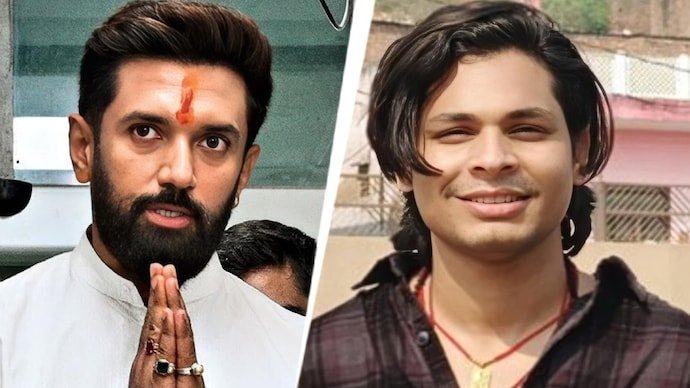
Union Minister Chirag Paswan has filed a police complaint against social media influencer Swatantra Bhardwaj, accusing him of misusing his name and suggesting political backing in connection with an alleged assault during a protest in Delhi.
The controversy erupted after a widely circulated video showed Bhardwaj discussing an altercation involving Sanjay Kumar, the father of student activist Nishu Azad, during a Cockroach Janta Party (CJP) protest at Jantar Mantar. In the video, Bhardwaj appeared to claim that he had “cracked” the man’s skull and had escaped jail despite the alleged assault.
Bhardwaj also named several political figures while describing people he regarded as senior supporters or “elder brothers”, including Paswan and Delhi minister Kapil Mishra. Paswan has now categorically rejected any association with him and asked police to take action over what he described as the false use of his name.
The dispute intensified on Friday when Delhi Police detained Bhardwaj in Uttar Pradesh after a CJP-led protest outside Parliament Street police station demanding action against him. Police have separately disputed some of the more serious claims made about the victim’s injuries, saying their Investigation did not establish a skull fracture as alleged in the viral video.
Why Chirag Paswan filed the police complaint
Paswan’s party legal cell submitted the complaint at Parliament Street police station in New Delhi. The complaint seeks action against Bhardwaj over his alleged use of Paswan’s name and claims that could create a false impression of political protection.
The minister said neither he nor his party had authorised Bhardwaj to associate himself with them. His intervention came after the influencer’s public comments generated questions about whether politicians had intervened on his behalf following the alleged assault.
Paswan said that merely being photographed with public figures or meeting political leaders should not be interpreted as evidence of a political relationship that extends to legal protection.
The complaint also reflects a broader concern for politicians in the social media era: photographs, informal meetings and public interactions can be presented online as evidence of an association even when no formal or personal relationship exists.
What did Swatantra Bhardwaj claim?
The controversy began with comments attributed to Bhardwaj in a podcast-style interview. He spoke about the confrontation during the CJP Protest and claimed that he had seriously injured Nishu Azad’s father.
He described the alleged assault in unusually aggressive terms and claimed the victim required dozens of stitches. He further suggested that the incident could have attracted a serious criminal charge but that he had not been jailed.
Most controversially, Bhardwaj claimed that he enjoyed the backing of political figures. He referred to Kapil Mishra as an elder brother and used similar language while referring to Chirag Paswan.
Those statements became the basis of the political controversy because they could be interpreted as suggesting that his political connections helped him avoid serious legal consequences. There is no established evidence that Paswan intervened to protect Bhardwaj from police action.
Paswan denies any association with Bhardwaj
Paswan’s response was direct: he said Bhardwaj had improperly used his name and photographs. The minister maintained that an ordinary political interaction or photograph should not be treated as proof of an ongoing relationship or political patronage.
His party’s legal cell also said that neither the party nor Paswan had any association with the influencer and expressed solidarity with the protester and her injured father.
The distinction is important because politicians regularly interact with large numbers of people at public events. A photograph with a politician does not, by itself, establish that the politician supports an individual’s conduct or has intervened in a criminal case.
Paswan’s decision to approach the police therefore serves two purposes: seeking action over the alleged misuse of his name and publicly distancing himself from Bhardwaj’s claims.
Police had already disputed the “cracked skull” narrative
Another important element of the controversy is the difference between Bhardwaj’s account and the findings publicly outlined by Delhi Police.
Police said Sanjay Kumar suffered a head injury during the confrontation but disputed claims that he had suffered a skull fracture. According to the police account, the injury was caused by a metal bracelet, commonly referred to as a kada, rather than a weapon.
Police also said that medical findings did not support the claim that the victim’s skull had been fractured. This does not eliminate the underlying allegation of assault, but it means Bhardwaj’s description of the injury should not be treated as an independently established medical fact.
The distinction is especially significant because the viral video transformed Bhardwaj’s own account into a major political issue before the full circumstances of the confrontation had been established publicly.
Bhardwaj later described the incident as self-defence
As the controversy grew, Bhardwaj’s position appeared to shift. In a later statement, he denied the interpretation that he had deliberately attacked the protesters and claimed that he had acted in self-defence.
He argued that he faced a threatening crowd and suggested that he could have been seriously harmed had he not defended himself. He also said that video footage existed that could support his version of events.
This creates two sharply different narratives around the same confrontation. The protesters and their supporters describe Bhardwaj as an aggressor, while Bhardwaj says his actions were defensive.
Determining which account is supported by the evidence remains a matter for the police investigation and any subsequent judicial proceedings.
Swatantra Bhardwaj detained in Uttar Pradesh
The political controversy was followed by direct police action. Delhi Police detained Bhardwaj in Bulandshahr, Uttar Pradesh, on Friday as pressure mounted for his arrest.
The detention came hours after CJP members and supporters gathered outside Parliament Street police station demanding that police take action over the alleged assault.
Police had previously indicated that Bhardwaj and another suspect had been questioned in relation to the case. Authorities later moved to locate and detain him as the issue received renewed attention following the viral video.
The development changed the nature of the controversy. What had initially resurfaced through social media became an active police matter involving demands for accountability from political activists and clarification from politicians whose names had been invoked.
CJP protests outside Parliament Street police station
The Cockroach Janta Party organised a protest outside the Parliament Street police station, demanding Bhardwaj’s arrest over the alleged assault.
The demonstration was connected to the July confrontation at Jantar Mantar and sought renewed police action following the emergence of the video in which Bhardwaj discussed the incident.
CJP representatives were joined by political figures including Chandrashekhar Azad, chief of the Azad Samaj Party (Kanshi RAM) and MP from Nagina, and MP Pappu Yadav.
After meeting police officials, the protesters were reportedly assured that action would be taken within 72 hours. The subsequent detention of Bhardwaj in Uttar Pradesh marked a significant development in the dispute.
Photographs with politicians fuelled the controversy
Adding to the political sensitivity, photographs of Bhardwaj with several political figures surfaced after his comments attracted attention. The images included photographs involving Paswan, Kapil Mishra and Bihar Chief Minister Samrat Choudhary.
Such photographs became a focal point for critics seeking to establish whether Bhardwaj had meaningful political connections. But a photograph alone cannot establish that a political leader had intervened in a criminal matter or endorsed a person’s conduct.
Paswan’s complaint specifically addresses this problem by rejecting the impression that his public association with Bhardwaj amounted to political backing.
The incident illustrates how photographs and short video clips can acquire a significance far beyond the circumstances in which they were originally recorded, particularly during politically charged controversies.
What is the CJP protest assault case?
The underlying confrontation took place during a CJP protest at Jantar Mantar in New Delhi. Sanjay Kumar, the father of student activist Nishu Azad, was allegedly assaulted during the protest.
The incident had already resulted in a police investigation before the new controversy erupted. The emergence of Bhardwaj’s comments brought renewed public scrutiny and led political parties and activists to demand stronger action.
The precise circumstances surrounding the confrontation remain important because the legal consequences will depend on evidence, witness statements, medical records and available video footage rather than on statements made later on social media or podcasts.
That evidence-based approach is particularly relevant because the public claims made by Bhardwaj about the severity of the injury have been disputed by police.
Why the political name-dropping matters
The controversy surrounding Bhardwaj is not simply about an alleged assault. His claims about political connections have created a second issue: whether individuals can invoke the names of political leaders to project influence or suggest immunity from legal consequences.
For politicians, the problem is particularly sensitive. Even an unverified claim of political protection can generate public suspicion and place pressure on authorities to demonstrate that an investigation is proceeding independently.
Paswan’s decision to file a complaint can therefore be seen as an attempt to establish a clear public record that he does not endorse Bhardwaj’s statements or actions.
At the same time, allegations of political interference should be distinguished from confirmed evidence. Delhi Police has publicly rejected claims that political influence prevented lawful action in the case and said its investigation followed established procedures.
The social media factor in the controversy
The case also highlights how quickly online statements can alter the course of an otherwise local legal dispute. A recording that might initially have reached a limited audience became widely circulated, prompting responses from politicians, activists and police.
Statements made in interviews or podcasts can have consequences beyond their intended audience because clips can be isolated and redistributed without the surrounding context.
That makes verification especially important in cases involving alleged crimes. A person’s own description of an incident does not automatically establish what happened, how severe an injury was or whether another person’s account is accurate.
In the Bhardwaj case, police findings and medical evidence have become important counterpoints to the claims made in the viral video.
Paswan says justice must be ensured
Paswan has also positioned his intervention as support for the family involved in the assault case. He argued that allowing an accused person to publicly claim political protection without consequence would create a damaging precedent.
The minister said he would take responsibility for ensuring that justice is pursued for the affected family. His comments were aimed at separating his political identity from the influencer’s claims while reinforcing his support for action based on law.
For the Samajwadi Party and other opposition voices that have raised the incident, however, the broader question remains whether the initial police response was sufficiently strong and whether anyone involved received preferential treatment.
Police have rejected the allegation of political interference, making the evidence gathered through the investigation crucial to resolving the dispute.
What happens next in the case?
With Bhardwaj detained, the focus will now shift toward the formal investigation and the evidence relating to the alleged assault. Police will have to examine video recordings, witness accounts, medical documents and statements from the people involved.
The legal position will ultimately depend on what investigators can establish rather than on the claims made in the viral interview.
Paswan’s complaint will also require police examination to determine whether Bhardwaj’s statements and use of the minister’s name or images amount to a criminal offence or other actionable misconduct.
The situation could therefore develop on two separate tracks: the original assault investigation and the complaint concerning the alleged misuse of political names.
A controversy now bigger than the original protest
The Swatantra Bhardwaj controversy has evolved rapidly from an alleged confrontation at a Delhi protest into a broader political dispute over accountability, political influence and the use of social media.
Chirag Paswan’s police complaint adds an important new dimension because it directly rejects Bhardwaj’s suggestion that the Union minister was an influential supporter. At the same time, Bhardwaj’s later self-defence claim and the police’s disagreement with his description of the victim’s injuries show why the allegations must be separated from established facts.
The detention of Bhardwaj means the issue is now firmly back in the hands of law-enforcement authorities. The credibility of competing accounts will ultimately depend on evidence from the July confrontation and the findings of the investigation.
For Paswan, the immediate priority is to distance himself from claims of political patronage and protect his name from what he describes as false association. For the CJP and the injured man’s family, the focus remains accountability for the alleged assault. And for the police, the challenge is to resolve a highly politicised case through evidence and due process rather than through competing public narratives.
For breaking news and live news updates, like us on Facebook or follow us on Twitter and Instagram. Read more on Latest India on thefoxdaily.com.





COMMENTS 0