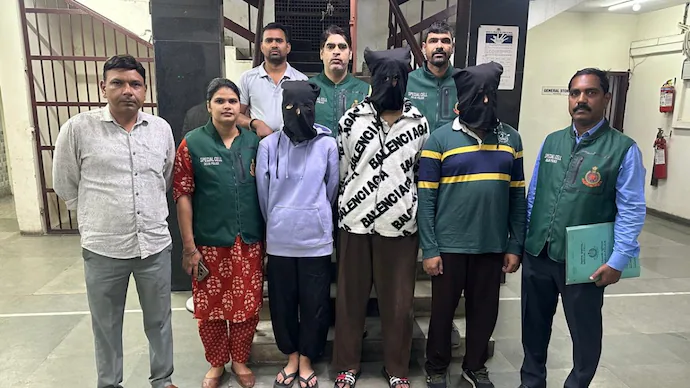
Delhi Police have arrested three men for allegedly writing pro-Khalistan slogans targeting Punjabi singer and actor Diljit Dosanjh at two Delhi Metro stations. Investigators suspect the accused carried out the act at the direction of individuals associated with the banned organisation Sikhs for Justice (SFJ), and are now searching for the alleged handlers behind the operation.
The graffiti was discovered at Jahangirpuri Metro station on October 29 and Shastri Nagar Metro station on October 30. It contained a threatening message referring to Dosanjh and calling for revenge in the name of Khalistan. Police said the accused were allegedly offered large sums of money to write the slogans in public places and record videos of their actions.
The incident came shortly after Dosanjh performed his first Delhi concert as part of his Aura India Tour on Friday. The singer is scheduled to travel to several other cities over the following two months.
Three Men Arrested Over Graffiti at Delhi Metro Stations
The three arrested men have been identified as Sumit alias Raftar, 30, a resident of Samalkha in Haryana’s Panipat district; Sumit Kumar alias Kaka, 22, from Dera Baba Nanak in Punjab’s Gurdaspur district; and Gurpreet, 22, from Mahilpur in Punjab’s Hoshiarpur district.
According to Delhi Police, the accused allegedly travelled to the national capital and wrote the slogans at two separate Metro stations. Investigators believe they were recruited through contacts connected to pro-Khalistan ideology and were promised substantial financial rewards for carrying out the activity.
The Delhi Police Special Cell’s Northern Range took up the investigation after the graffiti was reported. Officers examined CCTV footage, collected local intelligence and used technical leads to identify the people allegedly involved.
Police first traced and arrested Sumit alias Raftar. During questioning, investigators reportedly obtained information about two other associates, leading to further operations in Punjab and the arrests of Kaka and Gurpreet.
Where the Pro-Khalistan Slogans Were Found
The first incident was reported on October 29 at Jahangirpuri Metro station, which is part of the Yellow Line. Police found the slogans written on the floor near Gate No. 1.
A second instance of graffiti was discovered on October 30 at Shastri Nagar Metro station on the Red Line. The writing was found on the inner wall of a staircase near Gate No. 2.
The message included a reference to Diljit Dosanjh and accused him of betraying the community. It also invoked revenge in the name of SFJ and Khalistan.
The slogan read: “Diljit Singh quam d gaddar khoon d badla, SFJ Khalistan”. The supplied translation described it as a threat claiming that the blood of the community would be avenged because of Dosanjh’s alleged betrayal.
Police are treating the graffiti as part of a suspected coordinated operation rather than isolated incidents. Investigators are examining whether the two locations were selected as part of a wider plan to attract public attention and intimidate the singer.
Police Suspect SFJ-Linked Conspiracy
Investigators suspect that individuals associated with Sikhs for Justice may have commissioned the graffiti. According to the police account, Kaka played a key role in coordinating the alleged operation and was in contact with people linked to pro-Khalistan ideology in Ludhiana and Gurdaspur.
Police said an associate contacted Kaka and instructed him to download an encrypted messaging application. He allegedly received further directions through the application, including designs and templates for the slogans.
Investigators claim that a prominent SFJ member sent the material and offered Kaka a substantial amount of money to carry out the task in Delhi. Kaka allegedly recruited Gurpreet and Raftar, who agreed to travel to the capital and write the messages.
The suspected financial arrangement and the alleged involvement of people outside Delhi are now important parts of the investigation. Police are attempting to establish who issued the instructions, how the accused were contacted and whether additional people helped arrange the operation.
How the Accused Allegedly Carried Out the Operation
According to investigators, the three accused reached Delhi around October 28 and 29. They allegedly travelled from Punjab to the national capital by taxi and reached Kashmere Gate Inter-State Bus Terminal before proceeding to the Metro stations.
Police said Raftar went to Jahangirpuri Metro station and wrote the slogans near Gate No. 1. He allegedly recorded a video of the act and sent it to his handlers as proof that the task had been completed.
Kaka and Gurpreet allegedly carried out a similar activity at Shastri Nagar Metro station. The police said the accused admitted their respective roles during questioning.
Investigators are examining the alleged video-sharing process and other digital evidence to determine how the operation was coordinated. They are also trying to identify the people who received the recordings and may have directed the accused.
How the Three Accused Allegedly Knew Each Other
The investigation has also focused on the backgrounds of the arrested men and the circumstances in which they allegedly came into contact.
Sumit Alias Raftar
Raftar, who studied up to Class 12, later enrolled at ITI Ajitwal in Punjab’s Moga district but did not complete the course, according to the police account.
He subsequently worked as a freelance content creator on online live-streaming platforms. Police said he initially worked on Bigo Live, which was banned by the Indian government in 2019, before moving to Tango Live.
Investigators believe he met Kaka through the latter platform. Raftar had reportedly travelled to Ludhiana around a week before the graffiti incidents.
Sumit Kumar Alias Kaka
Kaka, also a Class 12 pass-out, allegedly became involved in drug abuse and anti-social activities after completing his studies, according to the police account.
Police said he met Gurpreet around four years ago when Gurpreet was working at a hotel in Samalkha. The two subsequently began living together. Kaka later came into contact with Raftar through a mutual acquaintance.
Investigators allege that Kaka was recently approached on WhatsApp and asked to download an encrypted messaging application, where he received the instructions and financial offer for the Delhi operation.
Gurpreet
Gurpreet, 22, is from Mahilpur in Punjab’s Hoshiarpur district. Police allege that he was recruited by Kaka to participate in the graffiti activity at Shastri Nagar Metro station.
Investigators are examining his role in the alleged operation, his communication with the other accused and whether he had any direct contact with the people suspected of organising the activity.
Incident Comes After Diljit Dosanjh’s Delhi Concert
The graffiti was discovered shortly after Dosanjh performed in Delhi as part of his Aura India Tour. The concert marked his first performance in the national capital during the tour, which is scheduled to continue across several other cities over the next two months.
The timing has drawn attention because the slogans specifically named the singer and included threatening language. However, the available police account does not establish a confirmed motive beyond the suspected instructions and alleged payment arrangement being investigated.
Police are working to determine whether the concert had any direct connection to the graffiti or whether the singer was targeted as part of a separate attempt to generate publicity for the alleged handlers.
Special Cell Searches for Alleged Handlers
With three people in custody, the Special Cell is now focusing on identifying the alleged handlers and establishing the extent of the suspected network. Investigators are examining digital communications, encrypted messaging activity and the links between the arrested men and individuals associated with SFJ.
Police are also seeking to determine whether the accused were acting independently or following instructions from a wider group. The alleged offer of money, the distribution of slogan templates and the recording of videos are among the details investigators are attempting to verify through evidence.
The investigation will also need to establish the identities and roles of those who allegedly commissioned the graffiti. Police have not yet publicly established the full chain of responsibility, and the suspected links to SFJ remain part of the ongoing probe.
What Happens Next in the Investigation?
The arrests mark an important development in the investigation into the threatening graffiti at the two Delhi Metro stations. However, identifying the three alleged writers is only one part of the case. Police are continuing efforts to trace the people who allegedly supplied the instructions, arranged the payments and received recordings of the activity.
Investigators will also examine whether the accused had contact with other individuals who may have helped plan or facilitate the operation. Digital evidence and communication records could help establish the sequence of events and the extent of each person’s alleged involvement.
For now, Delhi Police are pursuing the suspected SFJ-linked conspiracy while searching for the alleged handlers. The investigation is expected to focus on uncovering the wider network behind the slogans and determining whether additional arrests are necessary.
For breaking news and live news updates, like us on Facebook or follow us on Twitter and Instagram. Read more on Latest India on thefoxdaily.com.





COMMENTS 0