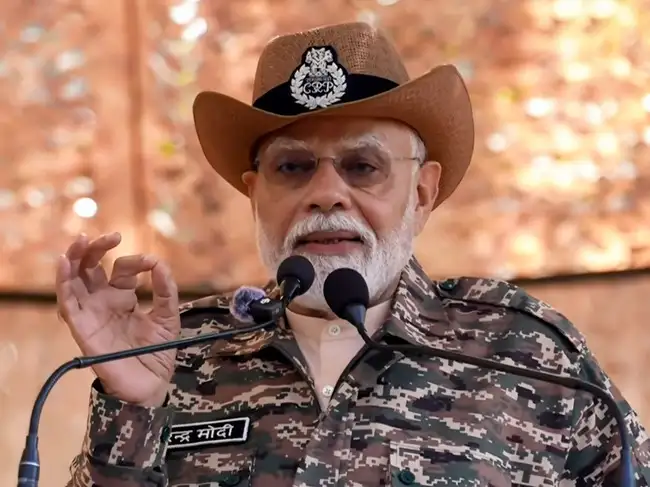
Prime Minister Narendra Modi celebrated Diwali with security personnel deployed in Chhattisgarh‘s Bastar region, using the occasion to highlight what he described as a major turning point in India’s fight against Left-Wing Extremism (LWE). He praised the personnel for their courage, commitment and sacrifices during years of anti-Naxal operations.
Modi described this Diwali as particularly significant because, according to his assessment, India had overcome the threat of Naxalism. He said the country had reached a stage where every district was free from Naxalism, allowing people to live without the fear and insecurity that had affected several areas for decades.
The Prime Minister’s visit carried both a festive and a security-related message. Bastar was once among the most prominent centres of Maoist insurgency, where armed groups challenged government authority, attacked security forces and disrupted public services. The region has also been the focus of an intensified campaign combining security operations with efforts to expand roads, healthcare, education and other development facilities.
Why This Diwali Is Significant for Bastar
The celebration comes after the Centre announced on March 31, 2026, that India had achieved its target of eliminating Left-Wing Extremism as an active organised security challenge. The government had earlier set March 31, 2026, as the deadline for making the country free from Naxalism, and the Home Ministry subsequently described the target as achieved.
The announcement marked the culmination of a sustained campaign involving the Central government, state administrations, police forces and central armed police forces. Chhattisgarh was at the centre of this effort because large parts of its southern region had experienced prolonged Maoist activity.
Modi’s visit to Bastar therefore carries significance beyond the annual tradition of celebrating Diwali with security personnel. It highlights the government’s effort to present the region’s changing security situation as a major national achievement and recognise the personnel who participated in the operations.
In his message ahead of the visit, the Prime Minister described Bastar as an area where Naxalism once held sway but where development was now flourishing. He said he was travelling to salute security personnel for their sacrifices, selfless service and unwavering devotion to the country.
India’s Naxalism-Free Declaration and the Government’s Claim
The Centre’s declaration on March 31 followed years of efforts to reduce the geographical reach and operational strength of Maoist groups. The government said the campaign had weakened the insurgency through action against senior leaders and armed cadres, arrests, surrenders and the expansion of security infrastructure in previously inaccessible areas.
According to figures submitted by the Union Ministry of Home Affairs to Parliament, Left-Wing Extremism-related incidents fell from 1,936 in 2010 to 234 in 2025, a decline of 88 per cent. Civilian and security personnel deaths dropped from 1,005 in 2010 to 100 in 2025.
The same data recorded 364 Maoists neutralised, 1,022 arrested and 2,337 people surrendering during 2025. The number of police stations reporting LWE-related violence also declined from 465 in 2010 to 119 in 2025.
These figures illustrate the scale of the security challenge and the reduction in reported violence over time. They also help explain why the government considers the March 2026 declaration a significant milestone.
However, describing India as free from Naxalism does not mean that every security concern has disappeared. The government’s own approach emphasises continued surveillance, development assistance and measures to prevent the insurgency from returning. Formerly affected areas still require sustained attention to ensure that improvements in security become permanent.
How Bastar Became the Centre of the Anti-Naxal Campaign
Bastar, in southern Chhattisgarh, has historically been one of the most important regions in India’s Maoist insurgency. Its extensive forests, difficult terrain and remote settlements created conditions in which armed groups could maintain influence and operate away from regular administrative and security infrastructure.
The insurgency affected several districts in and around the Bastar division, including Bijapur, Sukma, Dantewada and Narayanpur. Maoist groups used violence, intimidation and attacks on infrastructure to challenge government authority. Security personnel, local residents and public representatives faced threats, while development work was frequently disrupted.
For communities in remote villages, the consequences extended beyond direct violence. Poor road connectivity, limited access to healthcare and education, and difficulties in reaching government offices made everyday life more challenging. Insecurity also complicated the delivery of welfare schemes and the expansion of public infrastructure.
The state’s response gradually expanded from conventional security operations to a wider strategy aimed at establishing a sustained administrative presence. Security camps were established in strategically important locations, while road construction, communication networks and public services were expanded in areas previously difficult to access.
The government’s argument is that these measures helped weaken the Maoist network while allowing residents to access facilities and services that had remained limited for years.
Security Forces Played a Central Role
Personnel from the Central Armed Police Forces and Chhattisgarh Police have been closely involved in the anti-Naxal campaign. Their responsibilities included operations in difficult forest terrain, protection of vulnerable settlements, intelligence gathering and securing areas where government infrastructure was being expanded.
Forces deployed in the region faced significant operational challenges. Dense forests, limited road access and the threat of improvised explosive devices made movement and coordination difficult. Personnel also had to operate in areas where armed Maoist groups had established networks over several decades.
The expansion of security camps was an important part of the strategy. A stronger presence in remote areas made it easier for forces to respond to threats and support administrative activity. Better coordination between central forces and state police also helped strengthen the campaign.
Modi’s decision to spend Diwali with personnel involved in these operations places their contribution at the centre of the national celebration. His message recognises not only those currently deployed in Bastar but also the wider group of personnel who served in the region during the prolonged campaign.
From Security Camps to Development Centres
The next challenge for Bastar is to ensure that improved security translates into lasting social and economic progress. The Centre has indicated that infrastructure created during the anti-Naxal campaign can also support development and public service delivery.
In May 2026, Union Home Minister Amit Shah announced plans to convert a portion of the security infrastructure into community-oriented service centres. He said nearly 200 Central Armed Police Forces camps had been established in Chhattisgarh and that 70 of them would be transformed into Shaheed Veer Gunda Dhur Seva Dera centres.
These centres are intended to help residents access government services closer to their villages. The announced plan includes online access to hundreds of government schemes, assistance with essential documents such as Aadhaar and ration cards, and facilities to register complaints about the non-delivery of subsidised food grains.
The idea is to use the administrative reach established during security operations to address gaps in governance. Instead of functioning only as security installations, selected camps are expected to become points through which people can connect with government departments and welfare programmes.
This transition is particularly important for tribal communities living in remote settlements. Access to identity documents, food entitlements, healthcare, education and livelihood opportunities can influence whether residents experience a meaningful improvement in their daily lives.
Development Remains the Next Test for Bastar
The end of organised Naxal violence is an important security milestone, but it does not automatically resolve the region’s long-standing development challenges. Better roads and communication networks need to be accompanied by reliable public services, employment opportunities and access to markets.
Healthcare facilities must be accessible to people living far from district headquarters. Schools need trained teachers and consistent attendance, while young people require opportunities for higher education, vocational training and employment. Improving electricity, mobile connectivity and transport can also help connect remote communities with wider economic activity.
Livelihoods linked to agriculture and forest produce are another important part of the region’s future. Bastar’s tribal communities depend on local natural resources and traditional economic activities. Better market access, storage facilities, processing infrastructure and fair prices could help households benefit more directly from local production.
The Centre has also highlighted initiatives such as the Bastar Olympics and Bastar Pandum as ways to engage young people and promote the region’s cultural identity. Sports and cultural events can provide platforms for participation while helping communities showcase their traditions beyond the region.
For the government, the broader objective is to demonstrate that areas once affected by insurgency can become centres of economic activity and improved public services. The success of that transition will depend on whether development reaches villages consistently rather than remaining concentrated in larger towns.
Why the Naxalism-Free Status Still Requires Vigilance
Even after the Centre’s March 2026 declaration, preventing a resurgence of Maoist influence remains an important policy priority. The Home Ministry has continued to stress the need for security monitoring and development support in areas previously affected by Left-Wing Extremism.
Formerly affected districts may face challenges such as limited administrative capacity, weak infrastructure and a lack of economic opportunities. If these problems remain unresolved, local grievances can make communities vulnerable to renewed intimidation or recruitment by extremist groups.
The government’s approach therefore involves maintaining security arrangements while expanding public services and ensuring that residents can access their rights and entitlements. The objective is to prevent a return to conditions in which armed groups can exploit isolation and administrative gaps.
It is also important that local communities remain central to the transition. Lasting peace depends not only on the presence of security forces but also on trust between residents and public institutions. Access to justice, transparent administration and meaningful participation in development decisions can help strengthen that relationship.
Modi Continues His Diwali Tradition With Security Personnel
Celebrating Diwali with security personnel has become a recurring feature of Modi’s annual festival schedule. Rather than limiting the occasion to celebrations in the national capital, he has regularly chosen locations where military and security personnel are deployed.
His visits have included locations along India’s borders and other strategically important areas. The tradition is intended to recognise the service of personnel who remain on duty during festivals while many families celebrate together at home.
In his Diwali message ahead of the Bastar visit, Modi said he would continue the tradition of spending the festival with the country’s security personnel. He also wished people peace, prosperity and happiness.
This year’s choice of Bastar gives the tradition a different emphasis. The region is not primarily a conventional international border location; it was one of the most significant theatres of India’s internal security challenge. The visit therefore highlights the role of police and central forces in addressing an insurgency that affected communities and governance over several decades.
What Comes Next for the Region?
The government’s declaration of a Naxalism-free India represents a major change in the country’s internal security landscape. For Bastar, the next phase will be judged by whether the improvement in security creates opportunities that residents can see and experience in their everyday lives.
The conversion of selected security camps into service centres, expansion of infrastructure and stronger delivery of welfare schemes could help bring government services closer to remote communities. But these efforts will require consistent implementation, adequate staffing and attention to the needs of local residents.
Modi’s Diwali visit offers recognition to the personnel who took part in the anti-Naxal campaign and reinforces the government’s message that Bastar is entering a new phase. The larger challenge now is to ensure that the end of organised insurgency is followed by durable peace, inclusive development and greater economic opportunities.
For the people of Bastar, the most meaningful measure of this transformation will be the ability to travel safely, access schools and hospitals, earn a stable livelihood and participate fully in public life. The security milestone may mark the end of one long chapter, but building a peaceful and prosperous future for the region remains an ongoing responsibility.
For breaking news and live news updates, like us on Facebook or follow us on Twitter and Instagram. Read more on Latest India on thefoxdaily.com.






COMMENTS 0