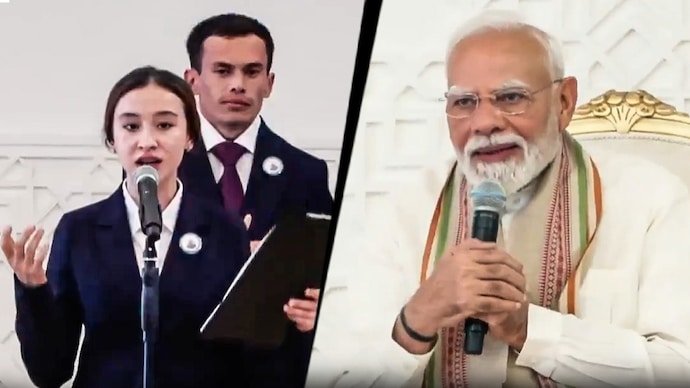
Prime Minister Narendra Modi received an unexpected and deeply personal welcome in Uzbekistan when students in Tashkent recited three of his poems in Hindi and Uzbek. The performance, delivered by young students at the Tashkent State University of Oriental Studies, turned a formal interaction into one of the most distinctive moments of his two-day visit.
The students did more than simply read the poems. They presented the verses in Hindi and then rendered them in Uzbek, allowing the audience to experience the same pieces of writing across two languages and cultures.
Modi said the performance brought back the emotions he had experienced when he originally wrote the poems many years ago, before he became prime minister or entered the highest levels of public office.
The moment was particularly meaningful to him because the students were reciting Hindi despite it not being their native language. Modi said their ability to communicate the emotion contained in the poems demonstrated how deeply they had engaged with the language.
Why the poetry performance moved Narendra Modi
Speaking during his interaction with students and members of the academic community at the Tashkent State University of Oriental Studies on Sunday, Modi reflected on the unusual experience of hearing his old poems performed by Uzbek students.
He said the poems had been written a very long time ago and that hearing young people recite them brought back the emotions he had felt while writing them.
For Modi, the most striking part was not simply that the students had learned Hindi. It was that they appeared to understand the emotional meaning behind the words.
The performance demonstrated a form of cultural exchange that goes beyond memorising vocabulary or translating individual sentences. Poetry depends heavily on tone, rhythm, imagery and emotion, making it considerably more demanding to reproduce in another language.
The students’ performance therefore offered a particularly personal form of recognition for the prime minister.
Three poems were performed in Hindi and Uzbek
The students selected three poems written by Modi and presented each in both languages.
Fourth-year student Keldiyorov Dilhushbek recited Abhi Toh Suraj Uga Hai in Hindi. Third-year student Dilshoda Juraboeva then presented its Uzbek translation.
The second poem, Naye Bharat Ke Naye Sankalp, was recited in Hindi by Otabek Amirov and followed in Uzbek by Ikromkhuja Sa’dillaev.
The third presentation featured Manavta Ko Kahin Na Lag Jaye Daag, a poem focused on themes of humanity, compassion and peace. Orzu Kuldosheva and Fayoza Abdurasulova presented the work in Hindi and Uzbek respectively.
The choice of poems also gave the performance a thematic connection to the broader message of friendship and cultural understanding that surrounded Modi’s visit.
Hindi was not the students’ native language
The language element made the performance particularly notable.
For the Uzbek students, Hindi was a language they had studied rather than their mother tongue. Yet they were able to recite literary material written by an Indian poet and then connect it with Uzbek-speaking audiences through translation.
Modi highlighted precisely this aspect of the presentation.
He said that although the students were speaking in Hindi, the language was not native to them, but they were still able to express the emotions that he had felt when he originally wrote the poems.
His observation points to an important distinction in language learning. Fluency is not limited to pronunciation and grammar. Literary understanding requires readers to recognize context, emotion and cultural meaning.
Poetry can therefore become a particularly effective way to demonstrate how deeply a language has been learned.
Uzbekistan has a long connection with Indian culture
The poetry recital did not emerge in isolation. Uzbekistan has maintained a strong popular interest in Indian culture for decades, particularly through Hindi cinema and music.
Bollywood films and songs have reached several generations of Uzbek audiences, helping make Indian popular culture familiar far beyond India‘s borders.
Indian songs have long been recognized in Uzbekistan, where Hindi-language cinema became an important source of cultural exposure.
The students’ performance represented a different form of that relationship.
Instead of performing a well-known Bollywood song, they chose literary works written by India’s prime minister before he became a national political figure. They studied the poems, recited them in Hindi and translated them into Uzbek.
That shift from popular Entertainment to literature gave the cultural exchange a more personal and academic dimension.
From a personal notebook to a university classroom
There was also something unusual about the journey of the poems themselves.
The verses were written by Modi years before his current political career. Their appearance in a university setting in Tashkent transformed what began as personal creative writing into material being studied and performed by students in another country.
For a writer, hearing old work interpreted by people from another linguistic and cultural background can be an unusual experience. The audience may bring meanings and emotional associations that the original writer never anticipated.
In this case, the performance also allowed Modi to encounter his own writing through the voice of another generation and another country.
That helped explain why the moment appeared to resonate with him beyond the usual diplomatic symbolism of an official visit.
The poems also reflected themes of humanity and peace
One of the three poems, Manavta Ko Kahin Na Lag Jaye Daag, centres on humanity, compassion and peace.
Those themes fit naturally into the broader cultural message of the event, which emphasized connections between people despite differences in nationality and language.
Literature can play an unusual role in Diplomacy because it allows countries to connect through ideas and emotions rather than only through government-to-government agreements.
When a poem is translated, its words cross a national border without requiring a political negotiation. The process can create a form of cultural familiarity that formal diplomatic language often cannot achieve.
The Tashkent performance offered an example of that softer side of International Relations.
The performance became a highlight of Modi’s Uzbekistan visit
The poetry recital was one of the memorable cultural moments during Modi’s two-day visit to Uzbekistan over the weekend.
The visit also carried significant diplomatic importance. During his stay, Modi was conferred with Uzbekistan’s highest state honour, the Order of “Oliy Darajali Dustlik.”
The award reflected the importance attached to the relationship between India and Uzbekistan and the wider ties between the two countries.
The cultural programme surrounding the visit reinforced the people-to-people dimension of those relations.
Rather than limiting the interaction to official meetings, the visit included opportunities for students and academics to engage directly with the Indian prime minister.
A special musical performance at Kuksaroy Palace
The poetry theme continued beyond the university event.
Uzbek President Shavkat Mirziyoyev hosted an informal dinner for Modi at Kuksaroy Palace in Tashkent, where guests were treated to a special musical performance based on Abhi Toh Suraj Uga Hai.
The inclusion of the poem in a musical presentation gave the work another form of interpretation.
Earlier, students had demonstrated how the poem could move between Hindi and Uzbek through recitation and translation. At the palace, the same work was presented through music, further expanding its cultural reach.
The sequence illustrated how a literary work can travel through different forms while retaining its central emotional character.
Why cultural diplomacy matters in India-Uzbekistan relations
India and Uzbekistan have diplomatic, economic, educational and cultural ties, but popular cultural familiarity can make those relationships more visible to ordinary people.
Bollywood has historically provided one such bridge. Indian films and music introduced Uzbek audiences to Hindi words, Indian performers, stories and cultural traditions.
Educational institutions add another layer to that relationship by allowing students to study Indian languages, literature and history more systematically.
The Tashkent State University of Oriental Studies is part of that academic Environment, making the participation of its students particularly relevant.
When students trained in an Indian language perform original Hindi poetry for an Indian leader, the exchange demonstrates that cultural connections are not limited to passive consumption of films and music. They can also involve education, translation and interpretation.
Why learning a foreign language through literature is different
The students’ performance also highlights the role of literature in language education.
Learning conversational Hindi can allow students to communicate in everyday situations. Reciting poetry requires a different level of engagement.
A poem may use unusual sentence structures, metaphorical expressions, cultural references and rhythms that are uncommon in ordinary speech. Students therefore need to understand more than the literal meaning of individual words.
Translation introduces another challenge. A translator must decide how to preserve meaning, tone and emotional impact while expressing the work naturally in another language.
The Hindi-to-Uzbek presentations at the event therefore represented both language learning and cultural interpretation.
Modi’s response gave the moment a personal dimension
Political leaders routinely participate in cultural events during international visits, but this performance was unusual because the material had been written by the visiting leader himself.
Modi was not simply watching students perform a famous Indian literary work. He was hearing his own words spoken in a foreign country by students who had learned Hindi.
His response suggested that the experience connected him to the period when the poems were originally written.
That personal reaction also helped distinguish the performance from a standard diplomatic ceremony. The students had effectively returned the prime minister’s own creative work to him in a new linguistic and cultural setting.
From Bollywood songs to Modi’s poetry
Uzbekistan’s familiarity with Indian culture has often been associated with Bollywood songs and films. The Tashkent poetry performance showed how that cultural relationship can evolve.
Indian culture abroad is not represented only through cinema. Language study, literature, music, academic institutions and political exchanges can all contribute to how another country understands India.
The fact that Uzbek students were able to recite and translate Modi’s poems illustrates that Hindi’s cultural reach can extend into educational settings as well.
It also shows how familiar cultural forms can create an opening for deeper engagement. Someone who first encounters India through a film or song may eventually encounter its language and literature through formal study.
A small performance with a larger diplomatic message
The Tashkent poetry recital may have lasted only a short time, but it carried several layers of meaning.
It showcased young Uzbek students learning Hindi, demonstrated the role of translation in cultural exchange and gave Modi an opportunity to revisit writing from an earlier stage of his life.
It also reinforced a broader message about the relationship between India and Uzbekistan: ties between countries are not built exclusively through treaties, trade or political meetings. They are also sustained by students who learn each other’s languages, audiences who embrace each other’s culture and artists whose work crosses borders.
For Modi, the emotional response came from hearing old poems again. For the students, the performance offered an opportunity to demonstrate their command of Hindi and their understanding of Indian literature.
And for the wider India-Uzbekistan relationship, the episode provided a vivid example of how cultural familiarity can become a bridge between societies.
The striking part of the Tashkent event was therefore not simply that Uzbek students knew Modi’s poems. It was that they had taken words written in one language, understood their emotional meaning, translated them into another language and performed them for the person who originally wrote them.
For breaking news and live news updates, like us on Facebook or follow us on Twitter and Instagram. Read more on Latest India on thefoxdaily.com.





COMMENTS 0