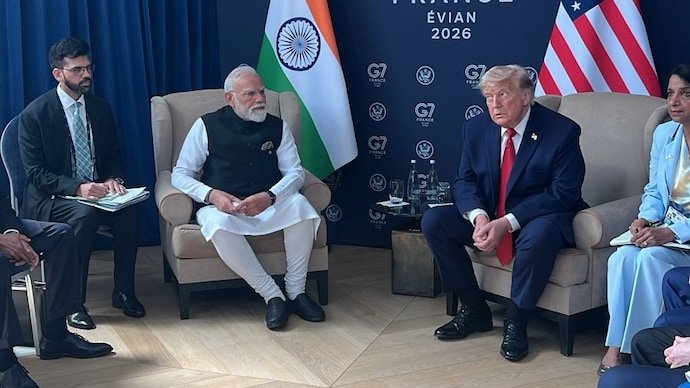
The safety of Indian seafarers has emerged as a major diplomatic and strategic concern amid escalating tensions in West Asia. During a high-profile meeting with US President Donald Trump on the sidelines of the G7 Summit in France, Prime Minister Narendra Modi stressed that the security of lakhs of Indian sailors working across Global Shipping routes remains a matter of paramount national importance.
The discussion came at a critical moment. Recent attacks on commercial vessels operating near the Strait of Hormuz and surrounding Gulf waters have disrupted maritime trade, increased insurance costs, threatened energy supplies, and tragically resulted in the deaths of Indian crew members. With India being one of the world’s largest suppliers of maritime manpower, any disruption to international shipping directly affects Indian citizens, global trade flows, and the country’s economic interests.
While the immediate focus was on the safety of Indian sailors, the broader conversation reflects a much larger geopolitical reality: Maritime Security has become one of the defining strategic challenges of the 21st century.
Why Maritime Security Matters More Than Ever
Modern globalization depends on uninterrupted maritime trade. Nearly 90% of global merchandise trade by volume moves through sea routes. From crude oil and natural gas to food supplies, electronics, automobiles, and industrial machinery, the global economy functions because ships continuously connect producers and consumers across continents.
For India, maritime trade is especially critical.
- More than 95% of India’s trade volume moves through sea routes.
- Around 85% of India’s crude oil requirements are imported.
- The majority of energy imports pass through the Gulf region.
- Millions of Indian jobs depend directly or indirectly on global shipping.
Any disruption in strategic maritime chokepoints can create immediate economic consequences for India and the wider world.
The Strait of Hormuz: One of the World’s Most Important Waterways
The Strait of Hormuz occupies a uniquely important position in global trade and Energy Security. Situated between Iran and Oman, this narrow passage serves as the primary gateway connecting the Persian Gulf to international markets.
Every day, massive quantities of crude oil, liquefied natural gas, and commercial cargo pass through this route.
| Strategic Factor | Importance of Strait of Hormuz |
|---|---|
| Global Oil Trade | One of the largest oil transit chokepoints globally |
| LNG Shipments | Critical route for liquefied natural gas exports |
| India’s Energy Security | Major source of India’s imported crude oil |
| International Shipping | Key route linking Gulf economies with global markets |
| Geopolitical Stability | Directly influences energy prices worldwide |
When tensions rise in the region, shipping companies face higher operational risks, increased insurance premiums, and longer transit times. Ultimately, these costs are often passed on to consumers through higher fuel prices and inflation.
India’s Massive Seafaring Workforce
India has quietly become one of the world’s leading suppliers of maritime professionals.
According to industry estimates and government data, hundreds of thousands of Indian seafarers work aboard merchant vessels worldwide. Indian officers and crew members are highly sought after because of their technical expertise, English-language proficiency, and extensive maritime training.
Indian sailors serve on:
- Oil tankers
- Container ships
- Bulk carriers
- LNG vessels
- Cruise ships
- Offshore support vessels
These professionals often spend months away from home, operating in some of the world’s most challenging maritime environments. Their work supports not only global commerce but also contributes significantly to India’s economy through remittances and employment generation.
This explains why the safety of Indian seafarers has become an increasingly important diplomatic priority.
The Recent Gulf Crisis and Its Impact
The latest tensions in the Gulf region have exposed the vulnerability of global shipping networks. Military actions, naval deployments, and attacks on commercial vessels have created uncertainty across international trade corridors.
For shipping companies, the risks are substantial:
- Higher insurance costs
- Route diversions
- Security expenditures
- Operational delays
- Increased fuel consumption
For seafarers, the consequences are even more personal. Sailors working aboard commercial vessels often find themselves operating in active conflict zones despite having no connection to geopolitical disputes.
The deaths of Indian sailors during recent incidents have intensified calls for stronger international safeguards to protect civilian maritime personnel.
Why PM Modi’s Remarks Carry Strategic Significance
Prime Minister Modi’s comments were not simply about protecting Indian nationals. They reflected India’s broader strategic vision for global maritime Governance.
India has consistently advocated for:
- Freedom of navigation
- Respect for international maritime law
- Secure sea lanes of communication
- Protection of commercial shipping
- Peaceful resolution of maritime disputes
These principles are central to India’s foreign policy because the country’s economic growth increasingly depends on uninterrupted access to international markets.
By raising the issue directly with President Trump, India signaled that maritime security should remain a key component of any long-term regional settlement involving Iran and the broader Gulf region.
The Economic Cost of Maritime Disruptions
Maritime insecurity has consequences that extend far beyond shipping companies and sailors.
When major shipping routes become unstable, several economic effects quickly emerge:
Higher Energy Prices
India remains heavily dependent on imported crude oil. Any disruption in Gulf supplies can push up international oil prices, increasing fuel costs domestically.
Inflationary Pressures
Higher transportation and energy costs often translate into more expensive goods and services.
Supply Chain Disruptions
Manufacturers relying on imported components may face delays and increased production costs.
Trade Uncertainty
Exporters and importers encounter greater volatility, affecting business planning and investment decisions.
In an interconnected global economy, even localized maritime disruptions can create ripple effects across multiple industries.
India’s Expanding Maritime Strategy
The discussion between Modi and Trump also reflects India’s broader maritime ambitions.
Over the past decade, India has significantly expanded its naval capabilities and maritime diplomacy.
Key initiatives include:
- SAGAR (Security and Growth for All in the Region)
- Indo-Pacific maritime cooperation
- Naval partnerships with friendly countries
- Anti-piracy operations
- Maritime domain awareness programs
- Strengthening coastal security infrastructure
India increasingly views maritime security not merely as a defense issue but as a foundation of economic growth, energy security, and regional stability.
The US-India Maritime Partnership
Maritime cooperation has become one of the strongest pillars of the India-US strategic relationship.
Both countries share interests in:
- Maintaining open sea lanes
- Combating piracy
- Protecting commercial shipping
- Ensuring regional stability
- Supporting international maritime law
Joint naval exercises, intelligence sharing, logistics agreements, and strategic dialogues have deepened cooperation over the years.
Trump’s assurance that the United States would work with India on maritime security issues reinforces the growing importance of this partnership.
Why Freedom of Navigation Is a Global Concern
The concept of freedom of navigation may sound technical, but it affects everyday life around the world.
Without secure maritime routes:
- Fuel prices could rise sharply.
- Consumer goods could become more expensive.
- Supply chains could experience significant delays.
- Global economic growth could slow.
- Developing economies could face increased financial pressure.
That is why countries across Asia, Europe, North America, and the Middle East closely monitor developments around key maritime chokepoints.
For India, which aspires to become a major global economic power, ensuring safe and secure maritime trade routes is no longer optional—it is essential.
The Human Side Often Overlooked
Discussions about maritime security frequently focus on oil tankers, naval vessels, and geopolitical competition. Yet the human dimension often receives less attention.
Behind every commercial vessel are crew members spending months at sea, far from their families, ensuring that global trade continues uninterrupted.
Indian seafarers represent one of the largest professional groups serving this vital role. Their contribution supports economies across continents, making their protection not only a national responsibility but also an international obligation.
The recent loss of Indian sailors serves as a reminder that geopolitical conflicts often have very real human consequences.
Future Outlook: What Happens Next?
The proposed peace framework involving Iran could help reduce tensions in one of the world’s most strategically important regions. If successfully implemented, it may lower risks for commercial shipping, stabilize energy markets, and improve safety for seafarers.
However, maritime security challenges are unlikely to disappear entirely. Future risks may arise from regional conflicts, piracy, cyber threats to shipping infrastructure, and growing competition among major powers.
This means countries such as India will continue investing in naval capabilities, maritime partnerships, and diplomatic engagement to protect their interests.
The coming years may see even greater emphasis on international cooperation to safeguard critical shipping lanes and protect the millions of people whose livelihoods depend on maritime trade.
Conclusion
Prime Minister Narendra Modi’s discussion with US President Donald Trump about the safety of Indian seafarers goes far beyond a bilateral diplomatic exchange. It highlights a critical reality of the modern global economy: secure oceans are essential for economic stability, energy security, and international prosperity.
India’s growing role as both a maritime nation and a supplier of skilled seafarers means that developments in strategic waterways such as the Strait of Hormuz directly affect national interests. The recent attacks on vessels carrying Indian crew members have underscored the urgency of stronger protections for commercial shipping and maritime workers.
As global trade becomes increasingly interconnected, the safety of seafarers and the preservation of freedom of navigation will remain central issues in international diplomacy. For India, ensuring both is not simply a strategic objective it is a national imperative that will shape its economic and geopolitical future for decades to come.
For breaking news and live news updates, like us on Facebook or follow us on Twitter and Instagram. Read more on Latest World on thefoxdaily.com.




COMMENTS 0