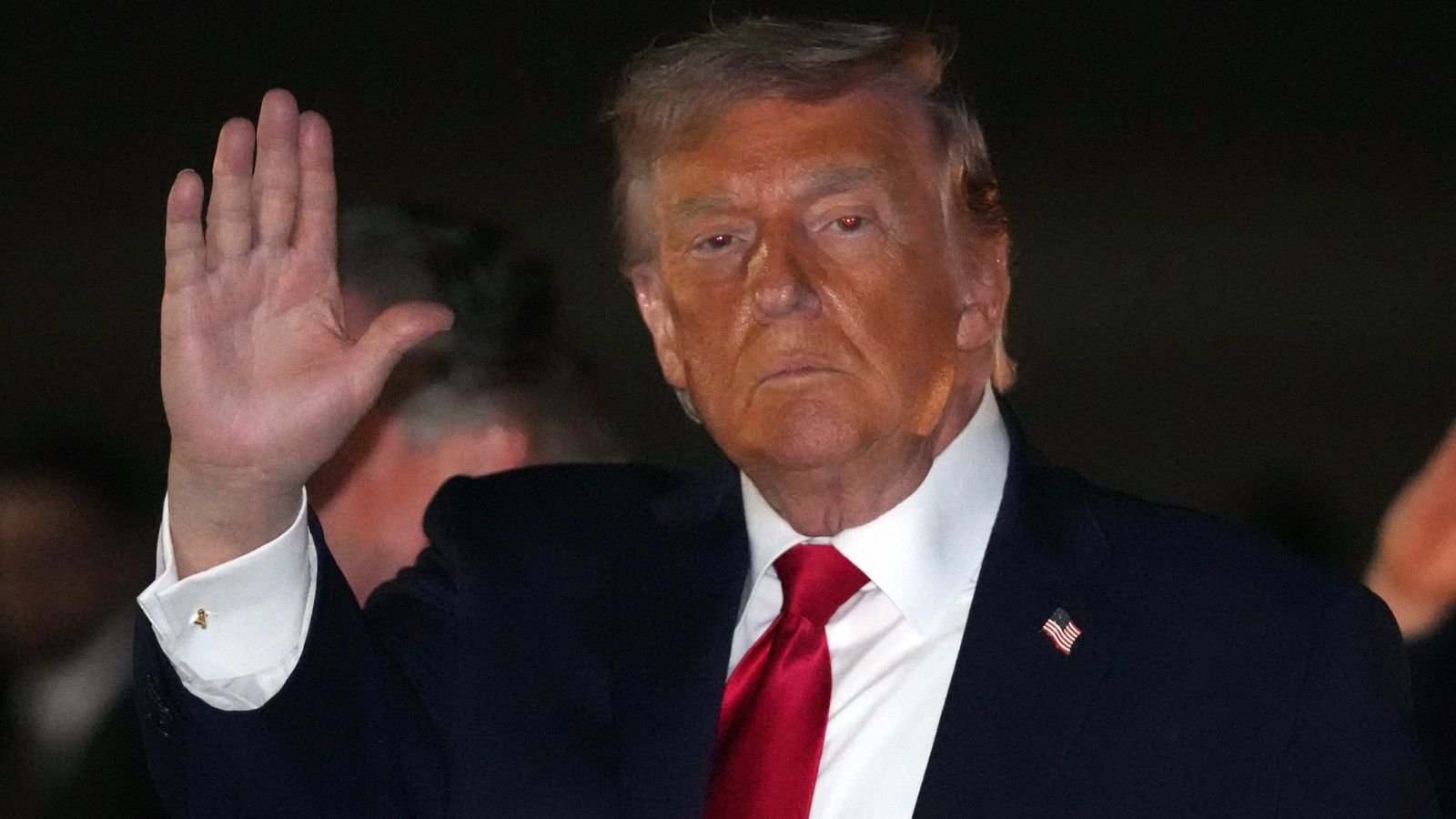
US President Donald Trump has escalated economic pressure on Iran, declaring what he called an “Economic D-Day” and warning that countries or entities helping Tehran could face “tremendous” economic consequences.
In a statement posted on Truth Social on Wednesday, Trump said Iran had failed to take what he described as a major opportunity to reach a deal with his administration. He responded by announcing what he called the “most crushing economic operation” ever imposed against a country.
The announcement marks a potentially significant expansion of the US campaign to isolate Iran. Trump said the effort would target not only Tehran but also the financial and commercial networks that continue to provide Iran with access to international trade and money.
His warning specifically mentioned oil smuggling, financial transactions, exchange houses, cash transfers, ship registries and front companies. He also warned that financial institutions, businesses, airports and government entities that provide what he described as a “lifeline” to Iran could face severe US economic pressure.
The exact scope and enforcement mechanisms of the new campaign were not fully detailed in Trump’s announcement. That leaves an important question for governments and companies around the world: how far will Washington go against countries that continue trading with Tehran?
What did Trump announce against Iran?
Trump presented the new campaign as an unprecedented effort to economically isolate Iran.
He said the United States had given Tehran an opportunity to reach a deal but that Iran had failed to accept it. His announcement followed months of conflict and stalled diplomatic efforts surrounding Iran’s nuclear programme and the wider confrontation in the region.
Trump described the new strategy as “economic warfare and isolation on an unprecedented scale.”
He also argued that Iran’s conventional military capabilities had already been severely weakened. In his assessment, Iran’s navy and air force had suffered major damage and military production facilities had been heavily affected.
Those are statements from the US president’s assessment of the conflict rather than independently established measures of Iran’s remaining military capacity. The broader significance of the announcement lies in what Trump wants to do next: increase pressure on the economic channels that allow Tehran to continue operating internationally.
Why Trump is targeting countries that help Iran
The most consequential part of Trump’s announcement may not be the threat against Iran itself. It is his warning to third countries.
Trump said any country that allows its financial institutions, businesses, airports or government entities to provide a financial or commercial lifeline to Iran could face what he called “tremendous Economic Consequences.”
That approach can potentially extend the impact of US policy far beyond American companies.
The United States has used sanctions and financial restrictions against Iran for years. A major escalation aimed at foreign entities could force companies and governments to make difficult choices about whether continuing business with Iran is worth the risk of losing access to the US financial system or facing other American penalties.
This is the central leverage behind secondary economic pressure: a company may have little direct connection with the United States but still have a strong reason to avoid violating American restrictions if its access to US markets, banks or international financial partners could be threatened.
Oil is likely to be at the centre of the pressure campaign
Trump specifically mentioned oil smuggling among the activities that he wants to stop.
Oil remains crucial to Iran’s ability to generate foreign-currency revenue and maintain external trade. Attempts to restrict Iranian oil exports therefore have the potential to affect the country’s broader economy.
But enforcement is complicated.
Oil can move through complex networks involving intermediaries, ship operators, trading companies and other entities. Identifying the ultimate destination or ownership of cargoes can be difficult, particularly when businesses attempt to conceal their connections to sanctioned parties.
Trump’s reference to ship registries and front companies indicates that Washington intends to look beyond the direct seller or buyer and target some of the infrastructure used to move Iranian goods internationally.
The success of that strategy will depend on how aggressively the United States pursues those networks and how willing other governments are to cooperate.
What does “Economic D-Day” actually mean?
“Economic D-Day” is Trump’s political description of the campaign rather than the name of a single economic measure.
The reference to D-Day evokes the massive Allied military operation in Normandy during World War II. Trump is using the term to portray the economic campaign as a decisive and unusually large-scale action against Iran.
In practical terms, the announcement points toward a broader effort to restrict Iran’s ability to access money, conduct international commerce and generate revenue through channels that Washington considers part of its support system.
However, the announcement did not provide a complete list of new sanctions, penalties or implementation dates. That distinction matters.
Confirmed: Trump announced a new economic campaign and threatened severe consequences for entities helping Iran.
Not yet fully established: the precise legal measures, penalties and enforcement mechanisms that will be used against every category of foreign business or government activity mentioned by Trump.
The difference will become clearer as the US administration publishes specific measures and enforcement decisions.
The threat comes as diplomacy with Iran remains stalled
The economic escalation comes against a backdrop of stalled negotiations.
Trump said on Tuesday that there were no talks or conversations with Iran and that none were scheduled. He also said the naval blockade remained in effect.
The latest announcement therefore represents a shift toward increased economic pressure at a moment when there is no clear diplomatic breakthrough.
The US president has continued to insist that Iran must not obtain a nuclear weapon. The nuclear issue remains one of the central points of disagreement between Washington and Tehran.
The June agreement had established a period for negotiations, but that deadline expired without a substantive resolution of the major disputes. With negotiations stalled, Washington is now signaling that economic pressure will become an even more important part of its strategy.
Iran rejects Trump’s economic campaign
Iranian Foreign Minister Abbas Araghchi sharply criticized Trump’s announcement.
Araghchi described the so-called “Economic D-Day” as a diversion from what he characterized as America’s own economic problems. He also accused Washington of pursuing what he called “economic terrorism” and warned that such policies could threaten the global economy and national sovereignty.
Iran’s response makes clear that Tehran does not view the new pressure campaign as a pathway to surrender.
Instead, the Iranian government is portraying US economic restrictions as part of a broader confrontation in which Washington is attempting to force Tehran into accepting American demands.
That creates a difficult diplomatic problem. Economic sanctions can reduce a government’s access to revenue, but they do not automatically produce political concessions. The targeted government may instead seek alternative trading partners, develop new financial channels or increase reliance on countries willing to continue doing business with it.
China could become an important test of the strategy
One of the biggest questions surrounding the new campaign is how Washington will deal with major economies that maintain commercial relationships with Iran.
China is particularly important because it has remained a major buyer of Iranian oil. Any serious effort to eliminate Iran’s oil revenue would therefore face the practical challenge of dealing with trade involving one of the world’s largest economies.
This illustrates the limits of economic pressure. The United States can impose sanctions on Iranian entities and threaten companies involved in sanctioned transactions, but enforcing a truly global economic isolation campaign requires cooperation from other governments.
If major trading partners comply, the pressure on Tehran could intensify substantially. If important countries continue purchasing Iranian goods through alternative channels, Iran could retain some access to international revenue.
India could also face a difficult balancing act
India’s relationship with Iran extends beyond energy.
Indian companies export products to the Iranian market, including basmati rice, tea, sugar, fresh fruits and pharmaceuticals, according to information cited by India’s diplomatic mission in Iran.
That means an increasingly aggressive US campaign against Iranian trade could have consequences for businesses in countries that maintain legitimate commercial relationships with Tehran.
For India and other countries, the challenge would be balancing existing commercial and strategic interests with the risk of falling foul of expanded US restrictions.
The effect on individual companies would depend heavily on the specific measures Washington eventually adopts, including which transactions are prohibited and which foreign entities could face penalties.
Strait of Hormuz adds another layer of risk
The economic confrontation cannot be separated from the situation around the Strait of Hormuz, one of the world’s most strategically important energy routes.
The waterway connects the Persian Gulf with the Gulf of Oman and is critical to global energy shipping. Restrictions on maritime traffic through the strait have already contributed to major uncertainty in global oil markets.
Recent reporting has indicated that tanker traffic has dropped sharply and shipping costs have risen as the conflict continues. Oil prices have also been affected by concerns about prolonged disruption.
That creates a difficult paradox for the United States.
Washington wants to restrict Iran’s ability to earn money from energy exports, but any prolonged disruption around Hormuz can also affect global energy supplies and prices. Higher energy costs can feed into inflation and raise transportation and production expenses far beyond the Middle East.
What could happen to global oil and trade?
The economic consequences of Trump’s strategy may therefore extend beyond Iran.
If Iranian oil exports are reduced further without an equivalent increase in supply elsewhere, Global Energy Markets could face additional pressure. The extent of that impact would depend on the scale and duration of any reduction in Iranian exports and on how other producers respond.
Higher oil prices can affect consumers through more expensive fuel and transportation. Businesses can also face higher costs for shipping, Manufacturing and logistics.
Financial markets may react as well because investors generally pay close attention to geopolitical risks that could affect inflation, economic growth and interest rates.
These effects are not guaranteed outcomes of Trump’s announcement, but they are among the potential consequences that markets and governments will be watching as the policy becomes clearer.
Why the new strategy could be difficult to enforce
Iran has lived under extensive US sanctions for years, giving its government and businesses considerable experience in finding ways to continue international commerce.
Sanctions enforcement can become increasingly difficult when transactions involve multiple intermediaries, alternative payment systems, complex ownership structures or shipping arrangements.
Trump’s reference to oil smuggling, exchange houses, cash transfers, ship registries and front companies suggests that Washington is aware of these mechanisms and intends to target them.
But shutting down every channel is considerably more difficult than identifying a single sanctioned company or bank.
The effectiveness of the campaign will therefore depend not only on American enforcement but also on the willingness of other countries to cooperate.
Could economic pressure bring Iran back to negotiations?
That is one of the central strategic questions.
The US administration appears to believe that increased economic pressure can weaken Iran’s position and create incentives for Tehran to negotiate. Trump has repeatedly linked his pressure campaign to the possibility of reaching a deal that addresses American concerns, particularly Iran’s nuclear programme.
Iran, however, has rejected the framing that greater economic pressure will force it to accept Washington’s demands.
The outcome could therefore move in two very different directions.
If economic pressure becomes sufficiently costly, Tehran could eventually decide that renewed negotiations are preferable. But if Iranian leaders conclude that concessions would threaten their strategic interests, further pressure could instead deepen the confrontation.
The available evidence does not establish which outcome will occur.
What happens next in the US-Iran confrontation?
The immediate focus will be on the details behind Trump’s announcement.
Markets, governments and companies will be watching for specific US measures identifying which transactions, financial institutions, shipping networks and commercial activities will be targeted.
Another key issue will be how Washington handles foreign governments that continue trading with Iran. A broad threat against countries and businesses is politically significant, but its practical impact will depend on enforcement.
Diplomacy will also remain an important variable. Trump says there are currently no talks with Iran, while Tehran has rejected the US approach. Any reopening of negotiations could change the economic calculation quickly.
For now, however, Washington is signaling maximum economic pressure rather than compromise.
Trump’s “Economic D-Day” puts the pressure on Iran’s trading network
Trump’s latest announcement is significant because it expands the focus of the confrontation from Iran itself to the network of companies, financial institutions and governments that keep Iran connected to the global economy.
The goal is clear: reduce Tehran’s ability to generate revenue, restrict access to international finance and make it increasingly costly for other countries to maintain economic ties with Iran.
Whether that strategy succeeds will depend on factors far beyond the White House. Iran’s ability to adapt, the cooperation of major trading partners, the future of the Strait of Hormuz, global oil supplies and the possibility of renewed diplomacy will all play a role.
For businesses outside Iran, the message from Washington is already unmistakable. Trump’s “Economic D-Day” is not simply a threat directed at Tehran. It is a warning that companies and governments doing business with Iran may increasingly have to choose between maintaining those relationships and avoiding the economic consequences of crossing the United States.
The next phase will therefore be defined less by Trump’s rhetoric and more by the concrete sanctions, enforcement actions and diplomatic decisions that follow.
For breaking news and live news updates, like us on Facebook or follow us on Twitter and Instagram. Read more on Latest World on thefoxdaily.com.




COMMENTS 0