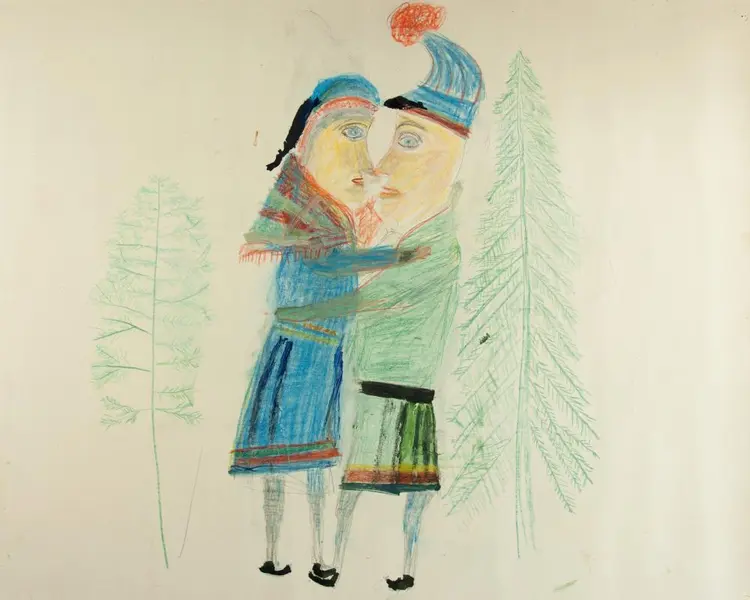
A new exhibition at the Kin Museum of Contemporary Art in Kiruna is bringing the work of Sami writer and artist Johan Turi back into public view as Sweden confronts a long history of abuses against its Indigenous population.
Titled On the Ugly and the Beautiful, the exhibition brings together Turi’s writings, drawings, paintings and Duodji, the traditional Sami handicraft tradition, alongside works by contemporary Sami artists Outi Pieski and Johanna Minde.
The exhibition has opened to coincide with the handover of a long-awaited report by Sweden’s Truth Commission for the Sami People. The commission’s work examines abuses committed by the Swedish state against the Sami and is intended to contribute to future discussions about reparation and reconciliation.
Johan Turi’s Record of Sami Life
At the centre of the exhibition is the work of Johan Turi, whose detailed observations provide a rare record of Sami life in northern Scandinavia at the beginning of the 20th century.
Turi’s work covered subjects ranging from reindeer herding and traditional beliefs to childbirth, Relationships with the land and everyday experiences. His drawings include detailed depictions of reindeer and the environments in which Sami communities lived.
His most important work, Muitalus sámiid birra, or An Account of the Sami, was published in 1910. Turi wrote the book to explain Sami life from a Sami perspective at a time when discrimination, disputes over land and growing industrial development were placing increasing pressure on Indigenous communities.
Turi is widely regarded as the first Sami author to write about Sami life in his own language. His book was originally published in Sami and Danish before being translated into Swedish seven years later.
For the Kin Museum, the return of Turi’s work to public display is significant because his writings offer more than a historical account. They document how a Sami person experienced the political, economic and social changes taking place around him.
Why Turi Wanted the Swedish Public to Understand
Turi was born in Guovdageainnu, known as Kautokeino, in the Norwegian part of Sápmi in 1854. His family were reindeer herders, but changing national borders increasingly affected traditional Sami movements and livelihoods.
As formal borders became more influential in the region, Turi’s family moved to Kiruna. The area was undergoing major changes, with settlers arriving and industrial development expanding across northern Sweden.
Mining and the construction of the railway were transforming the landscape and increasing pressure on land traditionally used by Sami communities, including for reindeer herding.
Maria Lind, director of the Kin Museum, said Turi had dreamed of writing a book that would help people in Sweden understand the difficulties facing the Sami during those years.
Turi also hoped that the Swedish king would read his book and recognise the challenges facing Sami communities. According to Lind, Turi believed that if the king understood their situation, conditions could change.
There is no indication that his hoped-for royal audience happened. Yet the book itself became successful and survived as an important record of Sami history and Culture.
‘On the Ugly and the Beautiful’ Looks at Both Sides of Sami History
The exhibition’s title comes from Turi’s belief that both positive and negative aspects of life should have a place in public view.
That idea shapes the exhibition, which does not present Sami history only through cultural traditions or artistic achievements. Instead, it places everyday life alongside discrimination, land disputes, political pressure and the consequences of industrial expansion.
Lind described An Account of the Sami as a work about Sami life in its broadest sense, covering both external circumstances and inner experiences.
The exhibition therefore connects historical material with contemporary artistic responses. Turi’s works are displayed alongside those of Pieski and Minde, creating a dialogue between the early 20th century and the present.
Contemporary Sami Struggles Echo Turi’s Concerns
More than a century after Turi documented the pressures facing Sami communities, many of the same questions remain relevant.
Land use continues to be a major issue. Industrial development, including the search for rare earth minerals and the expansion of wind energy, is creating new disputes over land in northern regions where reindeer herding remains an important part of Sami life.
The conflict is not simply about individual development projects. For reindeer-herding communities, access to grazing areas and the ability to move Animals through traditional landscapes are closely connected to cultural continuity and livelihoods.
The expansion of Infrastructure and energy projects can alter those landscapes, creating concerns about fragmentation and access to land.
At the same time, anti-Sami rhetoric has become a concern, including criticism and hostile language from political figures. The persistence of such tensions has added significance to Sweden’s current truth and reconciliation process.
Climate Change Adds a New Pressure
The challenges facing Sami communities today also differ from those Turi experienced because of the growing impact of the climate crisis.
The effects of climate change are particularly visible in Arctic and northern regions. Changing weather patterns can affect snow conditions, vegetation and access to grazing areas, creating additional uncertainty for reindeer herders.
For communities whose livelihoods are closely connected to seasonal changes and the natural environment, climate disruption can compound pressures already created by land use and industrial development.
This combination of environmental change and competing demands for land has made questions about the future of Sami culture increasingly connected to broader debates over climate policy, energy development and resource extraction.
Truth Commission Examines State Abuses
The exhibition comes at a significant moment for Sweden’s relationship with its Indigenous population. The Truth Commission for the Sami People has prepared a long-awaited report examining abuses committed by the Swedish state against the Sami.
The report is intended to provide a basis for discussions about reparation and reconciliation. Its handover marks another stage in an effort to examine historical policies and their consequences for Sami communities.
Similar truth and reconciliation processes have also taken place in Norway and Finland, where Sami communities have experienced the effects of state policies, discrimination and attempts to reshape Indigenous societies.
The presentation of the Swedish report gives Turi’s work an additional contemporary significance. His book was itself an attempt to document Sami experiences and challenge the lack of understanding among the wider Swedish population.
More than a century later, his writings are being displayed at the same time that Sweden is formally examining aspects of its own treatment of the Sami.
Outi Pieski Sees the Land in Turi’s Drawings
Contemporary Sami artist Outi Pieski, WHO lives on the Finnish side of Sápmi, grew up with Turi’s writings and drawings.
For Pieski, the paper on which Turi drew can be understood almost as an extension of the land itself. His drawings place people, animals and their surroundings within the same physical and cultural network.
That approach contrasts with a more distant view of landscape as something observed from outside.
Pieski argues that the Sami relationship with land involves being physically present within it and participating in a network connecting people, animals and place.
Her interpretation gives Turi’s drawings a contemporary relevance. Rather than treating them simply as historical illustrations, the exhibition presents them as part of a continuing conversation about Indigenous relationships with land.
The Return of the Traditional Ládjogahpir
Pieski’s research with Eeva-Kristiina Nylander into the ládjogahpir, a traditional hat historically worn by Sami women, is also represented in the exhibition.
Their work has contributed to renewed interest in the traditional headwear and helped bring it back into use.
For Pieski, the ládjogahpir has taken on a meaning beyond clothing. She describes it as a new symbol associated with decolonial feminism and the recovery of Sami cultural identity.
The revival demonstrates how traditional cultural forms can become part of contemporary debates over identity, history and Indigenous rights.
It also reflects one of the central themes of the exhibition: cultural practices that were once marginalised or suppressed can be reclaimed and given new meaning by later generations.
‘The Same Struggles Are Still Existing’
Pieski sees Turi’s writing as an early contribution to the process of truth and reconciliation now taking place in Sweden.
By recording Sami life from his own perspective, Turi created a written history at a time when Sami experiences were often described or interpreted by outsiders.
For Pieski, that distinction remains important today because control over historical narratives is closely connected to questions of power and recognition.
She has pointed to the continuing similarities between the problems Turi documented and the challenges faced by Sami communities today, particularly conflicts over industrial land use.
The comparison is striking because the economic and technological context has changed dramatically, while disputes over land and the recognition of Sami perspectives remain unresolved in many areas.
Why Sami History Matters Today
The exhibition also raises a broader question about who gets to record history.
Turi wanted Swedish society to understand Sami life through the experiences of Sami people themselves. His decision to write in the Sami language was central to that effort, giving his community a voice in a written record at a time when Indigenous perspectives were often overshadowed by official or outside accounts.
For contemporary Sami artists such as Pieski, that principle remains relevant. Cultural survival is not only about preserving objects, clothing, art or language. It also involves maintaining the ability to tell the story of a people in its own words.
The Kin Museum’s exhibition places that idea at the heart of its presentation. Turi’s work provides the historical foundation, while contemporary artists show how Sami identity and cultural expression continue to evolve.
A Century-Long Conversation Continues
Johan Turi died in 1936, but his account of Sami life continues to speak to questions that remain central in northern Scandinavia.
The landscape around Kiruna has changed since his lifetime. Mining, infrastructure, energy development and climate change have transformed the pressures placed on the region. Yet questions about land, cultural identity, discrimination and recognition remain part of Sami political and social life.
The timing of On the Ugly and the Beautiful therefore gives the exhibition a significance beyond the rediscovery of a historic artist.
As Sweden receives the Truth Commission for the Sami People’s report, visitors are being invited to consider the relationship between historical testimony and present-day struggles. Turi’s writings show how one Sami author tried to make those experiences visible more than 100 years ago.
The exhibition’s combination of historical and contemporary works suggests that the story is still being written. The circumstances have changed, but the questions Turi raised about land, culture, discrimination and the right of the Sami to define their own history remain part of the conversation.
For a people whose history has often been recorded by others, the continued presence of Turi’s voice offers a reminder of the importance of Indigenous authorship. His work remains not only a record of the past, but also a lens through which the continuing challenges facing the Sami can be understood.
For breaking news and live news updates, like us on Facebook or follow us on Twitter and Instagram. Read more on Latest World on thefoxdaily.com.


COMMENTS 0