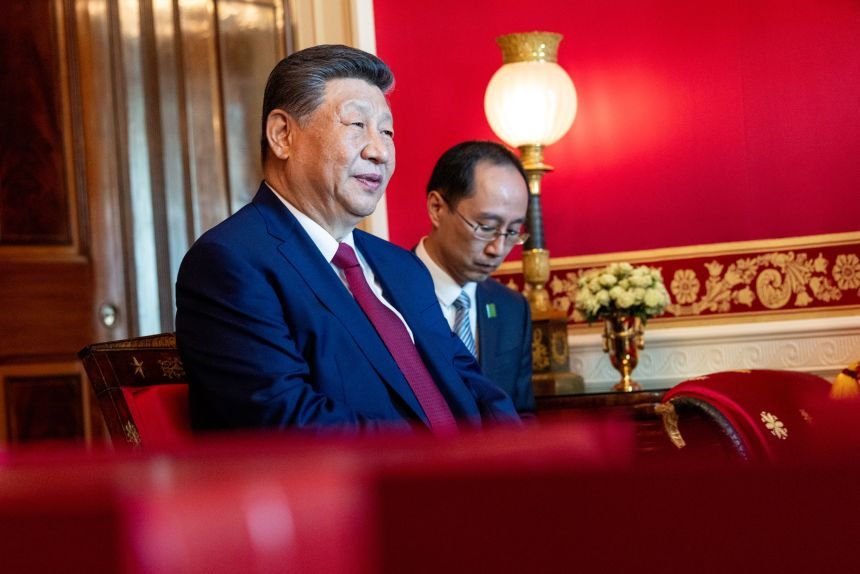
US President Donald Trump and Chinese President Xi Jinping wrapped up a closely watched Washington summit with plenty of ceremony, warm words and carefully choreographed diplomacy, but relatively few concrete breakthroughs on the biggest disputes between the world’s two most powerful economies.
Xi’s visit to Washington, his first to the US capital in more than a decade, featured a White House welcome, a state dinner, a tea ceremony and an exchange of gifts and compliments. The two leaders also extended their existing Trade truce and acknowledged the possibility of greater cooperation over the risks associated with artificial intelligence.
Yet the central disagreements between Washington and Beijing remained largely intact. Taiwan, technology restrictions, trade, artificial intelligence and wider geopolitical tensions continue to divide the two countries.
For china, however, that may not necessarily represent a disappointing outcome.
Xi entered Washington with a different set of priorities from those facing Trump. Beijing has an interest in keeping relations stable without making major concessions, particularly while China’s exports remain strong and its influence over critical materials gives it leverage in the global economy.
The result was a summit where symbolism did much of the work. For Xi, preserving stability and demonstrating that China can engage with the United States as a major power may itself have been an important objective.
Trump and Xi Extend the Trade Truce
The clearest practical outcome was an extension of the existing US-China trade truce, keeping the two economies from immediately returning to another escalation in tariffs while negotiations continue.
The agreement does not resolve the underlying trade dispute. Instead, it gives both governments additional time to negotiate and maintain a degree of stability in their economic relationship.
That limited outcome is significant because the relationship between Washington and Beijing has become deeply intertwined with global supply chains, technology markets and international trade.
A return to rapid tariff escalation could have consequences far beyond the two countries. Businesses depend on predictable access to Chinese manufacturing, American technology and international shipping networks, while consumers and industries on both sides remain exposed to changes in trade policy.
The extension therefore offers breathing room, but it does not amount to a comprehensive settlement.
Xi Uses the Summit to Promote Cooperation
At the White House state dinner, Xi emphasized cooperation rather than confrontation.
The Chinese leader presented the relationship between the two countries as one in which differences can coexist with collaboration. He described the friendship between the American and Chinese peoples as a worthwhile cause and called for the two sides to move forward together.
Xi’s language also connected Trump’s “Make America Great Again” slogan with China’s long-term goal of the “Great rejuvenation of the Chinese nation.”
The comparison was revealing. Rather than presenting China’s rise as an inevitable confrontation with the United States, Xi framed the country’s ambitions as compatible with a relationship based on coexistence and cooperation.
That message is useful for Beijing because China’s growing economic and technological capabilities are at the heart of many of Washington’s concerns.
China’s Rise Remains the Bigger Story
China’s transformation over the past several decades has made it a central competitor to the United States across manufacturing, technology, trade and strategic influence.
Washington has responded with restrictions affecting Chinese imports, investment and access to certain US technologies. American officials have argued that these measures are necessary to protect national security and maintain technological advantages in strategically important areas.
Beijing sees many of those measures differently, regarding them as attempts to slow China’s development.
Despite those restrictions, China has continued to maintain a powerful export sector and make advances in areas such as artificial intelligence and robotics. It also retains significant influence over global supplies of rare earth elements and other materials that are important to modern manufacturing and technology.
That position gives Xi leverage that China did not necessarily have during his previous visits to Washington.
The balance of economic power may therefore help explain why Beijing can accept a summit focused more on stability and symbolism than major concessions.
A Diplomatic Replay of Earlier Trump-Xi Engagement
The Washington meeting followed another high-profile encounter between Trump and Xi earlier in the year. That meeting also featured significant symbolic gestures but produced limited movement on some of the most difficult issues dividing the two governments.
The latest summit followed a similar pattern.
The leaders displayed a willingness to communicate and avoid an immediate deterioration in relations, while leaving several fundamental disagreements unresolved.
For governments managing a relationship as complicated as that between the US and China, preventing escalation can itself be a diplomatic objective. A stable relationship provides room for negotiators and officials to continue discussions without the pressure of an immediate economic or military crisis.
That appears to have been an important feature of the Washington visit.
Trump Faces Pressure at Home
The summit also took place against a challenging domestic and international backdrop for Trump.
The US president has faced political pressure connected to the prolonged war with Iran and rising prices, with the November midterm elections approaching.
Those circumstances create an incentive for the administration to demonstrate progress in foreign policy while avoiding unnecessary economic disruption.
A prolonged trade confrontation with China could add pressure to businesses and consumers, particularly if tariffs increase the cost of imported goods or disrupt supply chains.
For Trump, therefore, maintaining a trade truce while keeping pressure on Beijing can provide a temporary balance between confrontation and economic stability.
Press Restrictions Became Part of the Summit Story
The diplomatic spectacle surrounding the summit was complicated by a dispute over access for White House reporters.
Trump’s administration had restricted some news organizations from the White House press pool, including CNN, MS NOW and Politico. A court later overturned the ban, but the dispute affected how the summit was covered.
The restrictions also created a striking contrast with China’s tightly controlled state-media coverage of Xi’s visit.
Chinese state media traditionally presents carefully managed images of Xi’s overseas engagements, emphasizing ceremony, diplomatic stature and China’s role on the international stage. The controversy over media access in Washington created a different kind of attention around Trump’s meeting with the Chinese leader.
Instead of the summit being defined exclusively by the substance of the negotiations, the Politics of media access became part of the broader story surrounding the visit.
Xi Arrived Without a Major Business Delegation
Another notable feature of Xi’s Washington visit was the limited role of Chinese Business leaders compared with some previous high-level US-China engagements.
That absence was interpreted by some observers as a sign that the relationship had not yet reached the stage where major commercial breakthroughs were ready to be announced.
Cui Hongjian, an international relations scholar at Beijing Foreign Studies University, described the two countries as being in a phase focused on stabilizing the political relationship.
That assessment fits the broader character of the summit. Rather than producing a sweeping new economic agreement, the leaders concentrated on keeping the relationship from deteriorating while leaving difficult negotiations to officials working behind the scenes.
Xi also expressed a desire for the United States to remain open to Chinese businesses, while Trump highlighted the long history of trade and people-to-people ties between the two countries.
Taiwan Remains a Major Sticking Point
Behind the friendly public exchanges, Taiwan remained one of the most sensitive issues.
Beijing considers Taiwan part of China and has long opposed moves toward formal Taiwanese independence. The future of the island is closely connected to Xi’s broader vision of national rejuvenation.
During the Washington talks, Xi pressed Trump to oppose Taiwan independence, according to Chinese state media.
The United States maintains a deliberately complex position on Taiwan. Washington does not have formal diplomatic relations with Taipei in the same way it does with sovereign states, but US law provides for arms sales that allow Taiwan to maintain its self-defense capabilities.
The strategic ambiguity surrounding Taiwan has been a longstanding feature of US policy, allowing Washington to support Taiwan while avoiding an explicit commitment to a particular outcome over the island’s political status.
The summit did not produce a publicly announced breakthrough on that question.
That matters because Taiwan remains one of the issues most capable of turning broader US-China competition into a direct security crisis. Beijing has warned against support for Taiwanese independence, while Washington continues to emphasize peace and stability across the Taiwan Strait.
AI Creates an Unusual Area for Possible Cooperation
Artificial intelligence was another important topic discussed by the two leaders.
The US and China are competing aggressively in the development of advanced AI systems, making the technology both an economic opportunity and a national-security concern.
Xi argued that the two countries should cooperate on managing AI development and ensuring that increasingly capable systems remain under human control.
The issue is unusual because Washington and Beijing are simultaneously competitors and potential partners in AI safety.
Both countries have powerful technology companies and research communities working on increasingly sophisticated models. The speed of development has raised questions about safety, oversight and the possibility that advanced AI systems could become difficult for humans to control.
American technology leaders have called for greater attention to managing those risks, while Chinese companies have continued advancing despite US restrictions on certain technologies and exports.
AI Competition Is Still Intensifying
The possibility of cooperation should not be confused with an end to technological competition.
US officials have accused Chinese technology companies of benefiting from American AI advances and have considered additional restrictions in response. Beijing has warned that it could take countermeasures if Washington attempts to further restrict China’s technological development.
That creates a complicated environment for negotiations.
The two countries may have common interests in preventing an uncontrolled AI race, but they also have strong incentives to ensure that the other side does not gain a decisive technological advantage.
Xi’s message at the summit was that competition did not necessarily have to lead to confrontation. His call for peaceful coexistence offered a framework for discussing AI governance without requiring either side to abandon its broader technological ambitions.
China Has More Leverage Than Before
One of the most important differences between the current relationship and the one Xi faced during his earlier Washington visits is China’s economic position.
Despite US restrictions, China has continued to export at high levels and maintain strong manufacturing capabilities. Its position in global supply chains and control over important raw materials also give Beijing tools that can be used when negotiating with Washington.
China’s progress in artificial intelligence and robotics adds another dimension to that leverage.
The result is that Xi can approach negotiations from a position in which Beijing does not necessarily need a dramatic agreement to demonstrate progress.
Keeping trade stable, avoiding a new escalation and presenting China as an equal participant in discussions with Washington can serve Beijing’s interests even if major disputes remain unresolved.
Why Symbolism Matters to Beijing
It would be easy to dismiss the ceremony surrounding Xi’s visit as purely theatrical, but diplomatic symbolism has practical value.
A state visit to Washington, a White House welcome, a state dinner and highly visible interactions between the two leaders demonstrate that direct engagement remains possible despite deep disagreements.
For Xi, the imagery also reinforces China’s status as a major global power whose leader is welcomed at the centre of American political power.
Chinese state media can use such events to communicate that the United States is engaging with China at the highest level rather than treating Beijing as a country that can simply be isolated or contained.
The symbolism therefore serves a political purpose even when the underlying negotiations produce only limited results.
What the Summit Did Not Resolve
The meeting left several of the most difficult US-China disputes unresolved.
- Taiwan: Beijing continues to oppose Taiwanese independence, while Washington maintains its longstanding policy of supporting Taiwan’s ability to defend itself.
- Trade: The truce has been extended, but the larger structural disagreements over tariffs, market access and economic policy remain.
- Technology: US restrictions on Chinese access to advanced technology remain a major source of tension.
- Artificial intelligence: The two sides can discuss safety and responsible development while continuing to compete over advanced AI capabilities.
- Strategic rivalry: Broader disagreements over China’s rise and America’s response remain at the centre of the relationship.
None of these issues can be resolved simply through a ceremonial meeting between two presidents.
A Quiet Summit May Serve Xi’s Interests
The most striking feature of the Trump-Xi meeting may ultimately be what did not happen.
There was no dramatic collapse in relations, but there was also no major settlement of the central disputes. The two leaders exchanged warm words, extended the trade truce and discussed areas where cooperation might be possible.
For Xi, that may be enough for the moment.
China benefits from a stable external environment in which its exporters, technology companies and manufacturers can continue operating without a sudden return to maximum economic pressure from Washington.
Beijing also has an interest in demonstrating that its rise cannot easily be stopped by tariffs or technology restrictions alone.
A summit that avoids escalation while requiring few major concessions can therefore support that objective.
The US-China Relationship Remains a Long-Term Contest
The Washington summit should be understood as one stage in a much longer US-China relationship rather than a final settlement.
Trump and Xi have shown that they can maintain a working diplomatic channel even while their governments disagree over trade, technology, Taiwan and global security.
That channel matters because the consequences of a breakdown would extend far beyond Washington and Beijing. Global manufacturers, technology companies, commodity markets and supply chains are all affected by the relationship between the two countries.
The extension of the trade truce therefore provides an opportunity for negotiators to continue working, even though the fundamental disagreements remain.
For now, Xi leaves Washington with the relationship stabilized rather than transformed. Trump gets time to pursue negotiations without an immediate return to full-scale trade escalation. And China retains the ability to continue its economic and technological development while presenting itself as a power willing to cooperate with the United States.
The summit may have been heavy on ceremony and light on dramatic announcements, but that does not necessarily make it insignificant. In a relationship where escalation can have global consequences, maintaining dialogue and avoiding a new crisis can itself be a meaningful outcome.
For Xi, however, the bigger advantage may be that China did not need to give up much to achieve it.
For breaking news and live news updates, like us on Facebook or follow us on Twitter and Instagram. Read more on Latest World on thefoxdaily.com.




COMMENTS 0