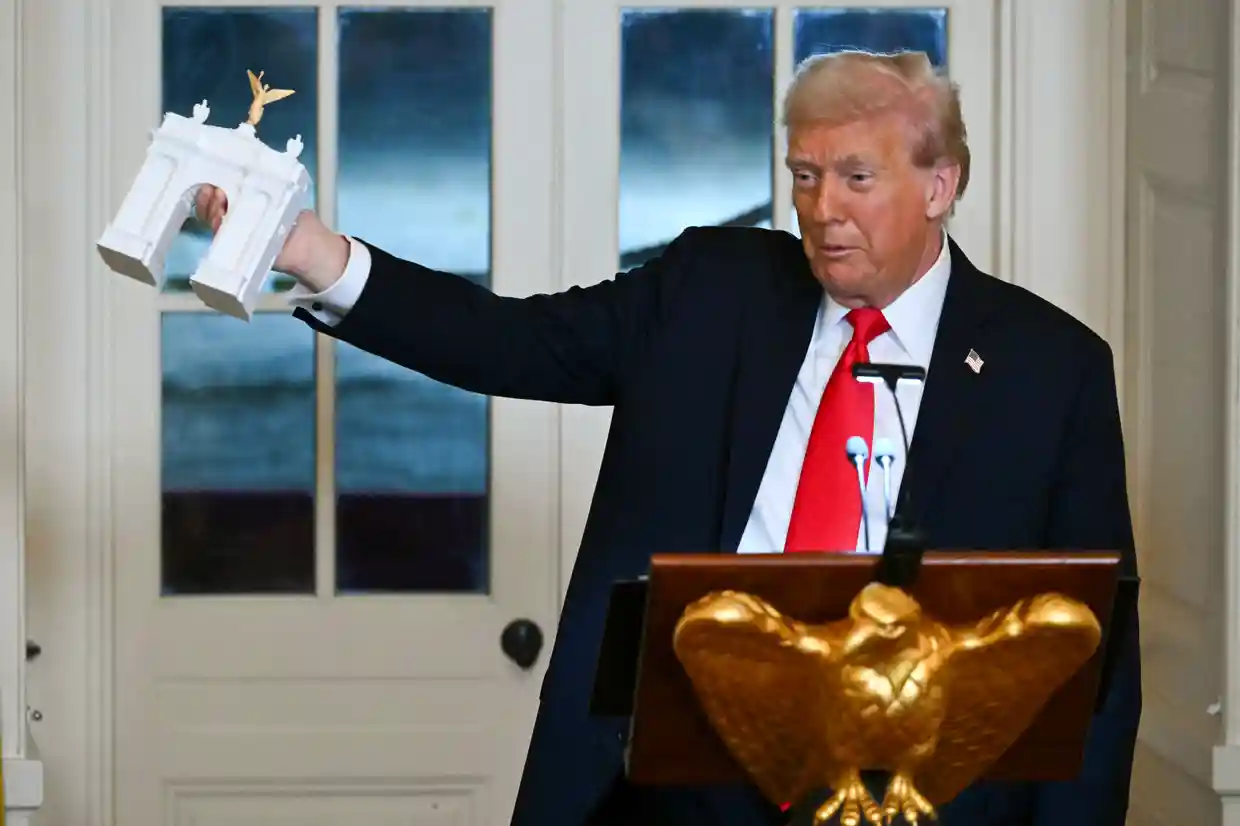
President Donald Trump‘s proposed triumphal arch in Washington, DC, has suffered a legal setback after a federal judge temporarily stopped construction work on the project. US District Judge Tanya Chutkan issued a 14-day temporary restraining order early Friday, preventing the administration from beginning construction while legal challenges continue.
The decision came only hours after the National Capital Planning Commission approved the proposed 250-foot monument in an 8-4 vote. The approval followed a hearing lasting more than nine hours, during which veterans, local representatives, historians and other participants raised objections to the structure’s location, design and potential impact on Washington’s historic landscape.
The arch is among several major projects associated with Trump’s efforts to reshape the appearance of the US capital. However, the latest court order means the administration cannot immediately proceed with construction, despite the planning commission’s approval.
Judge Tanya Chutkan Issues 14-Day Restraining Order
US District Judge Tanya Chutkan issued the temporary restraining order in a Washington, DC, federal court. The order blocks construction activity on the proposed arch for 14 days, granting a request from plaintiffs challenging the project.
The judge also consolidated lawsuits filed by the District of Columbia and Virginia with a separate legal challenge brought by a group that includes Vietnam War veterans and an architectural historian.
The legal challenges question whether the administration has followed the necessary procedures and obtained the required authorisations to construct the monument.
The temporary order does not permanently cancel the project. Instead, it prevents construction from moving forward during the initial period of judicial review. The legal dispute will determine whether the administration can proceed under its current plans or must address the objections raised by the plaintiffs.
Trump’s 250-Foot Arch Received Planning Commission Approval
The court’s intervention followed a significant development at the National Capital Planning Commission, which voted 8-4 to approve the proposed triumphal arch on Thursday.
The monument is planned to stand approximately 250 feet tall, or around 76 metres. Its proposed scale has made it one of the most prominent architectural projects associated with Trump’s plans for Washington.
The commission’s decision followed a public hearing lasting approximately nine and a half hours. Numerous participants spoke against the proposal, arguing that its size and location could affect important views and the character of nearby historic landmarks.
The vote also exposed divisions between federal and local representatives on the commission. Supporters included officials connected to the Trump administration, while opponents included representatives of Washington, DC.
Although the commission’s approval represented an important administrative step, it did not resolve the separate legal questions raised in the lawsuits.
Why the Proposed Arch Has Faced Strong Opposition
Opposition to the project has focused heavily on its proposed location and potential impact on the landscape surrounding Arlington National Cemetery and other important national landmarks.
Critics argue that the enormous structure could obstruct established sightlines and alter the solemn character of an area associated with American military history and remembrance.
During the public hearing, veterans and other participants expressed concern that the monument could undermine the visual relationship between existing landmarks and the cemetery, where hundreds of thousands of fallen service members and military veterans are buried.
Some opponents also questioned whether a monument of this scale was appropriate for the proposed location, particularly given the area’s historical and symbolic significance.
Vietnam War Veteran Challenges the Project
Michael Lemmon, a Vietnam War veteran and former ambassador who is the lead plaintiff in one of the lawsuits, has strongly opposed the proposed arch.
In a court filing submitted in February 2026, Lemmon argued that the structure would disrupt an important unobstructed sightline associated with national unity and disrespect the memory of veterans.
He also expressed concern about the possibility of being buried at Arlington National Cemetery beneath the shadow of a monument he considers a personal vanity project.
His objections reflect a broader concern among opponents that the proposed structure could shift attention away from existing memorials and the historical significance of the surrounding area.
The lawsuit involving Lemmon and other plaintiffs is part of the wider legal effort that led Judge Chutkan to issue the temporary construction halt.
Trump Administration Officials Defend the Monument
Officials supporting the arch have presented it as a monument celebrating American history, national identity and military service.
Mark Paoletta, chair of the National Capital Planning Commission and a Trump administration appointee, opened the hearing with strong support for the proposal. He argued that large monuments help communicate a country’s identity and pointed to famous arches in major European cities as examples of this architectural tradition.
Paoletta also praised Trump’s interest in creating grand monuments, describing the project as part of a broader effort to give Washington a prominent national landmark.
Another supporter, Commissioner Paul Ingrassia, a lawyer for the General Services Administration, said the project was not intended to be political. He described it as a tribute to the country’s history and veterans.
These arguments reflect the administration’s position that the arch would serve as a national monument rather than a personal political statement.
Washington Officials Question Congressional Approval
Not all members of the planning commission supported the proposal. Washington, DC, City Council member Phil Mendelson raised questions about whether the project had received the necessary congressional approval.
Mendelson argued that Congress had not authorised the project or appropriated funding for its construction. He also questioned the administration’s references to potential military uses, noting that the plans submitted to the commission did not include such a purpose.
His objections focused on the distinction between approving a design and establishing that the government has all the legal authority and funding required to build it.
The dispute over congressional approval is among the issues that could become important as the lawsuits proceed.
Democratic Lawmakers Call the Project Illegal
Representative Jared Huffman, a California Democrat expected to chair the House Natural Resources Committee, also criticised the proposed monument during the commission’s proceedings.
Huffman described the project as ill-advised and illegal, arguing that it was more closely associated with Trump’s personal image than with the commemoration of military service.
He questioned the administration’s claim that the arch was primarily intended to honour veterans and argued that its design resembled monuments historically associated with emperors and kings.
These comments represent the position of opponents of the project. Whether the proposed construction violates applicable laws will be determined through the relevant legal proceedings.
How the Planning Commission Hearing Unfolded
The planning commission’s hearing lasted more than nine hours and included extensive public participation. Many speakers objected to the proposed structure, while administration representatives defended its design and purpose.
The remote call-in hearing experienced repeated technical problems during its opening hours. Despite those interruptions, participants continued to present arguments about the monument’s historical, architectural and legal implications.
Opponents raised concerns about the impact on Arlington National Cemetery, the surrounding viewshed and the character of Washington’s monumental landscape.
The 8-4 vote eventually secured approval from the commission, but the outcome did not end the controversy. The lawsuits remained active, and the subsequent restraining order prevented the administration from moving directly into construction.
Trump’s Broader Plans to Reshape Washington
The triumphal arch is part of a wider series of projects and proposals associated with Trump’s efforts to change the appearance and use of public spaces in Washington.
His administration has pursued changes involving public landmarks and recreational properties, including renovations to a historic public golf course. Trump has also raised the possibility of demolishing the John F. Kennedy Center for the Performing Arts.
These proposals have generated debate about presidential authority, Historic Preservation and the role of public institutions in decisions affecting nationally significant buildings and spaces.
The political environment could also influence how closely these projects are scrutinised. Democrats have gained control of Congress, potentially creating additional oversight of administration decisions involving federal property, public funding and major construction initiatives.
How Much Will Trump’s Triumphal Arch Cost?
The total cost of the proposed monument remains unclear. Some estimates have placed the potential expense as high as $100 million, but a confirmed final budget and funding arrangement have not been established in the supplied project details.
The question of who will pay for the construction is also significant. Critics, including Mendelson, have questioned the absence of congressional appropriations for the project.
Until the financing arrangements and legal authority are clarified, the estimated cost should not be treated as a confirmed government expenditure.
What Happens After the 14-Day Construction Halt?
The temporary restraining order prevents construction from beginning during the initial 14-day period. It gives the court time to consider the legal challenges and the arguments presented by the parties involved.
The administration had previously indicated that work could begin once the planning commission approved the project, the Interior Department issued its final decision authorising construction and the required notification was published by the National Park Service.
However, the judicial order has interrupted that expected process. The government must now address the legal challenge before construction can proceed.
The court’s order is temporary and should not be interpreted as a final ruling against the monument. The outcome will depend on further judicial consideration of the claims raised by Washington, Virginia, veterans and the other plaintiffs.
Why the Court’s Decision Matters for Washington’s Historic Landscape
The dispute over Trump’s triumphal arch raises broader questions about how major monuments should be planned and approved in a capital city filled with historically significant buildings, memorials and public spaces.
Supporters view the arch as an opportunity to create a landmark celebrating American identity and military service. Opponents argue that its scale, location and approval process raise concerns about historic views, congressional authority and the appropriate use of public spaces.
The temporary construction halt ensures that these disagreements will receive further judicial consideration before work can begin. It also demonstrates that planning commission approval does not necessarily end legal challenges involving major federal construction projects.
For now, Trump’s proposed 250-foot triumphal arch remains at the centre of a legal and political dispute. Whether it will eventually be built, redesigned or delayed further will depend on the outcome of the ongoing court proceedings and the administration’s ability to satisfy the relevant legal requirements.
For breaking news and live news updates, like us on Facebook or follow us on Twitter and Instagram. Read more on Latest World on thefoxdaily.com.






COMMENTS 0