US Senate Democratic leader Chuck Schumer has warned President Donald Trump that Democrats will not allow him to appoint another conservative justice to the Supreme Court without facing strong opposition from the incoming Senate majority. His remarks offer an early indication of how Democrats intend to use their expanded congressional power after winning control of both chambers in the November 2026 midterm elections.
In an interview with the Associated Press, Schumer said Democrats would reject nominees they considered unsuitable for the Supreme Court, lower federal courts and Trump’s Cabinet. He made clear that judicial appointments would become one of the central areas of confrontation between the Democratic-led Senate and the Republican administration.
“The bottom line is we’re not going to allow a rightwinger on the court,” Schumer said.
He also said Democrats would not confirm what he described as “any crappy nominees” to important government positions. The remarks indicate that Trump could face a more difficult confirmation process for senior appointments when the new Congress begins its work in January 2027.
The warning comes after Democrats secured a decisive midterm victory, taking control of the Senate and House of Representatives. The result gives the party greater authority over congressional committees, legislative priorities and the confirmation of presidential nominees, although it does not give Democrats the power to enact every policy they support.
Democrats Prepare to Use Their New Congressional Majority
The 2026 midterm elections significantly changed the balance of power in Washington. Democrats won control of both chambers, reversing the Republican position in Congress and giving the opposition party an opportunity to challenge Trump’s second-term agenda.
As of November 6, Democrats had secured at least 54 Senate seats, compared with 44 for Republicans. Two Senate contests, in Mississippi and Alaska, remained unresolved, with Democratic candidates leading in both races. The final balance could therefore change as the remaining results are confirmed.
In the House of Representatives, Democrats had secured at least 253 seats after flipping more than 40 districts. The party’s expanded numbers give it control of the chamber and the ability to take charge of its committees and legislative schedule.
The results mean Trump will face a Congress controlled by the opposition for the remainder of his current presidential term. Democrats are preparing to use that position to investigate administration activities, challenge policies and advance legislation they promised voters during the election campaign.
However, a congressional majority does not automatically guarantee that Democrats can turn their proposals into law. Trump retains presidential veto powers, and overriding a veto would require a two-thirds majority in both chambers. The incoming Congress will therefore have considerable oversight authority but will still face significant limits when attempting to enact legislation over the President’s objections.
Supreme Court Appointments Become a Major Political Flashpoint
The Supreme Court is expected to be one of the most important areas of disagreement between Trump and the incoming Democratic Senate. The President has already appointed three justices during his first term: Neil Gorsuch, Brett Kavanaugh and Amy Coney Barrett.
Those appointments helped establish a 6-3 conservative majority on the nine-member court. The court has ruled in favour of some challenges to Trump’s second-term policies while rejecting others, making its composition particularly important to the administration’s legal and political agenda.
Supreme Court appointments can have consequences extending well beyond a single presidential term because justices generally serve for life, unless they retire, resign or are removed through the constitutional process. Their decisions can influence major questions involving presidential authority, federal regulations, civil rights, healthcare, immigration and other areas of American law.
Schumer’s warning is therefore significant even though no immediate vacancy has been announced. If a justice leaves the court during Trump’s remaining time in office, the President would be able to nominate a replacement, but the Senate would have to consider and confirm that nominee.
With Democrats preparing to control the Senate, Trump’s ability to secure confirmation for a conservative nominee would become considerably more difficult. Schumer’s comments suggest the party is prepared to use that authority to prevent a further shift in the court’s ideological balance.
Clarence Thomas and Samuel Alito Draw Attention Over Their Ages
Questions about the future composition of the Supreme Court have gained attention because several justices are in their 70s. The court includes four members in that age group, while its two oldest conservative justices are Clarence Thomas and Samuel Alito.
Thomas, who is 78, and Alito, who is 76, are both older than the other members of the conservative bloc. Their future decisions about retirement could become politically significant because any vacancy would give the sitting President an opportunity to nominate a successor.
Neither justice had announced plans to leave the court in the information available around the midterm elections. Alito specifically rejected retirement rumours and told Fox News on Thursday that he intended to remain on the court for the rest of the term.
Thomas had also given no indication that he planned to retire. As a result, the possibility of a vacancy remained uncertain rather than an immediate development.
Nevertheless, the age of senior justices has become relevant to the political calculations of both parties. A vacancy during Trump’s presidency could allow him to attempt another appointment, while a Democratic-controlled Senate could use its confirmation powers to block the nomination.
Could Democrats Keep a Supreme Court Vacancy Open?
Schumer did not provide a clear answer when asked whether Democrats might leave a Supreme Court vacancy unfilled until after the next presidential election. His response leaves open the question of how aggressively the party would use its Senate majority if a justice retired or died before Trump’s term ends.
The issue carries historical significance because of the 2016 Supreme Court vacancy following the death of Justice Antonin Scalia. At the time, Republican Senate Majority Leader Mitch McConnell refused to hold confirmation hearings for President Barack Obama’s nominee, Merrick Garland, arguing that the next President should make the appointment because it was an election year.
Republicans later confirmed Trump’s nominee Neil Gorsuch after he took office in 2017. The episode remains a major point of disagreement over how the Senate should handle Supreme Court nominations during politically sensitive periods.
Schumer’s refusal to rule out holding a vacancy open suggests Democrats are considering the full range of options available to them. However, the precise approach would depend on when a vacancy occurred, the circumstances surrounding it and the political balance at the time.
The broader issue is whether the Senate majority will treat Supreme Court nominations as a matter requiring bipartisan agreement or use its voting power to prevent nominees whose judicial positions it strongly opposes.
Democrats Also Plan Investigations Into Trump and His Administration
Judicial nominations are only one part of the incoming Democratic strategy. Several lawmakers are preparing investigations into Trump, his administration and the conduct of senior officials.
Robert Garcia, who is expected to chair the House Oversight Committee, signalled an aggressive approach to congressional scrutiny. On Tuesday evening, he warned Republicans to “lawyer up”, a remark that indicated Democrats intended to make investigations a prominent part of their return to power.
The House Oversight Committee has broad responsibilities involving government operations, federal spending and executive branch activities. Under Democratic control, it could organise hearings, request documents and question administration officials about matters within its jurisdiction.
Potential investigations could examine alleged corruption, the administration’s decision-making and the conduct of people holding senior positions. Democrats have also indicated that immigration enforcement and the use of federal authority could receive attention.
However, investigations are not the same as findings of wrongdoing. Allegations would need to be examined through evidence, testimony and established congressional procedures before conclusions could be reached.
For Democrats, the investigations would serve two purposes: examining the administration’s conduct and demonstrating to voters that the party intends to use its new congressional authority to hold the executive branch accountable.
Medicaid, Iran War Funding and Other Legislative Priorities
Alongside investigations, Democrats are preparing legislation on issues that featured prominently in their midterm campaigns. Healthcare, household costs and the economic effects of Trump’s policies are expected to remain central to the party’s agenda.
One potential priority is restoring Medicaid funding reductions associated with Trump’s One Big Beautiful Bill. Medicaid is a major public healthcare programme that provides coverage to eligible low-income Americans, children, older people and individuals with disabilities.
Changes to Medicaid funding can affect state budgets, healthcare providers and the availability of services for people who depend on the programme. Democrats have argued that restoring the reductions should be an important part of their legislative response after the election.
Another area of disagreement concerns funding for the war in Iran. Some Democrats want to halt or restrict financial support connected to the conflict, which has become a major political issue following its economic consequences and the administration’s foreign policy decisions.
Democrats have also focused on policies related to affordability, including healthcare, housing, childcare and energy costs. These issues were central to the party’s election messaging and are likely to influence its legislative proposals.
Even with control of both chambers, however, the party will need to negotiate the details of legislation and consider the President’s position. Trump has indicated that he intends to veto bills he opposes, making bipartisan support or sufficiently large majorities important for major legislative changes.
Republicans Debate the Reasons Behind Their Midterm Defeat
While Democrats prepare to take control of Congress, Republicans are facing questions about the reasons for their election losses. The results have triggered disagreements within the party over Trump’s policies, the Iran war, tariffs and the administration’s handling of politically sensitive issues.
Several prominent Republicans have publicly acknowledged that decisions made by the administration may have contributed to voter dissatisfaction.
Vice-President JD Vance recognised the frustration caused by the Iran war. The conflict became a particularly difficult issue for Republicans because Trump had campaigned on avoiding new foreign wars and prioritising domestic concerns.
Senator Ted Cruz of Texas criticised the effect of Trump’s tariffs on everyday costs. Tariffs can increase the cost of imported goods and components, and businesses may pass some of those additional expenses on to consumers. Their impact varies depending on the products affected, the countries involved and how companies adjust their supply chains.
Florida Governor Ron DeSantis also acknowledged that the Republican Party’s handling of the Epstein files had damaged its public image. The issue had become a source of political pressure, particularly among voters who expected greater transparency from the administration.
The criticism reflects a wider debate within the Republican Party about whether the administration’s policies have remained sufficiently focused on the economic concerns that helped Trump secure his return to the White House.
Iran War and Tariffs Add to Cost-of-Living Concerns
The economic impact of the Iran war became a major subject during the midterm campaign. Higher fuel prices can affect transport, electricity generation, manufacturing and the distribution of goods, placing additional pressure on household budgets.
For voters already concerned about groceries, housing and other essential expenses, rising energy costs can reinforce dissatisfaction with the administration’s economic performance.
The war also created a political contradiction for Trump. His earlier promise to avoid new military conflicts had helped distinguish his campaign message, but the conflict with Iran became a major foreign policy issue during his second term.
Tariffs added another source of economic debate. Businesses that depend on imported materials or finished products can face higher costs when tariffs increase. The extent to which those costs reach consumers depends on market conditions, company decisions and the availability of alternative suppliers.
Republican leaders are now confronting questions about whether these policies contributed to the party’s losses in states and districts where economic concerns were important to voters.
Although the election outcome cannot be attributed to one issue alone, the Iran war and cost-of-living pressures featured prominently in post-election explanations offered by both political observers and Republican figures.
Trump Focuses on White House Projects After the Election
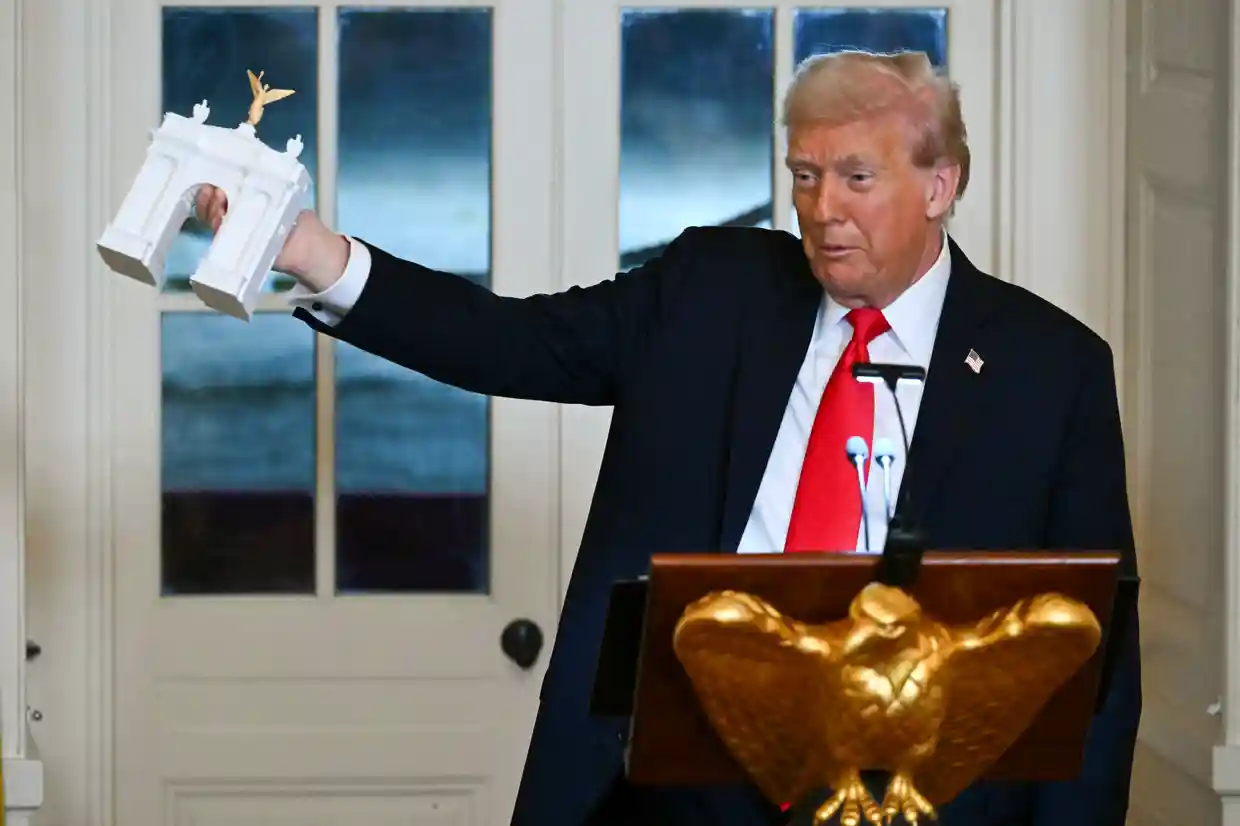
While Democrats were outlining their plans for the incoming Congress, Trump continued to draw attention to construction and renovation projects in Washington. His public appearances after the election included discussions of the White House ballroom, the Lincoln Memorial Reflecting Pool and a proposed triumphal arch.
On Monday, the day before the midterm elections, Trump held a press conference to discuss upgrades to the Lincoln Memorial Reflecting Pool. The project had attracted criticism over its cost and execution, with administration officials previously blaming vandalism for problems associated with the work.
A Trump-appointed US attorney later determined that the reported failures were connected to poor workmanship rather than the explanation initially offered by administration officials.
On Wednesday, after Republicans had lost control of Congress, Trump held another press conference to discuss the renovation of the White House ballroom. He spent a substantial part of the appearance describing the project before responding to questions about the Republican election losses.
On Thursday, he held a press conference in the Oval Office to sign a proclamation intended to prevent future presidents from changing the design of his renovated Oval Office and Cabinet Room.
“I just thought it was very important that nobody be allowed to come and take it down and try and do something with it,” Trump said.
The focus on construction projects came as Republicans were dealing with the political consequences of losing both chambers of Congress. The contrast between the President’s public appearances and the incoming Democratic leadership’s plans became another feature of the post-election debate.
Federal Judge Temporarily Blocks Trump’s Proposed Triumphal Arch
Trump also faced a legal setback involving his proposed triumphal arch in Washington. A federal judge blocked construction work from beginning for 14 days, temporarily preventing the project from moving forward after a commission dominated by Trump allies had approved it.
The temporary order does not necessarily determine the final outcome of the dispute. It pauses the start of construction while the legal issues are considered, leaving the project’s longer-term status subject to further proceedings.
The proposed arch is among the President’s high-profile plans to reshape parts of the capital. Its approval and the subsequent court intervention have raised questions about the process used to authorise major construction projects and the legal limits governing changes to public spaces.
The timing of the ruling added to an already difficult week for the administration, which was dealing with the election results and the prospect of increased congressional scrutiny.
What Schumer’s Warning Means for Trump’s Remaining Presidency
Schumer’s comments suggest that Democrats intend to take a confrontational approach to several parts of Trump’s agenda when the new Congress begins in January 2027. Supreme Court nominations, lower-court appointments, Cabinet confirmations, investigations and legislation are all likely to become areas of disagreement.
The Senate majority gives Democrats a significant role in deciding whether presidential nominees receive confirmation. That authority could become especially important if a Supreme Court vacancy emerges before the next presidential election.
At the same time, Democrats will have to balance oversight with legislative responsibilities. Voters who supported the party’s candidates on promises to address healthcare and living costs will expect more than investigations and political disputes.
Trump, meanwhile, retains the presidency and the power to veto legislation. This means that control of Congress will not automatically allow Democrats to reverse every policy or implement their entire programme.
The coming two years could therefore involve a mixture of congressional investigations, confirmation battles, legislative negotiations and presidential vetoes. The outcome will depend on how both parties use their institutional powers and whether they can reach agreements on selected issues.
For now, Schumer’s message is clear: Democrats intend to use their incoming Senate majority to scrutinise Trump’s choices, particularly appointments to the federal judiciary. Whether that leads to a prolonged confrontation over the Supreme Court will depend on future vacancies and the nominees the President chooses to put forward.
For breaking news and live news updates, like us on Facebook or follow us on Twitter and Instagram. Read more on Latest World on thefoxdaily.com.






COMMENTS 0