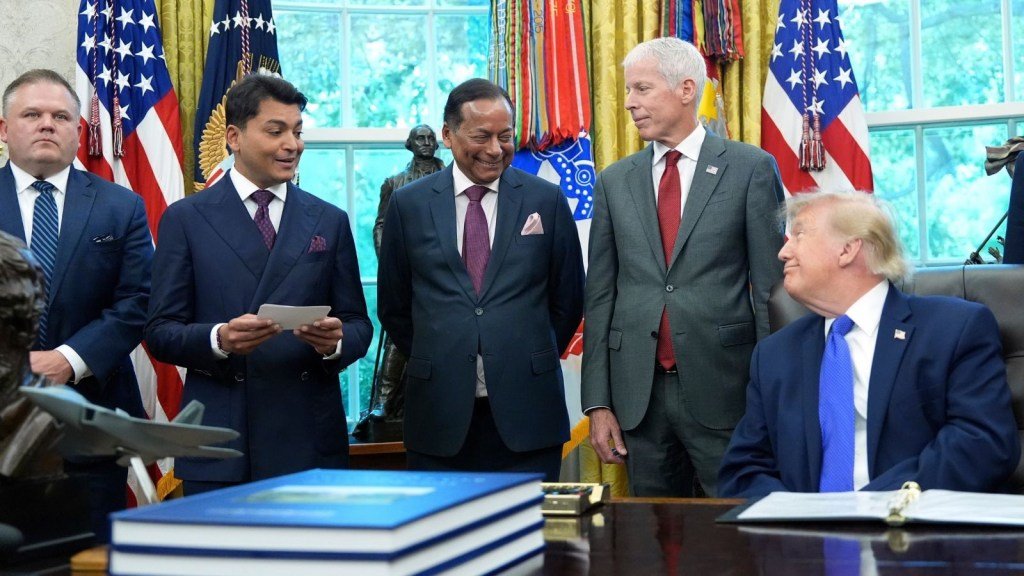
US President Donald Trump has announced an $18 billion Investment by Essar-backed Mesabi Metallics to build a fully integrated steel business in the United States, linking an iron ore mine in Minnesota with a planned steel manufacturing complex in Iowa.
The announcement was made at the White House on September 28 in the presence of Essar Group Vice Chairman and founder Ravi Ruia and Mesabi Metallics Chairman Rewant Ruia. The project combines approximately $3 billion already invested in Minnesota with a proposed $15 billion steel complex in Iowa.
The proposed development is designed to create a domestic mine-to-mill supply chain in which iron ore is extracted in Minnesota, processed into material suitable for steelmaking and then converted into finished steel in Iowa. Mesabi Metallics says the project would represent one of the largest single-location investments in an integrated steel complex in US history.
The announcement also places India‘s Essar Group at the centre of a major expansion in American steel and mining. The company plans to use iron ore from its newly opened Minnesota mine as feedstock for the Iowa facility, allowing the two operations to function as parts of one integrated production network.
$18 billion project connects Minnesota mine to Iowa steel complex
The investment is divided into two major components. Mesabi Metallics has already invested billions of dollars in its iron ore operations in Nashwauk, Minnesota, while the company plans to commit another $15 billion to the proposed steel complex in Iowa.
The Minnesota operation sits on the Mesabi Iron Range, one of the country’s historic iron ore-producing regions. The mine is expected to supply the raw material needed for the Iowa steelmaking operation once the new complex begins production.
The project is therefore different from a conventional steel plant that relies primarily on purchased or imported raw materials. Mesabi Metallics is attempting to control the chain from extraction of iron ore to production of finished steel.
The company says the approach will provide a domestic source of iron ore and steel for industries that depend on reliable supplies of critical materials, including Infrastructure, shipbuilding, defence manufacturing and other industrial sectors.
The White House has said the Iowa facility is expected to begin producing steel in 2030. Initial production capacity is expected to be around 7.5 million tons annually, with the potential to rise to approximately 10 million tons as the facility reaches full build-out.
Essar expands its US industrial footprint
For Essar Group, the project represents a major expansion of its industrial presence in the United States.
Essar is an Indian multinational conglomerate with interests across several sectors, while Mesabi Metallics is its US-based steel and mining business. The Minnesota mine has already become a major investment project for the group, and the proposed Iowa complex would extend that investment downstream into steel production.
Ravi Ruia and Rewant Ruia were present at the White House announcement alongside senior US government officials and Iowa political leaders.
The project also demonstrates how foreign-owned companies can participate in the expansion of US domestic manufacturing while building operations that rely heavily on American raw materials, workers, energy and industrial infrastructure.
Rather than exporting steel into the United States, Essar-backed Mesabi Metallics intends to establish a production chain inside the country, beginning with iron ore extraction in Minnesota and ending with steel manufacturing in Iowa.
Minnesota mine is the foundation of the supply chain
The first major part of the integrated operation is Mesabi Metallics’ mine in Nashwauk, Minnesota.
Nearly $3 billion has been invested in the mining and pelletising project so far. The company recently described the operation as the first new iron ore mine opened in the United States in 50 years, giving the project significance beyond its role as a supplier for the planned Iowa plant.
The mine is expected to produce a specialised iron ore pellet called Patriot Pellet. The product is designed as a direct-reduction-grade pellet for use in modern electric arc furnace steelmaking.
That specification is important because the Iowa facility is planned around direct-reduced iron and electric arc furnace technologies rather than the conventional blast furnace route used by many traditional integrated steel plants.
The Minnesota operation currently employs more than 200 full-time workers, while more than 1,500 construction workers are involved in building out the mine and related infrastructure. Once the mine is fully operational, the company expects it to employ approximately 350 full-time workers.
The ore produced in Minnesota is intended to move directly into the next stage of the production chain, making the mine a critical component of the proposed Iowa steel operation.
$15 billion Iowa steel complex
The largest portion of the new investment will go toward the proposed steel complex in Iowa.
Mesabi Metallics plans to invest approximately $15 billion in the facility, which is expected to become one of the largest steel manufacturing projects in the United States.
The construction phase is expected to generate thousands of jobs. Company plans cited in the announcement indicate that the project could create more than 8,000 construction jobs, while other estimates put the expected construction workforce at around 6,000 depending on the stage and scope of development.
Once operational, the complex is expected to employ at least 1,750 full-time workers.
The employment impact could extend beyond the facility itself. Large industrial projects typically require contractors, equipment suppliers, transportation providers, engineering companies and other businesses during construction and operation.
Mesabi Metallics says it intends to use local suppliers and businesses as part of the development, potentially extending the economic impact beyond the steel plant’s direct workforce.
How the mine-to-mill steelmaking process will work
The planned operation is built around a sequence that connects mining and steelmaking more closely than many existing US production models.
Iron ore will first be extracted at the Mesabi Metallics mine in Minnesota and converted into pellets suitable for direct reduction. Those pellets will then supply the Iowa complex, where the iron will be transformed into a form that can be used in electric arc furnaces.
The direct reduction process removes oxygen from iron ore without melting the ore completely. The resulting material, known as direct-reduced iron or DRI, is solid metallic iron that can be used as a feedstock for steelmaking.
At the Iowa facility, the DRI will be combined with scrap steel and fed into electric arc furnaces. Electrical energy is used to melt the metallic material, after which the molten steel can be processed into products for industrial and commercial applications.
This configuration allows Mesabi Metallics to combine newly produced iron with recycled steel rather than relying exclusively on scrap or traditional blast furnace production.
Why direct-reduced iron and electric arc furnaces matter
The planned steel complex is designed around technologies that differ from the traditional coal-intensive blast furnace route.
In a conventional blast furnace, iron ore is processed at very high temperatures using coke and other carbon-intensive inputs to produce molten iron. The molten iron is then converted into steel.
Direct reduction operates differently. Oxygen is removed from iron ore at temperatures below its melting point, producing solid iron that can subsequently be melted in an electric arc furnace.
Electric arc furnaces can also make extensive use of scrap steel. In Mesabi Metallics’ proposed configuration, the furnaces will use a combination of hot DRI and scrap.
The company says this combination can reduce energy consumption and emissions compared with conventional coal-fired blast furnace production. The actual environmental performance of the finished facility, however, will depend on factors including the energy sources used, operating efficiency, raw materials and final production configuration.
The technology also gives the company a way to connect newly mined iron ore with a steelmaking system that can incorporate recycled material.
Building a domestic US steel supply chain
One of the project’s central objectives is to create a domestic supply chain that begins with US-mined iron ore and ends with steel produced in the United States.
The US steel industry currently includes several different production models. Traditional integrated steel mills use iron ore as a major raw material, while electric arc furnace producers rely heavily on recycled scrap steel. Some electric arc furnace operations can also use alternative iron inputs such as DRI or hot-briquetted iron.
Mesabi Metallics’ planned model combines these elements by producing iron ore itself and then supplying that material to its own electric arc furnace operation.
The company argues that the integrated model can provide greater control over raw material supplies while reducing dependence on imported iron units.
That has implications for industries that consume large quantities of steel. Construction, infrastructure projects, transportation, shipbuilding, energy systems and defence manufacturing all require dependable access to steel and related raw materials.
Trump administration highlights domestic manufacturing
The White House has presented the project as part of a broader effort to expand US manufacturing and domestic steel production.
Trump has placed steel tariffs at the centre of his trade and industrial policy, arguing that higher barriers on imported steel can encourage companies to invest in domestic production.
During the announcement, Trump linked the new investment to his administration’s approach toward imported steel and the expansion of US manufacturing capacity.
The project also comes with a political dimension because the announcement was made ahead of the November midterm elections. Iowa has competitive congressional contests, and the planned steel complex is expected to have a significant economic impact in the state.
That political context does not change the structure of the investment itself, but it helps explain why the White House has placed considerable emphasis on the project’s job-creation and domestic-manufacturing implications.
Iowa to become the downstream manufacturing hub
The planned Iowa complex will represent the downstream end of the Mesabi Metallics supply chain.
While Minnesota provides the iron ore, Iowa will host the processes that transform the material into steel. The facility is planned for eastern Iowa and is expected to begin production around 2030.
Once fully developed, the complex is expected to have annual steelmaking capacity of approximately 10 million tons. The scale would place it among the largest steel facilities in the United States.
The facility’s location also means that transportation infrastructure will play an important role. Moving iron ore and finished steel requires rail networks, roads, energy infrastructure and connections to industrial customers.
The integrated model is intended to reduce the number of stages between raw material extraction and steel production, while keeping those stages within the United States.
Thousands of jobs expected across two states
The project is expected to create employment in both Minnesota and Iowa.
Construction activity at the Minnesota mine has already created a large temporary workforce, while the planned Iowa complex is expected to require thousands of construction workers during its development.
Once both facilities are operational, the companies expect hundreds of permanent jobs in Minnesota and at least 1,750 at the Iowa steel complex.
The wider economic effect could be larger because major industrial facilities require services from contractors, equipment manufacturers, transportation companies, maintenance providers and other suppliers.
For communities in the regions involved, the timing and scale of the project could therefore influence local demand for housing, infrastructure, transportation and other services during the construction period.
A new model for American steel production
The proposed Essar-backed investment combines several priorities that have become increasingly important in the US steel industry: domestic raw materials, large-scale steel production, electric arc furnace technology and greater integration between mining and manufacturing.
The Minnesota mine provides the iron ore. The planned Iowa facility would convert that material into steel using DRI and EAF technologies, while scrap steel would also be incorporated into the production process.
The result would be a supply chain stretching across two states but remaining within the United States from mining through steel production.
Whether the project ultimately reaches its full planned scale will depend on construction, financing, infrastructure, permitting, market conditions and the execution of the development plan. The company is targeting steel production beginning around 2030.
For Essar, the investment represents a major expansion of its American operations. For the US steel industry, it introduces a large new production project built around an integrated domestic supply chain and newer steelmaking technologies.
The White House announcement has consequently put the proposed Iowa complex at the centre of the latest push to expand American steelmaking capacity, while connecting it directly to a new generation of iron ore production in Minnesota.
If completed as planned, the project would create a continuous domestic chain in which iron ore is mined in Minnesota, processed for direct reduction and transported to Iowa, where it is converted into steel for American industrial markets. That mine-to-mill structure is the defining feature of the $18 billion investment announced by Trump and Essar-backed Mesabi Metallics.
For breaking news and live news updates, like us on Facebook or follow us on Twitter and Instagram. Read more on Latest India on thefoxdaily.com.






COMMENTS 0