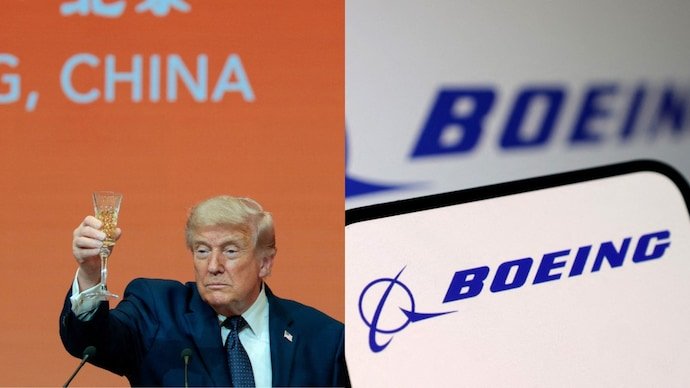
- Why This Boeing-China Deal Matters So Much
- The Deal Could Become the Largest in Aviation History
- Boeing Needs a Major Win
- General Electric Could Also Benefit
- China’s Aviation Market Is Too Big to Ignore
- The Political Timing Is No Coincidence
- But Many Questions Still Remain
- The Airbus Factor Still Looms Large
- The Deal Reflects a Broader Economic Reality
- Could This Signal a Wider US-China Economic Reset?
- Conclusion: Boeing’s China Return Could Reshape the Aviation Landscape
US President Donald Trump announced on Friday that China has agreed to purchase 200 Boeing aircraft, while also hinting that the order could eventually expand to as many as 750 planes if negotiations progress successfully.
The announcement immediately reignited global attention on the fragile but increasingly important economic reset between Washington and Beijing.
If finalized, the agreement would represent Boeing’s first major breakthrough in the Chinese aviation market in nearly a decade a market the American aerospace giant had effectively been locked out of amid years of trade wars, political tensions and escalating strategic rivalry between the world’s two largest economies.
“It includes approximately 200 planes and a promise of up to 750 if they do a good job,” Trump told reporters while discussing ongoing talks during his Beijing visit.
Although many details remain unclear including the exact aircraft models involved, delivery schedules and final contractual terms the scale of the proposed deal could reshape the global aviation industry.
Why This Boeing-China Deal Matters So Much
The significance of the potential agreement goes far beyond aircraft sales.
For Boeing, China represents one of the most critical long-term aviation markets in the world.
China’s expanding middle class, rapidly growing domestic travel demand and aggressive airport expansion plans make it central to the future of global commercial aviation.
However, geopolitical tensions severely disrupted Boeing’s access to that market over recent years.
The company faced multiple setbacks, including:
- The US-China trade war
- Tariff disputes
- Political friction over Technology and security
- The Boeing 737 MAX crisis
- China’s growing preference for Airbus
As relations deteriorated, Boeing lost substantial ground in one of aviation’s most valuable markets.
That is why Trump’s announcement is being viewed as potentially transformative.
The Deal Could Become the Largest in Aviation History
Before Trump’s latest comments, reports had already suggested discussions involving roughly 500 aircraft were underway ahead of his summit with Chinese President Xi Jinping.
If the order eventually reaches 750 jets, it could become the largest commercial aircraft agreement ever negotiated.
| Potential Deal Scale | Industry Impact |
|---|---|
| 200 aircraft | Major Boeing return to China market |
| 500 aircraft | One of largest aviation orders ever |
| 750 aircraft | Potentially historic global aviation deal |
The aviation industry closely watches large aircraft deals because they often reflect broader geopolitical and economic relationships between nations.
This proposed agreement therefore carries enormous symbolic value in addition to its commercial importance.
Boeing Needs a Major Win
For Boeing, the timing could hardly be more important.
The company has spent recent years navigating one of the most difficult periods in its History.
Challenges have included:
- The prolonged fallout from the 737 MAX crisis
- Manufacturing and quality-control scrutiny
- Supply chain disruptions
- Regulatory pressure
- Intense competition from Airbus
- Weak access to Chinese customers
A large-scale Chinese order would provide not only financial relief, but also a major confidence boost for investors and suppliers.
It would also help Boeing stabilize long-term production planning at a time when global airline demand continues recovering strongly.
Even the possibility of a deal immediately influenced market sentiment.
Boeing shares initially fell after Trump first referenced a 200-aircraft order because analysts had expected a larger figure closer to 500 jets. However, Trump’s later suggestion that the agreement could expand significantly revived speculation around the final scale of negotiations.
General Electric Could Also Benefit
Trump noted that the aircraft would include engines manufactured by General Electric.
That detail is important because major aviation deals create ripple effects across an enormous industrial ecosystem.
A large Boeing-China agreement would likely benefit:
- Aircraft engine manufacturers
- Component suppliers
- Aerospace engineering firms
- Logistics companies
- Maintenance providers
- US manufacturing jobs
GE Aerospace CEO Larry Culp reportedly joined Trump’s delegation in China alongside Boeing CEO Kelly Ortberg, underscoring how commercially important the talks have become.
China’s Aviation Market Is Too Big to Ignore
China is expected to become one of the world’s largest aviation markets over the next two decades.
Rapid urbanization, rising incomes and expanding regional connectivity continue driving enormous demand for commercial aircraft.
Chinese airlines are expected to require thousands of new planes in coming years to support:
- Domestic passenger growth
- International route expansion
- Cargo demand
- Tourism recovery
- Fleet modernization
That demand creates enormous leverage for Beijing in global aviation negotiations.
Both Boeing and Airbus compete aggressively for access to Chinese carriers because winning long-term fleet contracts can shape market share for decades.
The Political Timing Is No Coincidence
The announcement came during a broader diplomatic thaw between Washington and Beijing.
Trump’s visit to China has been heavily choreographed around restoring warmer public relations after years of hostility involving tariffs, technology restrictions and geopolitical tensions.
The Boeing discussions therefore fit into a larger strategic effort by both sides to demonstrate economic cooperation despite unresolved disagreements.
For Trump, the deal would also offer an important political narrative.
He has repeatedly argued that his administration’s tough trade strategy would eventually force China into more favorable economic arrangements for the United States.
A large Boeing order allows Trump to present himself as securing major industrial wins for American manufacturing and exports.
But Many Questions Still Remain
Despite the optimism, several uncertainties remain unresolved.
Key unanswered questions include:
- Which Boeing aircraft models are included?
- Will the order involve 737 MAX jets, widebody aircraft or both?
- What are the financing arrangements?
- When would deliveries begin?
- Are Chinese airlines or state entities placing the orders?
- How binding are the current commitments?
Large aviation agreements often involve years of phased negotiations, regulatory approvals and delivery scheduling.
That means the headline figures could still evolve substantially.
The Airbus Factor Still Looms Large
Even if Boeing secures a major order, competition with Airbus remains intense.
During the years Boeing struggled with regulatory and geopolitical setbacks, Airbus strengthened its position in China significantly.
The European aerospace giant expanded local partnerships and manufacturing cooperation while Boeing’s access became more limited.
China has also increasingly supported development of its domestic aviation ambitions, including the COMAC passenger aircraft program.
That means Boeing is not simply re-entering an empty market it is attempting to reclaim ground lost during years of turbulence.
The Deal Reflects a Broader Economic Reality
One of the most interesting aspects of the proposed agreement is that it highlights how deeply interconnected the US and Chinese economies remain despite political tensions.
Both countries continue competing strategically in areas such as:
- Technology
- Artificial intelligence
- Military influence
- Semiconductors
- Global trade rules
Yet at the same time, massive commercial cooperation remains economically beneficial for both sides.
China needs aircraft.
Boeing needs customers.
And both governments understand the symbolic and economic value of maintaining at least some level of stable commercial engagement.
Could This Signal a Wider US-China Economic Reset?
Analysts are increasingly debating whether the Boeing discussions reflect a broader shift in US-China relations.
While major structural disputes remain unresolved, both Washington and Beijing appear eager to stabilize economic ties after years of confrontation.
Several factors may be encouraging that shift:
- Global economic uncertainty
- Supply chain pressures
- Inflation concerns
- Slowing growth in China
- Manufacturing pressures in the US
- Financial market sensitivity
Large commercial agreements like the Boeing order can therefore serve dual purposes:
- Economic cooperation
- Diplomatic signaling
The aviation deal may ultimately become as politically important as it is commercially valuable.
Conclusion: Boeing’s China Return Could Reshape the Aviation Landscape
Trump’s announcement that China may buy between 200 and 750 Boeing aircraft has instantly become one of the most consequential developments in the global aerospace industry.
If finalized, the agreement would mark Boeing’s most significant return to China in years and potentially become the largest aviation order in history.
Beyond the numbers, however, the proposed deal reflects something larger: the complicated reality that the United States and China remain strategic rivals deeply dependent on economic cooperation.
For Boeing, the stakes are enormous.
For Trump, the deal represents a potential political and economic victory.
For China, it provides leverage, access to advanced aircraft and a chance to stabilize relations with Washington without abandoning broader strategic ambitions.
And for the global aviation industry, the agreement could signal the beginning of a major new chapter after years of geopolitical turbulence.
For breaking news and live news updates, like us on Facebook or follow us on Twitter and Instagram. Read more on Latest World on thefoxdaily.com.



COMMENTS 0