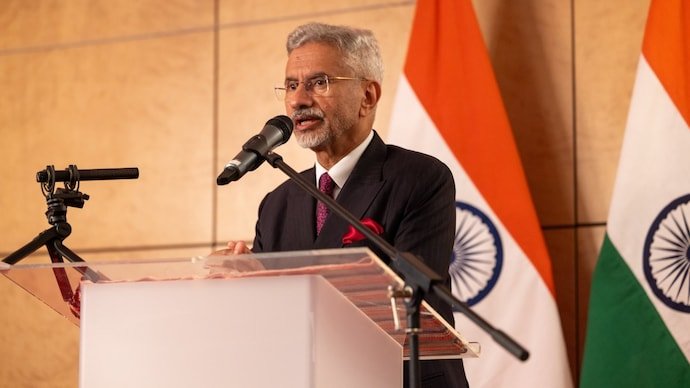
External Affairs Minister S Jaishankar said a near-final India-US trade agreement could help place bilateral relations on a better track, while acknowledging that changing US tariff policies and the ongoing Section 301 process have complicated the timing of the deal.
Jaishankar said India and the United States had reached a stage where there was broadly an understanding on the trade agreement, but completing the pact required patience because of the complexity of the negotiations and changes in the US trade policy environment.
Speaking at a special conversation hosted by the Asia Society in New York as the high-level week of the 81st session of the United Nations General Assembly concluded, Jaishankar said the relationship had experienced difficulties over the past year, particularly around tariffs and trade.
He was responding to questions from moderator Daniel Russel, a former American diplomat and distinguished fellow at the Asia Society Policy Institute, about the state of India-US Relations and what could help move the partnership onto a better trajectory.
Jaishankar pointed to the trade negotiations as one of the issues that had created friction, while also stressing that the economic structures of India and the US are substantially different.
Jaishankar Says Trade Agreement Is Far Advanced
Jaishankar said the two sides had reached a point where there was “more or less an understanding on the trade agreement”. However, he stopped short of suggesting that the deal could be concluded immediately.
According to the minister, the negotiations had demonstrated that expectations of a quick agreement had not fully matched the complexity of the issues involved.
“A trade negotiation required a certain amount of patience and detailing to see it through,” Jaishankar said.
He explained that India’s economic structure had to be taken into account during negotiations because the country has a large number of small producers, small agricultural producers and small factories.
“Bear in mind, India is a society of small producers, small agriculture producers, small factories,” he said, pointing also to the significant per-capita income gap between India and the United States and differences in the nature of production and society.
Those structural differences can make trade negotiations more complicated than simply agreeing on headline tariff rates. Market access, competition, domestic producers and the ability of different sectors to adjust to greater competition can all influence the terms under discussion.
Why the Timing of the India-US Trade Deal Is Complicated
The central question now, according to Jaishankar, is not simply whether the agreement is close to completion but when it should formally be closed.
He pointed to changes on the American side, particularly the new Section 301 process, as an issue that has complicated the timing.
“The 301 process is still in the works, it’s still unfolding. So the issue for us is at what point do you close out an agreement which is very, very far advanced,” Jaishankar said.
Section 301 of the US Trade Act provides Washington with a mechanism to investigate and respond to certain trade practices and policies involving foreign countries. The process has become relevant to the India-US trade discussions because of recent US action affecting Indian imports.
Jaishankar’s comments indicate that India wants greater clarity on how the changing US trade framework will interact with the agreement before the pact is formally concluded.
US Tariff Changes Have Added Another Layer
India and the US announced in February that they had finalised the framework for the first phase of their bilateral trade agreement. Subsequent changes in the American tariff landscape, however, led to further negotiations.
The US Supreme Court had earlier struck down reciprocal tariffs imposed by President Donald Trump under emergency powers. Washington subsequently adopted a different tariff framework.
In July, the US imposed an additional 10 per cent tariff on imports from India under Section 301 following a probe concerning India’s measures relating to goods produced using forced labour.
The changes complicated negotiations that had already involved difficult questions about market access and tariffs. Instead of operating against a fixed trade-policy backdrop, Indian and American negotiators have had to work while US tariff policy itself has been changing.
That environment helps explain Jaishankar’s emphasis on timing. An agreement that is substantially negotiated may still require adjustments or additional clarity if the policy framework surrounding it changes before the final signing or implementation.
Piyush Goyal Says the Pact Is Ready
Commerce and Industry Minister Piyush Goyal has offered a more definitive assessment of the state of the negotiations.
Last week, Goyal described the trade pact as “done and dusted” and said it would be executed once the US provides India with what he described as the right competitive advantage compared with other countries competing in the American market.
Goyal’s comments suggest that the remaining questions are concentrated around the conditions under which the agreement will be implemented rather than the broad structure of the negotiations.
He is scheduled to visit the United States from September 29 to October 5. During the visit, he is due to attend a G20 meeting in Milwaukee and hold discussions with US Trade Representative Jamieson Greer on advancing the trade negotiations.
His meetings could provide another opportunity for the two sides to address the outstanding issues surrounding tariffs and market access.
Why India Wants Competitive Access to the US Market
For India, access to the American market is a major consideration in any trade agreement with Washington.
The United States is an important destination for Indian goods and services, while Indian companies also compete with producers from other countries that have their own trade arrangements or tariff advantages in the American market.
Goyal’s emphasis on a “competitive advantage” reflects the concern that an agreement should not leave Indian exporters at a disadvantage compared with competitors from other economies.
For Indian manufacturers and smaller producers, tariff changes can have a direct impact on the final price of products in the US market. A reduction in barriers can improve competitiveness, while additional tariffs can make exports more expensive relative to competing goods.
At the same time, India’s negotiating position has to account for domestic producers who may face greater competition from imported American goods if market access is expanded.
Small Producers Are a Key Concern for India
Jaishankar’s remarks about India’s small producers highlight one of the fundamental differences between the two economies.
India has a large agricultural and manufacturing base made up of small and medium-sized producers. Changes in tariffs and import competition can affect these businesses differently from large corporations that may have greater financial resources, technology and access to international markets.
That makes trade negotiations particularly sensitive for India. A deal needs to address export opportunities while also considering sectors where increased imports could create adjustment pressures.
Jaishankar’s emphasis on patience and detailed negotiations reflects this complexity. A rapid agreement may be politically attractive, but the underlying terms can have long-term consequences for businesses and consumers on both sides.
Jaishankar Says Trade Friction Created “Bumps” in Relations
Jaishankar acknowledged that the length and difficulty of the trade negotiations had affected the wider India-US relationship.
“The period that it took to reach it, that did create bumps last year for the relationship,” he said.
He nevertheless suggested that completing the agreement could help improve the broader relationship.
“Presumably, if that agreement is closed out, that would be one point which would contribute to a better relationship,” he added.
The comment reflects the importance both governments place on economic ties within the wider bilateral partnership. Trade disagreements can extend beyond individual tariff lines because they can influence business confidence, investment decisions and perceptions of the overall relationship.
A completed agreement could provide greater clarity for companies planning cross-border trade and investment, although the extent of its impact would depend on the final terms and how they are implemented.
US Domestic Politics Also Affect Bilateral Ties
Jaishankar also pointed to developments inside the United States as an increasingly important factor in India-US relations.
He highlighted the changing Political Debate around mobility, an issue that has implications for international workers, students and skilled professionals.
“For many years mobility was seen as an economic gain. Now, today the economics of mobility and the Politics of mobility are at odds with each other,” he said.
The comment points to the broader challenge of managing bilateral relations when domestic political debates influence economic and foreign-policy decisions.
India and the US have extensive people-to-people and professional links, including significant movement of Indian students, technology workers and professionals to the American Economy. Policies concerning immigration and mobility can therefore affect the relationship even when they are driven primarily by domestic political considerations in the US.
Public Opinion Is Playing a Bigger Role
Jaishankar also argued that foreign policy is no longer shaped only by governments, presidents, ministers and diplomats.
The expansion of social media has changed how political debates develop and how citizens respond to international issues. In democratic societies, public opinion can influence the political space available for governments to negotiate and compromise.
That makes bilateral diplomacy more complicated because agreements that may appear technical at the negotiating table can quickly become subjects of public debate.
Trade agreements are particularly exposed to this dynamic. Tariffs, imports, employment and market access can directly affect businesses and consumers, while immigration and mobility policies can become politically sensitive topics.
For India and the US, managing these domestic pressures will remain part of maintaining a stable economic relationship.
India-US Relations Face Multiple Unresolved Issues
The trade agreement is only one component of the wider India-US relationship. Jaishankar’s comments suggest that progress on unresolved economic and policy issues will be important if the two countries want to move beyond recent tensions.
The changing US tariff framework has made the trade negotiations more complicated, while questions surrounding Section 301 remain part of the current discussion.
At the same time, the two governments have broader economic and strategic interests that extend beyond tariffs. The relationship includes investment, technology, supply chains, mobility and cooperation across several areas.
For India, maintaining access to the US market while protecting the interests of domestic producers is an important part of the trade negotiations. For the US, the terms of market access and treatment of American goods and businesses remain central considerations.
Those interests do not always align, which is why the final stages of negotiations can take longer than expected even when the broad contours of an agreement are already understood.
What Jaishankar’s Comments Mean for the Trade Talks
Jaishankar’s assessment suggests that India considers the proposed trade agreement to be substantially advanced but not yet ready to be treated as a completed arrangement.
The main complication is the changing US policy environment, particularly the ongoing Section 301 process and recent changes to the tariff framework.
Goyal’s upcoming US visit could provide an opportunity for further discussions with American trade officials. The focus will likely remain on resolving outstanding questions and determining the conditions under which the agreement can be formally executed.
The difference between an agreement being technically close and being formally concluded is important. Trade deals require detailed decisions covering tariffs, market access, implementation schedules and other commitments. Those details can determine how the agreement affects exporters, importers, manufacturers, farmers and consumers.
Jaishankar Wants India-US Ties on an Upward Trajectory
Despite acknowledging the difficulties of the past year, Jaishankar said India expected the relationship with the United States to move forward.
He said India would “certainly hope for and expect the relationship to move on an upward trajectory”, while stressing that progress on unresolved issues would be necessary to build a better relationship.
His comments place the trade agreement within the larger context of bilateral ties rather than treating it as an isolated economic negotiation. A completed trade pact could reduce one source of friction, but the broader relationship will continue to be influenced by tariff policy, mobility, domestic politics and public opinion.
For now, the two countries remain engaged in negotiations, with India seeking clarity on the changing US trade environment and the United States continuing to assess its own tariff and market-access priorities.
The trade agreement is therefore at an advanced stage, but Jaishankar’s remarks make clear that the final step still depends on resolving the remaining differences and determining when the evolving US policy framework provides sufficient clarity to close the deal.
For breaking news and live news updates, like us on Facebook or follow us on Twitter and Instagram. Read more on Latest World on thefoxdaily.com.




COMMENTS 0