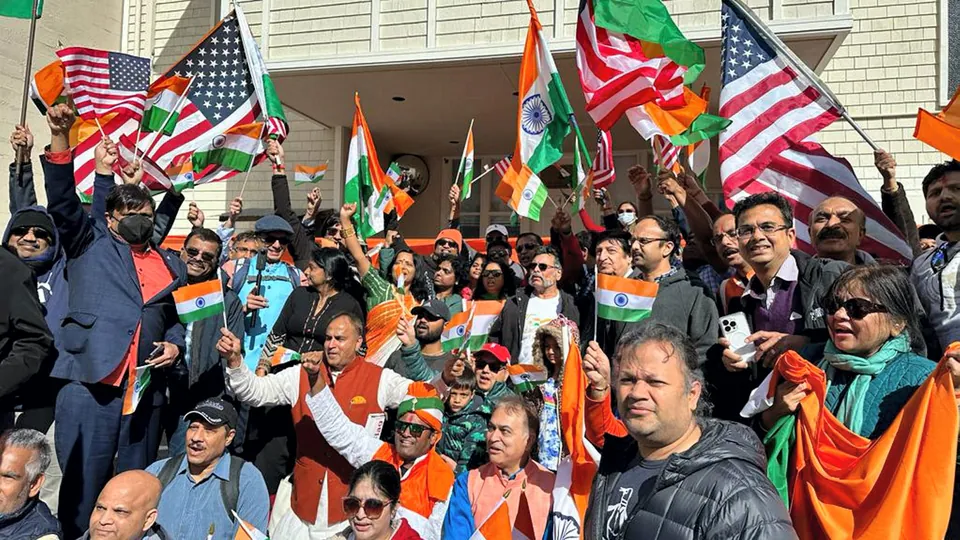
American Public Opinion of India has shown a modest recovery after declining for three consecutive years, but attitudes towards the country are becoming increasingly divided along political lines, according to a new survey by the Chicago Council on Global Affairs and Observer Research Foundation America (ORF America).
The 2026 Chicago Council Survey found that Americans gave India an average rating of 51 on a 0-to-100 feeling thermometer, up from 47 in October 2025. Although the improvement suggests that the sharp decline in India’s public image may have eased, the latest findings reveal a growing gap between Democrats, Independents and Republicans.
Democrats gave India an average rating of 55, while Independents rated it 52. Republicans, meanwhile, gave the country a lower score of 47. The findings indicate that views of India are increasingly influenced by political affiliation, particularly as disagreements over trade, immigration and India’s relationship with Russia shape discussions about US Foreign Policy.
The survey also found that Americans generally remain open to closer cooperation with India in areas such as trade, technology and defence. However, a substantial share of respondents said they did not know enough about the relationship to express an opinion, suggesting that public understanding of the strategic partnership remains limited.
American Views of India Recover to 51 After Falling to a Record Low
The Chicago Council’s 2026 survey recorded an average American rating of 51 for India on its feeling thermometer, where zero represents the coldest possible opinion and 100 represents the warmest. The score was four points higher than the 47 recorded in October 2025.
The 2025 rating marked the lowest assessment of India recorded in the Council’s polling since 2008. It followed several years during which American perceptions of India had generally improved, reflecting the expansion of bilateral engagement across defence, trade, technology and international affairs.
The latest increase is relatively small, but it indicates that public sentiment has moved away from last year’s low. The survey does not establish a single reason for the improvement, and the overall rating should not be interpreted as evidence that all sections of the American public have become more favourable towards India.
Indeed, the political breakdown points in a different direction. While Democrats and Independents continue to rate India above the midpoint of the scale, Republicans remain below it. The gap suggests that the recovery in the national average is taking place alongside a more pronounced partisan divide.
Other US Surveys Also Show Unfavourable Sentiment Towards India
The Chicago Council findings come against the backdrop of other surveys that have recorded a decline in American favourability towards India. A Pew Research Center survey published in August 2026 found that 50% of Americans held an unfavourable view of India, compared with 45% who expressed a favourable opinion.
Pew’s findings showed that negative views were particularly common among younger respondents. Among Americans aged 18 to 29, 56% held an unfavourable opinion of India, while 42% viewed the country favourably. The survey also found that Republicans and Republican-leaning respondents were more likely to view India unfavourably than Democrats and Democratic-leaning respondents.
The Pew results use a different question and measurement system from the Chicago Council’s feeling thermometer. The two surveys therefore cannot be compared as if they were measuring exactly the same thing. However, both point to a more complicated picture of American attitudes towards India than the generally positive trend recorded in earlier years.
The Chicago Council report also places its findings alongside Gallup polling, which recorded India’s favourability at 61% in 2026, down from 77% in 2022. Taken together, the surveys suggest that India’s image in the United States has faced pressure even as the two governments continue to engage on major strategic and economic issues.
Younger Americans Show a Sharper Decline in Positive Views of India
Age has emerged as another important factor in how Americans perceive India. The Chicago Council survey found that older respondents generally viewed the country more positively than younger adults.
Americans aged 60 and above gave India an average rating of 54 on the 100-point scale. Their assessment was broadly similar to the 55 recorded among the same age group in 2022, indicating that older Americans’ views have remained relatively stable over the period.
The picture among younger respondents was different. Americans aged 18 to 29 rated India at 47 in 2026, down from 55 in 2022. The eight-point decline represents a notable shift in attitudes among younger adults.
The survey identifies the change but does not establish why younger Americans have become less positive towards India. It would therefore be premature to attribute the decline to a particular political development, diplomatic disagreement or cultural issue without additional research.
Pew Research Center’s separate findings also point to an age gap. Its 2026 survey found that 56% of Americans aged 18 to 29 viewed India unfavourably, compared with 43% of those aged 65 and above. Among the oldest respondents, 50% expressed a favourable opinion of India.
The findings from both organisations suggest that younger Americans are an important group to watch when assessing the future of India’s public image in the United States. Their views may influence how the next generation understands the relationship between the two countries, although the surveys do not establish how those attitudes will develop over time.
Fewer Americans Now Describe India as a US Ally
The Chicago Council survey also examined how Americans understand India’s position in relation to the United States. The findings show that fewer respondents now consider India an American ally than did so in earlier years.
In 2021, 21% of Americans described India as an ally of the United States. By 2026, that share had fallen to 10%. The decline suggests that the public’s understanding of the bilateral relationship has changed, even though cooperation between the two countries continues across several strategic areas.
However, a much larger share of respondents still recognises India as an important partner. Around 41% described India as a necessary partner with which the United States must cooperate strategically.
Another 37% said they did not know how to characterise the relationship. This is a significant finding because it indicates that many Americans may be unfamiliar with the extent of cooperation between Washington and New Delhi or the differences that continue to affect their partnership.
Only a small proportion of respondents viewed India as a rival or adversary. The overall picture is therefore not one of widespread hostility towards India, but rather a relationship that many Americans see as strategically relevant without necessarily describing it as a formal alliance.
Why the Democratic-Republican Divide Matters
One of the most notable findings is the growing difference between Democrats and Republicans in their general assessments of India. The Chicago Council’s historical figures show that the three major political groups once gave India broadly similar ratings.
In 2022, Democrats rated India at 55, Independents also gave it 55, and Republicans recorded 52. All three groups were above the midpoint of the feeling thermometer.
By 2026, the figures had separated. Democrats continued to rate India at 55, while Independents gave it 52. Republicans rated India at 47, placing their average assessment below the midpoint.
The Republican score nevertheless represents a modest improvement from the group’s rating of 43 in 2025, which was an all-time low in the Council’s polling. The latest figures therefore show a slight recovery among Republicans, but the difference between them and other political groups remains pronounced.
The report suggests that political affiliation has become a more important factor in shaping American views of India. The divide is particularly visible in policy questions involving immigration and trade, where Democrats and Republicans often express different preferences.
However, the findings do not mean that all Democrats support closer relations with India or that all Republicans oppose them. Opinions vary depending on the specific policy being considered, and the survey found areas of agreement across party lines, including support for military cooperation.
Republicans Are Less Supportive of High-Skilled Indian Worker Visas
Immigration is one of the clearest areas of partisan disagreement identified in the survey. Respondents were asked whether the United States should increase the number of visas available to high-skilled workers from India.
Among Democrats, 45% supported increasing the number of visas. Support stood at 37% among Independents, while 27% of Republicans favoured the proposal. Within the Republican group, 36% opposed increasing the number of visas, meaning opposition was greater than support.
The figures highlight a difference in how political groups approach skilled immigration from India. Democrats and Independents were more supportive of expanding opportunities for Indian professionals, while Republicans were more likely to oppose an increase.
High-skilled Indian workers have a significant presence in sectors such as technology, engineering, research and healthcare in the United States. Visa programmes, including the H-1B system, have been an important route through which American employers recruit specialised international talent.
Debates surrounding these programmes often involve competing concerns. Supporters argue that access to international talent helps businesses fill specialised positions and maintain competitiveness. Critics raise questions about domestic employment, wage conditions and the design of temporary work visa programmes.
The Chicago Council survey measures public preferences rather than the actual effects of visa policies on employment or wages. Its findings show that the proposal to increase high-skilled visas for Indian workers receives substantially more support among Democrats and Independents than among Republicans.
Republicans More Supportive of Additional Tariffs Over Russian Oil Purchases
India’s continued purchase of Russian oil has become another point of disagreement in discussions about US-India relations. The Chicago Council survey asked Americans whether the United States should impose additional tariffs on Indian goods because of India’s purchases of Russian oil, even if doing so strains bilateral ties.
Republicans were more likely to favour additional tariffs than oppose them. Among Republican respondents, 29% supported the measure, compared with 19% who opposed it. A further 50% said they did not know enough to express an opinion.
Democrats and Independents showed a different pattern. More respondents in both groups opposed additional tariffs than supported them. Opposition stood at 37% among Democrats and 31% among Independents.
The results reflect differences in how political groups approach the use of tariffs as a foreign policy instrument. For some respondents, additional duties may be seen as a way to pressure countries over decisions that conflict with US foreign policy priorities. Others may be more concerned about the economic consequences of trade restrictions and the impact on bilateral relations.
India has maintained its position that its energy purchases are shaped by national interests and energy security requirements. The issue has nevertheless contributed to tensions with Washington, particularly as the United States has sought to increase pressure on countries continuing energy trade with Russia.
The survey shows that Republican respondents were more supportive of using tariffs against India over Russian oil purchases. However, the high proportion who said they did not know enough indicates that the issue remains unfamiliar to many Americans.
Republicans Show Greater Support for Military Cooperation Against China
Despite their less favourable overall ratings of India and stronger opposition to expanding high-skilled visas, Republicans were more supportive of increased military cooperation between the United States and India to counter China’s influence in Asia.
The Chicago Council survey found that 40% of Republicans supported expanding military cooperation for this purpose. Support stood at 35% among Independents and 31% among Democrats.
The finding is important because it shows that political differences over India do not translate into opposition to every aspect of the bilateral relationship. Republicans may be less supportive of certain economic and immigration policies while placing greater emphasis on defence cooperation and strategic competition with China.
India occupies an important position in the Indo-Pacific region. Its geographical location, military capabilities and participation in regional forums make it a significant country in discussions about the balance of power in Asia.
The United States and India have expanded defence engagement through military exercises, technology discussions, defence purchases and cooperation in regional security initiatives. Both countries are also members of the Quad, alongside Japan and Australia, which focuses on cooperation in the Indo-Pacific.
The survey does not suggest that Americans across political groups have identical views about China or the role India should play. It does, however, show that military cooperation remains an area where support exists across the political spectrum, with Republicans expressing the highest level of backing.
Americans Favour Lower Tariffs and Greater Technology Cooperation
Beyond party differences, the survey identified broad support for policies that could strengthen economic and technological ties between the United States and India. Respondents were asked about reducing tariffs on Indian goods through a bilateral trade agreement.
Overall, 48% favoured reducing US tariffs on imports from India, while 12% opposed the proposal. Another 38% said they did not know enough to express an opinion.
This was one of the clearest areas of support in the survey. Democrats were particularly favourable towards reducing tariffs, with 58% supporting the proposal. Support stood at 49% among Independents and 37% among Republicans.
Technology cooperation also received more support than opposition. Around 38% of Americans favoured expanding technological cooperation with India, compared with 16% who opposed it. The remaining respondents were largely uncertain or said they lacked enough information.
Democrats and Independents were more supportive of expanded technology cooperation than Republicans. Support stood at 43% among Democrats, 40% among Independents and 31% among Republicans.
The findings are relevant because technology has become one of the central areas of US-India engagement. Cooperation can involve semiconductor supply chains, artificial intelligence, telecommunications, advanced manufacturing, research and emerging technologies.
Both countries have an interest in building resilient technology supply chains and developing partnerships in areas that are increasingly important to economic growth and national security. Public support for closer cooperation could provide a favourable environment for such initiatives, although the survey does not measure how individual policies will ultimately be implemented.
Most Americans Do Not Know Enough About US-India Relations
One of the most important findings in the survey is the high level of uncertainty among respondents. On several questions about trade, immigration, defence and India’s relationship with Russia, a substantial share of Americans said they did not know enough to give an opinion.
More than a third of respondents were unable to characterise the overall US-India relationship. Around 37% described themselves as unsure whether India was an ally, a necessary partner, a rival or an adversary.
The same pattern appeared in policy questions. Although 48% supported reducing tariffs on Indian goods, 38% said they did not know enough to say. On additional tariffs over Russian oil purchases, 47% expressed insufficient knowledge to take a position.
This uncertainty is significant because the United States and India have developed a wide-ranging relationship involving trade, defence, education, technology, energy and people-to-people connections. Yet the survey suggests that much of this engagement may not be well understood by the broader American public.
It also means that headline support or opposition figures need to be interpreted carefully. A policy may receive more support than opposition among those who express a preference, while a large proportion of the overall population remains undecided.
The findings indicate that public attitudes towards India are not necessarily fixed. Greater awareness of the relationship, changes in diplomatic engagement and developments in trade or security could influence how Americans assess the country in the future.
How the Survey Was Conducted
The findings are based on the 2026 Chicago Council Survey, conducted jointly by the Chicago Council on Global Affairs and Observer Research Foundation America. The survey was carried out by Ipsos between July 10 and July 21, 2026.
It included a weighted national sample of 2,156 American adults aged 18 and above living across all 50 US states and the District of Columbia. Respondents participated through Ipsos’s KnowledgePanel, a nationwide online research panel, and could complete the survey in English or Spanish.
The survey’s margin of sampling error for the full sample was plus or minus 2.2 percentage points, including a design effect of 1.04. The results were weighted to reflect national demographic characteristics, including age, gender, race and ethnicity, education, household income, geographic region and language dominance.
The feeling thermometer used in the survey measures how warmly or negatively respondents view a country. A score of zero represents the coldest possible feeling, while 100 represents the warmest. A score of 50 is the midpoint of the scale.
It is important to distinguish this measurement from surveys that ask respondents whether they have a favourable or unfavourable opinion of India. The Pew Research Center’s 2026 survey, for example, used a different question and reported the percentage of Americans holding favourable and unfavourable views.
Indian Views of the United States Have Also Become Less Positive
The changing American perception of India coincides with a decline in positive views of the United States among Indians. A 2026 Pew Research Center survey found that 45% of Indians expressed a favourable view of the United States, down from 54% in 2025.
The decline points to a more complicated public opinion environment on both sides of the relationship. While governments in Washington and New Delhi continue to engage on strategic and economic matters, public perceptions do not always move in the same direction as official diplomatic cooperation.
Differences over trade, tariffs, energy purchases and immigration have become important parts of the bilateral conversation. These issues can influence how people assess the other country, particularly when they receive information about the relationship through domestic political debates.
However, the two surveys use different questions and methodologies, so their results should not be treated as a direct comparison of public opinion in the United States and India. They provide separate indications of how attitudes towards the other country have changed.
What the Findings Mean for the Future of US-India Relations
The Chicago Council survey presents a mixed picture of India’s standing in American public opinion. The overall rating has improved from its 2025 low, but the recovery has not erased the decline recorded over the previous three years. Political differences have also become more visible, particularly on immigration, trade and the use of tariffs against India over its Russian oil purchases.
At the same time, the findings show that Americans continue to recognise India’s strategic importance. A significant share considers India a necessary partner, while support for stronger cooperation in technology, trade and defence remains higher than opposition in the survey.
The partisan differences are especially relevant for policymakers because US-India relations have developed across successive Democratic and Republican administrations. Continued cooperation may depend partly on whether both countries can maintain areas of common interest despite disagreements over specific policies.
The survey also highlights an information gap. With many Americans saying they do not know enough about the relationship, public perceptions may be shaped by a limited understanding of the issues involved. This is particularly important as India and the United States expand engagement in areas such as advanced technology, regional security and global supply chains.
For India, the findings underline the need to understand not only Washington’s official position but also the changing attitudes of the American public. The modest recovery in the national rating offers a positive signal, but the growing political divide and weaker ratings among younger Americans remain notable challenges.
Ultimately, the 2026 survey suggests that American views of India are neither uniformly negative nor consistently positive. They reflect a relationship that remains strategically important but is increasingly debated through the lens of domestic politics, economic interests and foreign policy disagreements.
For breaking news and live news updates, like us on Facebook or follow us on Twitter and Instagram. Read more on Latest World on thefoxdaily.com.






COMMENTS 0