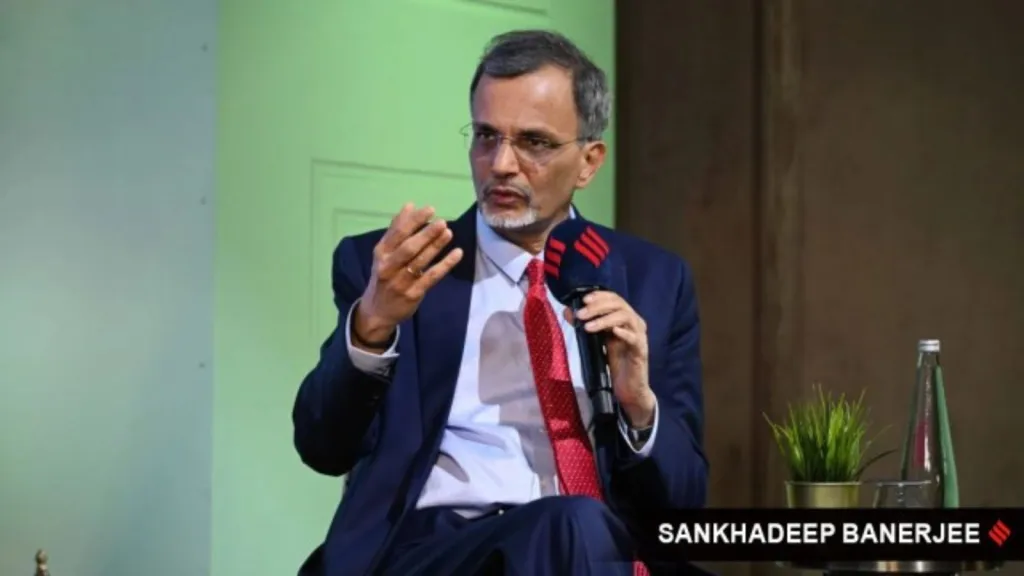
The United States has adopted a more cautious and, at times, hostile approach towards India under President Donald Trump’s second administration because it increasingly views the country as a competitor for critical resources, Chief Economic Adviser V. Anantha Nageswaran has said. His remarks highlight how geopolitical competition, supply-chain security and the global push to revive domestic manufacturing could influence India’s economic ambitions over the next two decades.
Speaking on Thursday at the Delhi Macroeconomics Workshop hosted by the India Sustainable Growth Hub at the Indian Statistical Institute-Delhi, Nageswaran warned that India should not assume its strategic partnership with Washington will automatically translate into economic cooperation. He also indicated that negotiations on an India-US trade agreement appear close to completion, describing the deal as being “just a few minor punctuation points away”.
Why the US Sees India as Both Partner and Competitor
Nageswaran said expectations that Trump’s second administration would maintain an approach similar to his first term towards India had not fully materialised. Instead, Washington has become more transactional, assessing India according to its strategic value and its ability to compete for resources.
According to the CEA, India’s expanding economic ambitions mean it will increasingly seek access to the same resources that developed economies need for manufacturing, industrial growth and supply-chain resilience. This creates areas of cooperation but also potential competition.
He argued that India’s participation in strategic groupings such as the Quad and its efforts to diversify supply chains away from China do not guarantee that Washington will always view New Delhi as an ally on economic matters.
The relationship will depend on the specific interests involved, particularly access to raw materials, manufacturing capabilities and strategically important industrial infrastructure. As India expands its domestic production, its interests may increasingly overlap with those of advanced economies attempting to bring manufacturing back home.
Nageswaran cautioned that these geopolitical realities could complicate India’s long-term economic objectives. Countries can cooperate on security while competing over investment, industrial capacity and access to essential resources.
Critical Resources Are Becoming a Geopolitical Tool
The CEA placed resource security at the centre of the emerging global economic order. He argued that competition over rare earth elements, semiconductors and other essential inputs could make the international environment more volatile during the 21st century.
He also referred to US interest in Greenland and Venezuela, along with President Trump’s statements about making Canada the 51st US state, as developments that should be examined in the context of access to resources and strategic assets.
For India, the implications extend beyond securing supplies of crude oil. Industrial metals, fertilisers and active pharmaceutical ingredients (APIs) are also essential to manufacturing, agriculture and healthcare. Disruptions in the availability of these inputs could raise costs, interrupt production and undermine industrial expansion.
Nageswaran emphasised that India needs to develop buffers for critical resources and establish clear frameworks for releasing those reserves when required. Such measures could help businesses withstand external shocks and reduce the risk that shortages derail domestic manufacturing.
He warned that without reliable access to essential inputs, India’s manufacturing ambitions would face significant constraints. Building strategic reserves and improving supply resilience would therefore need to become important parts of economic policy.
India-US Trade Deal Appears Close to Completion
Nageswaran’s comments come as Indian and US officials continue to signal progress in negotiations over a bilateral trade agreement. The CEA’s description of the deal as being only a few minor punctuation points away suggests that the two sides may be nearing the final stages of discussions, although the comments do not establish a formal signing date or confirm that all outstanding issues have been resolved.
The proposed agreement is being negotiated against the backdrop of a difficult period in bilateral relations. The United States imposed an additional 25% penal tariff on Indian goods in 2025 in connection with India’s purchases of Russian arms and energy products, adding to trade tensions between the two countries.
The dispute has demonstrated how decisions concerning energy security and foreign policy can affect commercial relations. India has sought to protect its economic interests while maintaining strategic autonomy, whereas Washington has used trade measures as part of its broader approach to international economic and geopolitical relationships.
Even if the two countries conclude a trade agreement, Nageswaran’s remarks suggest that India should not assume the deal will eliminate competition over resources or guarantee smooth economic relations. Trade cooperation and strategic rivalry may continue simultaneously.
Geopolitics Could Make Economic Shocks More Frequent
Nageswaran warned that future economic disruptions may increasingly be deliberate rather than accidental. Governments are placing greater emphasis on domestic production, strategic autonomy and the security of critical supply chains, creating conditions in which economic policies can become instruments of geopolitical competition.
He said that assumptions about uninterrupted global trade, international peace and abundant supplies could no longer be taken for granted. For India, this means economic planning must account for disruptions arising from political decisions, trade restrictions and competition between major powers.
Such risks could affect manufacturers that depend on imported raw materials, energy supplies and specialised industrial components. Companies may face higher input costs, longer delivery times and greater uncertainty when governments restrict exports or prioritise domestic industries.
For policymakers, the challenge is to strengthen economic resilience without abandoning the benefits of International Trade. Diversifying suppliers, improving domestic production capabilities and maintaining strategic reserves could reduce India’s exposure to sudden external shocks.
India Faces Greater Competition for Foreign Investment
The competition for economic resources is not confined to emerging markets. Nageswaran pointed out that advanced economies are also seeking large amounts of investment as they attempt to rebuild domestic manufacturing capacity and reduce dependence on overseas production.
He cited Canada’s plan to host an investment summit seeking $1 trillion in investment and Germany’s plans for a similar initiative the following month. Such efforts illustrate how countries traditionally viewed as sources of international capital are increasingly competing to attract investment for their own economic priorities.
This shift could make the global market for foreign direct investment (FDI) more competitive. India has traditionally competed with other developing economies for international capital, but it must now also contend with advanced economies offering investors opportunities linked to industrial policy, infrastructure and strategic manufacturing.
For India, attracting investment will require more than highlighting its large domestic market and growth potential. Reliable infrastructure, predictable regulations, skilled workers and access to essential resources will remain important in determining whether investors choose to establish or expand operations in the country.
Gross FDI Rises, but Net Investment Remains a Concern
India continues to attract substantial Foreign Investment in absolute terms, but the gap between gross and net FDI highlights the complexity of measuring capital flows into the economy.
According to the figures cited by Nageswaran, gross FDI reached $54.93 billion during the first five months of the 2026-27 financial year, representing a 21% increase from the corresponding period a year earlier. Net FDI stood at $13.79 billion, up 43% year-on-year.
Net FDI is lower than gross inflows because it accounts for factors including repatriation of investment by foreign investors and outward investment by Indian companies. As a result, strong gross inflows do not necessarily translate into equally strong net capital entering the country.
The improvement in net FDI is notable compared with the previous two financial years. Net inflows amounted to $6.71 billion in 2025-26, following a decline to less than $1 billion in 2024-25, according to the figures provided.
These trends underline the importance of sustaining investor confidence and encouraging new investment that supports domestic production, job creation and technology development. As competition for capital intensifies, India will need to demonstrate that it can provide stable conditions for long-term investment.
Trade Agreements Could Support Manufacturing Growth
Despite the geopolitical risks, Nageswaran expressed optimism about India’s economic prospects. He said the potential benefits of trade agreements that have already been signed, as well as those that have yet to become operational, have not fully materialised.
Some of these agreements could create opportunities for labour-intensive manufacturing and services. Businesses may gain access to new markets, while Indian producers could use expanded trade opportunities to increase exports and integrate more deeply into international supply chains.
However, the benefits will depend on India’s ability to convert market access into higher production, employment and investment. Exporters will need to remain competitive on quality, costs and delivery, while domestic industries must be able to secure the materials and components required to meet additional demand.
Trade agreements can reduce barriers, but they cannot independently resolve supply-chain weaknesses or eliminate geopolitical uncertainty. India’s long-term gains will therefore depend on combining international market access with stronger domestic industrial capabilities.
Building Strategic Buffers for Long-Term Economic Security
Nageswaran stressed that India must look beyond crude oil when developing strategies to protect its economy from resource disruptions. Industrial metals, fertilisers and APIs should also be considered for strategic buffers, given their importance to manufacturing, agriculture and pharmaceutical production.
Creating reserves would need to be accompanied by practical frameworks governing their storage, management and release during shortages. The objective would be to prevent temporary disruptions from turning into prolonged production problems or sharp increases in costs.
India’s policy challenge is to balance the cost of maintaining strategic reserves against the economic damage that could result from sudden shortages. A carefully designed approach could help protect critical industries while allowing businesses to continue benefiting from international trade.
The broader message from the CEA is that India’s economic strategy must increasingly account for the connection between geopolitics and industrial development. A trade agreement with the United States could strengthen commercial ties, but resource competition, investment rivalry and supply-chain vulnerabilities will remain important considerations.
As countries prioritise strategic resources and domestic manufacturing, India’s ability to secure critical inputs, attract investment and expand labour-intensive production will help determine whether it can sustain its growth ambitions over the next two decades.
For breaking news and live news updates, like us on Facebook or follow us on Twitter and Instagram. Read more on Latest Business on thefoxdaily.com.






COMMENTS 0