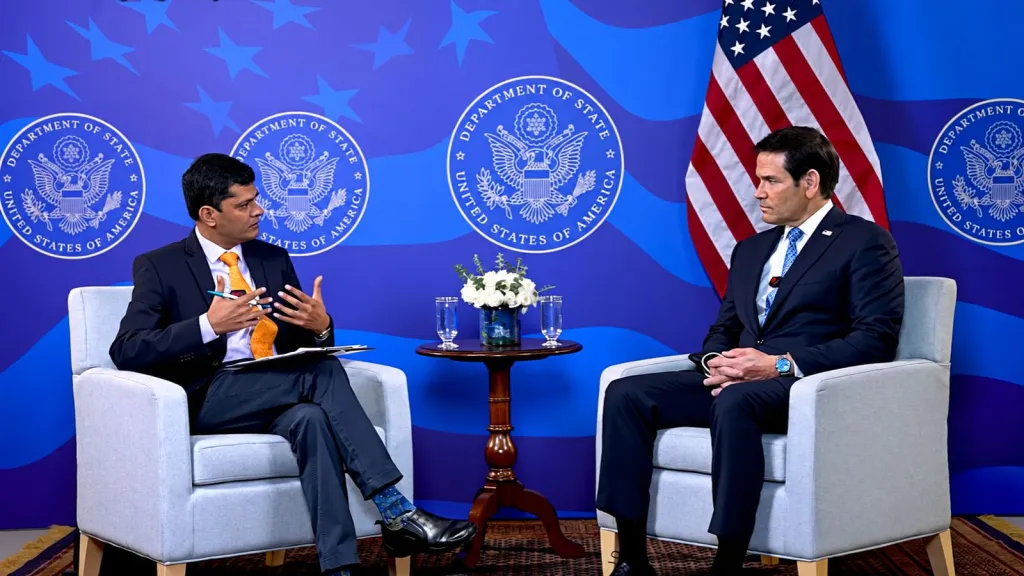
India and the United States have signalled fresh progress towards a bilateral trade agreement, with US Secretary of State Marco Rubio expressing optimism that negotiations could conclude soon. During talks with External Affairs Minister S Jaishankar in Mumbai on Tuesday, October 20, Rubio said the two countries were “very, very close” to finalising the deal, adding that only a small number of issues remained unresolved.
The discussions covered trade, Energy Security, defence, emerging technologies and wider strategic cooperation. Washington also urged New Delhi to increase its purchases of American energy supplies, technologies and defence systems, highlighting the growing connection between commercial negotiations and the two countries’ broader strategic partnership.
The latest diplomatic engagement comes after trade negotiations faced difficulties amid tensions over US tariffs and India’s purchases of Russian oil. Although Rubio indicated that an announcement could come soon, the agreement has not yet been formally executed, and the remaining issues still need to be resolved.
India-US trade deal: Rubio says negotiations are nearing completion
Speaking to reporters in Mumbai, Rubio said the two countries were close to reaching an agreement but acknowledged that some work remained. He clarified that the US State Department does not directly negotiate trade agreements, although he remains closely involved because of the importance of the negotiations to American national security and foreign policy.
“We’re very, very close. I would say we’re about as close as you can be without having executed the agreement,” Rubio said, adding that there were only a few outstanding items to wrap up.
He expressed hope that the remaining issues would be addressed shortly and that the two sides could announce progress soon. Rubio also indicated that the leaders of the two countries might sign the agreement after the outstanding matters are settled.
His remarks offered an encouraging signal after negotiations encountered obstacles over trade conditions and energy-related disagreements. However, his comments represented an assessment of the state of negotiations rather than confirmation that the agreement had been finalised or that a signing date had been fixed.
For India, the proposed agreement carries implications for exporters, businesses and the wider economic relationship with Washington. For the United States, greater access to the Indian market could support exports of energy products, advanced technology and defence equipment.
Why energy trade has become central to negotiations
Energy cooperation was a major focus of the Mumbai meeting, with Rubio arguing that greater trade with the United States could help India diversify its sources of supply while meeting its substantial domestic energy demand.
India imports significant quantities of crude oil to meet the needs of its economy. Its energy procurement decisions are influenced by factors including price, availability, refinery requirements and long-term supply security. Maintaining access to multiple suppliers can help reduce exposure to disruptions in individual markets.
India’s purchases of Russian oil have been a source of tension with Washington and have complicated the broader bilateral relationship. Rubio, however, framed the issue in terms of India’s stated interest in diversifying its energy portfolio rather than treating Russian oil purchases as the only concern.
“What India has expressed repeatedly is their desire to diversify their energy portfolio, which is a smart thing to do,” Rubio said. He acknowledged that changing energy supply arrangements cannot happen overnight and said India had made substantial progress towards diversification.
He added that the United States could become a source of some of India’s energy supplies. Rubio also referred to Venezuela and other potential suppliers, suggesting that a wider range of sources could serve the interests of both countries.
The US State Department’s account of the meeting said Rubio had emphasised that increased energy trade with the United States could help diversify India’s supply chains and meet consumer demand. The statement also highlighted cooperation in defence and civil nuclear energy.
Rubio to discuss Venezuelan crude with Reliance Industries
Rubio’s planned visit to Reliance Industries’ refinery complex in Jamnagar, Gujarat, is expected to provide another opportunity to discuss India’s refining capabilities and the potential for processing Venezuelan crude oil.
Asked whether Indian companies could refine more Venezuelan crude to help meet global energy demand, Rubio said they had the technical capability to do so. He pointed to India’s experience in processing heavy crude and said the issue would be discussed during his engagement with Reliance.
“India’s a refining superpower, and they have the ability to do that,” Rubio said, highlighting the country’s established refining expertise and industrial capacity.
His comments also drew attention to the difference between producing crude oil and processing it into usable fuels. Expanding oil production alone does not automatically resolve supply shortages if the available crude cannot be transported, processed or delivered to the markets that need it. Refining capacity therefore remains an important part of the wider energy supply chain.
Rubio said Indian companies also held oil concessions in Venezuela and could potentially increase production. He cautioned, however, that Venezuelan supplies alone would not necessarily replace all the energy volumes that might be disrupted elsewhere. They could provide some relief in the short term and potentially contribute more over time.
He also acknowledged that existing sanctions could create obstacles to expanding such activity. Any increase in trade involving Venezuelan oil would therefore depend on the relevant commercial arrangements, regulatory requirements and sanctions framework.
The proposed discussions reflect a broader effort to explore whether Indian refining capacity and alternative crude supplies could support energy security while creating opportunities for US-India commercial cooperation.
US pushes for greater purchases of American technology and defence systems
Energy was not the only area in which Washington sought deeper commercial engagement. Rubio also advocated increased Indian purchases of American technologies and systems, arguing that stronger cooperation could benefit the security and prosperity of both countries.
According to the US State Department, the secretary of state welcomed recent progress in bilateral defence and civil nuclear cooperation. He also encouraged India to expand its purchases of US technology and equipment.
Defence cooperation has become an important component of the India-US strategic relationship, alongside collaboration in advanced technologies, maritime security and regional affairs. Greater commercial engagement in these areas could create opportunities for American suppliers while giving India access to equipment and technological capabilities.
However, decisions on defence procurement and technology partnerships involve more than trade considerations. India must also account for operational requirements, costs, domestic manufacturing objectives and the need to maintain reliable supply chains. The extent to which American products gain a larger share of the Indian market will depend on the terms of individual agreements and India’s strategic priorities.
The US has also been pursuing a broader trade objective of expanding its commercial engagement with international partners. The supplied account places energy and defence equipment within Washington’s effort to reach a $500 billion trade target by 2030. Greater Indian purchases could contribute to that ambition, although the outcome will depend on the terms of future deals and actual trade flows.
Jaishankar and Rubio reaffirm the strategic partnership
Following the meeting, Jaishankar said the two sides had exchanged views on advancing bilateral ties, with discussions covering trade, energy, technology, defence and people-to-people connections. He also said they had discussed regional developments.
Rubio similarly described the talks as an opportunity to strengthen the US-India strategic partnership, particularly in energy security and defence cooperation.
India’s Ministry of External Affairs said the two officials reviewed the full range of bilateral relations and discussed ways to strengthen the Comprehensive Global Strategic Partnership. Both sides exchanged views on trade, defence, technology and energy security, welcomed progress in negotiations on the Bilateral Trade Agreement, and reaffirmed their commitment to an early conclusion.
The ministry also referred to the India-US COMPACT initiative, whose name stands for Catalysing Opportunities for Military Partnership, Accelerated Commerce and Technology. The initiative reflects the two countries’ stated intention to advance cooperation across defence, commerce and technology.
US Ambassador to India Sergio Gor welcomed the discussions, describing them as productive and highlighting cooperation across defence, energy, emerging technologies and trade.
The statements from both governments indicate that the relationship extends beyond the immediate trade negotiations. Even as differences over tariffs and energy procurement remain, both sides have emphasised the value of maintaining strategic engagement and expanding cooperation in areas of shared interest.
India, US and UAE discuss regional energy security
Jaishankar and Rubio later joined UAE Foreign Minister Sheikh Abdullah bin Zayed Al Nahyan for a trilateral meeting focused on energy, connectivity and wider regional developments.
Jaishankar described the discussion as a useful exchange of perspectives, while the meeting also addressed regional energy security and shared economic priorities.
The trilateral engagement added a regional dimension to the day’s discussions. Energy supply routes, connectivity and commercial relationships are important to countries seeking to manage disruptions and maintain reliable access to essential resources.
The meeting also took place against the backdrop of the conflict involving the United States and Iran, which the supplied account links to wider energy-market pressures. Developments in the Middle East can affect crude oil availability, shipping routes and prices, making energy security an important concern for major importing economies such as India.
Russian oil, sanctions and the wider diplomatic context
The India-US trade discussions have unfolded amid continuing disagreements over tariffs and India’s purchases of Russian oil. These issues have complicated efforts to conclude the bilateral agreement, even as officials from both countries have continued to engage on trade and strategic cooperation.
Rubio also referred to a recent US decision to waive certain Russia-related oil sanctions, saying the India-US trade deal had been among the considerations. The issue illustrates how energy policy, sanctions and commercial negotiations can intersect in the broader relationship.
For India, energy diversification remains a complex process because suppliers must be assessed against cost, availability, refinery compatibility and the reliability of delivery. A shift in procurement cannot necessarily be completed immediately, particularly when refiners and suppliers are working with existing contracts and established logistics networks.
For Washington, encouraging purchases of American energy and technology could strengthen commercial ties while supporting its wider strategic objectives. Whether the two sides can reconcile their remaining differences will depend on the final terms of the trade agreement and the practical arrangements that follow.
Rubio’s visit aims to sustain high-level engagement
Rubio said his visit was part of the effort to maintain regular contact with a country he described as an important commercial and strategic partner. He noted that Jaishankar had travelled to the United States several times during the year and argued that the two countries should engage more frequently.
He pointed to India’s status as the world’s most populous country and largest democracy, as well as its role as a commercial partner, defence collaborator and member of the Quad. His comments underscored Washington’s emphasis on India as a partner in economic and regional strategic affairs.
During the visit, Rubio also paid tribute at the 26/11 memorial at Mumbai’s Taj Mahal Palace Hotel. His schedule included engagements with Indian officials and business representatives, with Mumbai providing a setting for discussions involving India’s commercial community.
The visit comes amid strains in bilateral relations over tariff threats and visa restrictions. Against that backdrop, the meetings with Jaishankar and the planned engagement with Reliance Industries offer opportunities to discuss practical areas of cooperation alongside the outstanding trade issues.
What happens next for the India-US trade agreement?
Rubio’s remarks suggest that the negotiations have reached an advanced stage, but the agreement remains incomplete until the outstanding issues are settled and the relevant formal steps are taken. The secretary of state expressed hope for an announcement soon, without confirming a specific date for completion.
The next phase will depend on whether New Delhi and Washington can resolve their remaining differences and agree on the final terms. Energy trade, technology purchases and defence cooperation are likely to remain important elements of the broader economic and strategic relationship, even as the detailed provisions of the trade agreement are finalised.
For businesses, a completed agreement could provide greater clarity on the bilateral trading environment and create opportunities in sectors covered by the final terms. The precise effects on exporters, importers and investors will depend on the concessions and commitments ultimately adopted by both governments.
For now, Rubio’s assessment that the countries are “very, very close” signals renewed optimism, not a completed deal. The immediate test will be whether the remaining items can be resolved and the agreement moved from negotiations to formal execution.
For breaking news and live news updates, like us on Facebook or follow us on Twitter and Instagram. Read more on Latest India on thefoxdaily.com.




COMMENTS 0