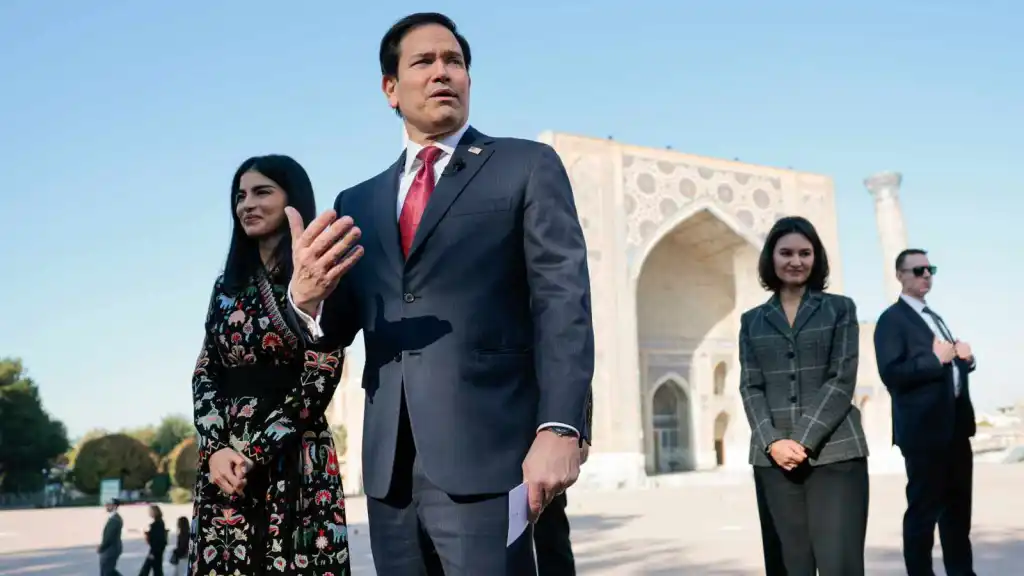
US Secretary of State Marco Rubio has said that the India-US trade deal, which he described as being close to finalisation, was among the factors considered when Washington decided to waive certain sanctions related to Russian Oil. His remarks highlight how energy security, global fuel prices and bilateral trade negotiations are influencing US policy towards India amid the continuing Russia-Ukraine war.
Speaking at a press conference in Uzbekistan on Monday, Rubio explained that the United States had to balance its efforts to pressure Russia with the economic consequences of restricting energy supplies to countries that depend on them. He acknowledged that the impact of high fuel prices varies across countries and that some governments have limited options for replacing existing energy sources.
Rubio’s comments came ahead of his expected visit to Mumbai on October 20, when he is scheduled to hold talks with India’s External Affairs Minister S. Jaishankar. The discussions are taking place at a crucial stage in India-US Relations, with both countries working towards a trade agreement while navigating disagreements over India’s purchases of Russian oil.
Marco Rubio Links Russia Oil Sanctions Waiver to India-US Trade Deal
Rubio said Washington had considered several economic and diplomatic factors when deciding whether to grant waivers from sanctions related to Russian oil. These included global energy supplies, international prices, the economic impact on other countries and the state of bilateral relationships.
Explaining the administration’s approach, Rubio said the United States had granted sanctions waivers over recent months after assessing the consequences of restrictions on global fuel markets.
“We’re trying to finalise a trade deal with India right now. We’re very close to doing that. So that’s one of the things we’ve taken into consideration,” Rubio said.
His statement is significant because it explicitly connects the India-US trade negotiations with Washington’s decision-making on energy-related sanctions. However, Rubio did not say that the prospective trade agreement was the sole reason for the waiver. Instead, he presented it as one consideration within a broader assessment of economic and foreign policy priorities.
The distinction matters because the United States has been trying to maintain pressure on Russia over its war against Ukraine while also managing the economic consequences of energy market disruptions. Restrictions that affect the availability of Russian oil can have consequences beyond Russia, particularly for countries that rely on imported energy.
For India, which has made Russian crude an important component of its energy sourcing in recent years, the treatment of Russian oil purchases has been a major point of contention in trade discussions with Washington.
Why the US Is Balancing Russia Sanctions With Global Energy Prices
Rubio’s explanation reflects the challenge facing US policymakers as they attempt to use sanctions to influence Russia without creating additional economic pressure on other countries. Energy markets are interconnected, and changes in supply can affect fuel prices, transportation costs, industrial production and household expenses across multiple economies.
When energy supplies become more expensive or difficult to obtain, governments must consider whether alternative sources can meet domestic demand at affordable prices. Replacing one supplier with another may require new commercial arrangements, changes to transportation routes and adjustments to refining or distribution systems.
These challenges can be particularly difficult for countries that depend heavily on imported oil and gas. A sudden disruption in supply can increase import bills and place additional pressure on currencies, government finances and inflation.
Rubio acknowledged that the United States was also experiencing elevated fuel prices, but said the pressure was more severe in several other countries. He argued that the administration had to account for these differences when deciding how to implement its foreign policy.
“That’s not an excuse, but all that has to be balanced when you make foreign policy,” Rubio said, referring to the difficulties some countries face in acquiring energy from alternative sources.
His remarks suggest that Washington’s approach to sanctions is not based exclusively on the objective of limiting Russia’s energy revenues. The administration must also weigh the potential economic consequences for countries that could face higher costs or supply shortages if restrictions become more stringent.
At the same time, a waiver should not automatically be interpreted as a broader change in US policy towards Russia. The scope, duration and conditions of any sanctions relief remain important in determining its practical effect on energy trade and diplomatic relations.
India’s Russian Oil Purchases Remain a Key Point in Trade Talks
India’s purchases of Russian oil have become a central issue in its economic relationship with the United States. New Delhi has maintained that its energy procurement decisions must account for domestic demand, market conditions and the need to secure reliable supplies.
Russian crude became an important option for Indian refiners after global energy markets were disrupted by Russia’s invasion of Ukraine and Western countries imposed restrictions on Moscow. Commercial considerations, including the availability and pricing of crude, have influenced decisions about where Indian companies source their supplies.
For India, the issue extends beyond the price of crude oil. Energy costs influence transportation, manufacturing, electricity generation and the prices of goods and services. Higher import costs can also put pressure on the country’s trade balance and contribute to inflation.
Washington, meanwhile, has sought to increase economic pressure on Russia because of the war in Ukraine. Restrictions and potential penalties affecting countries that purchase Russian energy have therefore become part of a wider diplomatic and economic debate.
The disagreement has complicated negotiations between India and the United States, even as both governments have continued to pursue closer economic ties.
Rubio’s remarks indicate that the administration has considered the broader relationship with India while assessing energy-related sanctions. Nevertheless, they do not establish that every disagreement over Russian oil has been resolved or that the proposed trade deal has been finalised.
India-US Trade Deal: What Is Holding Up the Agreement?
India and the United States have been working towards a trade agreement intended to strengthen bilateral economic ties and address differences over tariffs and market access. Rubio’s description of the negotiations as being very close to completion points to continued engagement between the two governments, although a final agreement would depend on the resolution of outstanding issues and the completion of the necessary procedures.
The prospect of a deal has become particularly important because the two countries have faced the threat of steep US tariffs. The source material indicates that the risk of 100% tariffs has eased, creating an opportunity for the negotiations to progress.
However, the treatment of India’s purchases of Russian oil has remained a major point of disagreement. The issue is politically sensitive because it connects trade policy with the broader US effort to influence Russia’s conduct in Ukraine.
Tariffs can affect the competitiveness of exports by increasing the cost of imported products. For Indian exporters, access to the US market is important across a range of industries, while American businesses also have interests in India’s large consumer market and expanding industrial economy.
A trade agreement could provide greater clarity on the commercial rules governing bilateral trade. Depending on its final terms, it could also help businesses make decisions about investment, sourcing, manufacturing and long-term market expansion.
Yet the exact benefits will depend on the provisions eventually agreed upon. Rubio’s comments alone do not confirm the final tariff structure, the treatment of particular products or the timetable for signing and implementing the agreement.
Section 301 Investigation Adds Another Dimension to Negotiations
The trade discussions have also unfolded alongside a US Section 301 investigation involving India. Section 301 of the US Trade Act provides a mechanism for Washington to investigate foreign practices that it considers unfair or harmful to American commerce and, where legally justified, take trade-related action.
The investigation adds another layer to negotiations that already involve tariffs, market access and energy policy. Both governments must consider how their trade measures could affect domestic industries, exporters and the broader economic relationship.
According to the supplied report, India had already prohibited imports of goods made using forced labour following the first US Section 301 investigation. The report also notes that India and other G20 countries issued a joint statement earlier in October committing to address structural overcapacity in certain geographical areas and industrial sectors.
The sectors identified included automobiles, electric vehicles, batteries, chemicals, foundational semiconductors and solar panels.
Structural overcapacity generally refers to situations in which production capacity exceeds what markets can sustainably absorb. Governments may raise concerns about the effects of excess production on prices, domestic manufacturers and international competition.
The inclusion of these issues in the broader trade environment illustrates that India-US negotiations extend beyond Russian oil. The two countries also have interests in industrial competitiveness, manufacturing, technology supply chains and the rules governing international commerce.
Even if progress is made on these issues, a durable agreement will require the governments to settle the remaining differences and establish clear terms for implementation.
India’s Official Position: Energy Security Through Diversified Sourcing
India’s Ministry of External Affairs has maintained that the government is committed to protecting the country’s energy security through diversified sourcing and decisions based on changing market conditions.
The ministry also said that the implications of the proposed US legislation had been raised during discussions with American representatives. These concerns included the potential impact on bilateral relations and the global energy market.
The emphasis on diversified sourcing reflects India’s interest in avoiding excessive dependence on any single supplier. Maintaining access to different sources of energy can help a country respond to supply disruptions, changes in international prices and geopolitical tensions.
For a major energy importer such as India, the cost and reliability of supplies have direct implications for the wider economy. Higher crude prices can increase the cost of imported energy, while expensive fuel can affect transport, agriculture, logistics and industrial production.
India’s position also highlights a distinction between its foreign policy and its commercial energy decisions. New Delhi has repeatedly emphasised the importance of making procurement decisions according to national interests and market realities.
That approach can bring India into conflict with US policies designed to restrict Russia’s economic resources. At the same time, both countries have reasons to preserve their wider economic relationship, including trade, investment and cooperation in strategic sectors.
Rubio’s remarks suggest that Washington recognises the need to consider these competing interests. However, India’s commitment to energy security does not by itself guarantee that future purchases of Russian oil will be exempt from every US restriction or potential penalty.
High Diesel Prices Put Pressure on the US Economy
Fuel prices have become an important domestic economic concern in the United States, providing additional context for the administration’s decision to consider the effects of sanctions on global energy markets.
According to figures cited by the Council on Foreign Relations from the US Energy Information Administration, average diesel prices in the United States reached $6.18 per gallon as of October 12, compared with $3.48 at the beginning of the year.
Diesel is essential to freight transportation, agriculture, construction and several industrial activities. When diesel prices rise, transport companies and businesses that depend on road freight can face higher operating expenses.
Those costs can eventually be passed on to consumers through more expensive goods and services. The effects may extend beyond the price displayed at a fuel station because businesses often incorporate fuel and logistics expenses into the prices they charge customers.
Higher energy costs can therefore complicate efforts to reduce inflation. Even when the prices of some goods stabilise, an increase in transportation and production costs can create renewed pressure elsewhere in the economy.
The US administration must consequently consider both its foreign policy objectives and the domestic consequences of higher energy prices. Rubio’s explanation indicates that the economic effects of sanctions have been part of that calculation.
US Inflation and Midterm Elections Add Political Pressure
The energy price challenge has emerged alongside broader concerns about the cost of living in the United States. The supplied report, citing the Council on Foreign Relations, said the latest Consumer Price Index showed that prices increased by 0.6% in September, taking annual inflation to 3.7%. The monthly increase was higher than economists had expected.
Inflation affects households through a range of expenses, including food, transport, housing and utilities. When prices rise faster than incomes, consumers may have less money available for discretionary spending, making the cost of living a prominent political issue.
The report also noted that polling suggested these economic concerns could affect Republican candidates in the upcoming US midterm elections. Campaigns have increasingly focused on affordability, placing additional political attention on policies that influence fuel prices and household budgets.
This political context does not establish that election considerations directly caused the sanctions waiver. Rubio’s public explanation instead identified several factors, including energy availability, global prices, economic consequences and the proposed India-US trade deal.
Nevertheless, the political sensitivity of fuel prices helps explain why governments may be reluctant to implement measures that could trigger further increases in energy costs at home or abroad.
Rising Inflation in India Creates a Similar Challenge
India is also facing pressure from rising prices, making the cost of imported energy an important concern for policymakers. The supplied report said retail inflation increased to 5.54% in September from 4.83% in August, according to data from the National Statistics Office.
Food inflation rose more sharply, reaching 7.74% in September compared with 6% in August. The report attributed part of the increase to items including onions, ginger, garlic and lemon.
Food prices are particularly significant in India because they represent a substantial component of household expenditure. An increase in the cost of essential food items can quickly affect family budgets, especially for households with limited room to absorb additional expenses.
The report also cited a 5.8% increase in the FAO food price index, indicating an uptick in international food prices. Movements in global commodity markets can affect domestic prices, although the extent and timing of the impact depend on individual products, supply conditions, exchange rates and domestic policy measures.
Energy prices can add to these pressures. More expensive fuel increases transportation and distribution costs, potentially affecting food supply chains and the prices of other essential goods.
For India, securing affordable energy is therefore connected to a broader objective of managing inflation and supporting economic activity. A sharp increase in crude oil import costs could create additional pressure on businesses, consumers and the country’s external finances.
These considerations help explain why New Delhi has emphasised diversified sourcing and market conditions in its response to questions about Russian oil.
How the Russia-Ukraine War Shapes the Sanctions Debate
The continuing war between Russia and Ukraine remains central to the dispute over Russian energy purchases. The United States has sought to use economic measures to impose costs on Russia, while countries importing energy must assess how restrictions could affect their own economies.
Rubio stressed that the US foreign policy approach takes the war into account but is not determined by that conflict alone. He said the administration must also consider its relationships with other countries and what those countries can realistically do to replace existing energy supplies.
“You also can’t unravel the economy of other countries because of one central issue,” Rubio said.
The statement reflects a broader challenge associated with economic sanctions: measures intended to pressure one country can also affect trading partners, consumers and industries elsewhere.
Energy markets make this particularly complicated because oil is traded internationally and can be redirected between suppliers and buyers. Changes in purchasing patterns can influence prices, shipping arrangements and the availability of alternative supplies.
At the same time, the effectiveness of sanctions depends partly on their design, enforcement and the behaviour of countries and companies involved in international trade. Broad exemptions may reduce immediate market disruption but can also affect the pressure that sanctions are intended to create.
The challenge for Washington is to balance these considerations without undermining its stated objectives towards Russia. India’s challenge is different but closely connected: it must maintain reliable energy supplies while managing the diplomatic and economic consequences of its procurement choices.
Rubio’s remarks indicate that the US administration is attempting to manage these competing priorities rather than treating the Russia-Ukraine war as the only factor in every energy-related decision.
What Rubio’s Upcoming India Visit Could Mean
Rubio’s expected visit to Mumbai on October 20 comes at a sensitive point in India-US relations. His planned discussions with External Affairs Minister S. Jaishankar are taking place as the two countries seek to conclude a trade agreement and address disagreements over energy policy.
The visit provides an opportunity for both governments to discuss the broader relationship, including trade, tariffs and the implications of US measures targeting Russian oil purchases.
However, the available information does not establish that the meeting will produce a final trade agreement or a new commitment on Russian energy. Any assessment of the outcome will depend on the statements issued by both governments and the details of any decisions announced after the talks.
Several developments will be important to watch:
- Trade agreement: Whether India and the United States announce progress towards a final deal, including clarity on outstanding tariff-related differences.
- Russian oil restrictions: Whether Washington provides further details about the scope and duration of sanctions waivers and how they apply to energy purchases.
- Energy security: Whether both governments acknowledge India’s need to maintain diversified and affordable energy supplies while discussing US concerns about Russian oil revenue.
- Section 301 investigation: Whether the two sides make further progress on trade concerns linked to industrial policy, market access and competition.
The outcome could help clarify whether the current flexibility on sanctions is part of a limited response to energy market pressures or a broader effort to accommodate the economic relationship with India.
What the India-US Trade Deal Could Mean for Businesses
A completed trade agreement could provide greater certainty for companies operating between India and the United States. Businesses often make investment and sourcing decisions based on expected tariffs, market access conditions and the predictability of trade rules.
Greater clarity could help exporters plan shipments, manufacturers assess supply chains and investors evaluate opportunities in both markets. However, the benefits would depend on the final terms, the products covered and the implementation schedule.
For India, access to the US market is important for exporters seeking international demand and opportunities to expand production. For American businesses, India offers a large market and potential opportunities across manufacturing, technology and consumer-facing industries.
Disagreements over Russian oil complicate these opportunities because energy policy has become linked to broader trade negotiations. A settlement could reduce uncertainty, but the available information does not confirm that all differences have been resolved.
It is also important to distinguish between the political signal provided by Rubio and the legal or commercial effect of a signed agreement. His statement that negotiations are close to completion reflects the administration’s assessment at the time of speaking; it does not establish the final terms or guarantee a specific implementation date.
Will the Sanctions Waiver Lead to a Final India-US Deal?
Rubio’s comments provide evidence that the proposed trade agreement was considered when the US administration assessed sanctions-related decisions. They also show that Washington is weighing the economic consequences of energy restrictions alongside its foreign policy objectives towards Russia.
However, the relationship between the waiver and the trade deal should not be overstated. Rubio did not say that sanctions relief was a formal concession under the proposed agreement, nor did he confirm that the two issues had been conclusively settled.
The immediate question is whether the countries can translate the current momentum into a completed trade agreement while managing their differences over Russian oil. That will depend on the final negotiations, the precise terms of any sanctions-related decisions and the actions taken by both governments.
For India, the priority remains securing affordable and reliable energy while protecting its wider economic interests. For the United States, the challenge is to sustain pressure on Russia without adding to global economic disruption or damaging important bilateral relationships.
The two countries have incentives to keep negotiations moving, but the competing interests involved mean that progress on one issue will not necessarily resolve every other disagreement.
Conclusion
Marco Rubio’s statement that the India-US trade deal was among the factors considered in the decision to waive certain Russia oil sanctions highlights the growing connection between energy security, trade policy and international diplomacy.
High fuel prices in the United States, rising inflation in India and the economic consequences of restricting Russian energy supplies have all contributed to a complicated policy environment. Washington is attempting to balance its approach to the Russia-Ukraine war with the practical limits faced by energy-importing countries, while New Delhi continues to emphasise diversified sourcing and domestic energy security.
Rubio’s expected meeting with S. Jaishankar in Mumbai could provide a clearer indication of the direction of bilateral relations. Until the governments announce further details, however, the proposed trade agreement should be treated as close to completion according to Rubio’s assessment, rather than as a finalised deal.
The next stage will depend on whether both sides can resolve their remaining differences and establish arrangements that accommodate their trade ambitions, energy requirements and wider strategic priorities.
For breaking news and live news updates, like us on Facebook or follow us on Twitter and Instagram. Read more on Latest India on thefoxdaily.com.






COMMENTS 0