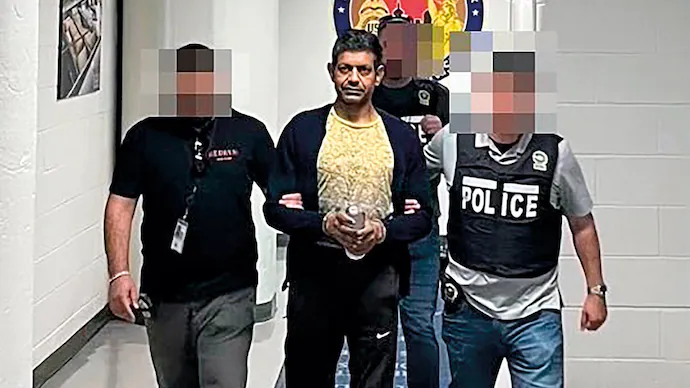
Indian national Nikhil Gupta is scheduled to be sentenced by a US federal court on Friday, November 20, 2026, after pleading guilty to his role in a murder-for-hire conspiracy targeting Khalistani separatist Gurpatwant Singh Pannun in New York. US prosecutors are seeking a prison term of 293 months, equivalent to approximately 24 years and five months, while Gupta’s defence lawyers have urged the court to impose a substantially shorter sentence of 12 years.
The case centres on an alleged conspiracy to assassinate Pannun, a dual American-Canadian citizen, on US soil in 2023. Prosecutors say Gupta helped coordinate the proposed killing with individuals in India and elsewhere, including an alleged co-conspirator identified as Vikash Yadav, whom US authorities have described as an Indian government employee.
Gupta, 55, pleaded guilty earlier this year to three federal charges: murder-for-hire, conspiracy to commit murder-for-hire and conspiracy to commit money laundering. The sentencing hearing will determine the punishment for his admitted role in the conspiracy, which was intercepted before the planned killing could take place.
When Will Nikhil Gupta Be Sentenced?
US District Judge Victor Marrero of the Southern District of New York is scheduled to pronounce Gupta’s sentence at approximately 10 am local time on Friday, November 20.
The sentencing hearing follows competing recommendations from federal prosecutors and Gupta’s defence team. Prosecutors want a sentence of 293 months, arguing that the conspiracy involved an attempt to arrange the killing of an American citizen because of his political beliefs. Gupta’s lawyers, meanwhile, support the Probation Department’s recommendation of 144 months, or 12 years, followed by three years of supervised release.
The difference between the two recommendations reflects the central dispute at sentencing: how to weigh the seriousness of the attempted assassination against Gupta’s personal circumstances, criminal history and other factors considered under US sentencing law.
Although Gupta has admitted guilt, the court must independently determine an appropriate punishment. The prosecution’s request and the defence’s recommendation are arguments submitted to the judge, not final sentencing decisions.
Why US Prosecutors Want Gupta to Spend 24 Years in Prison
The US government has requested a sentence of 293 months, or approximately 24 years and five months. In a 20-page sentencing submission filed the previous week, US Attorney James McDonald described Gupta’s conduct in strongly critical terms and argued that his role in the conspiracy warranted a lengthy prison sentence.
McDonald characterised the alleged operation as an attempt by foreign actors to arrange the execution of an American citizen inside the United States. Prosecutors maintain that the intended victim was targeted because of his political ideology, making the case particularly serious from the government’s perspective.
In its submission, the prosecution argued that Gupta was a crucial participant in the conspiracy and that the punishment should reflect both the seriousness of the offence and the wider implications of attempting to carry out political violence on American territory.
The government’s position is also based on the alleged involvement of multiple individuals. Prosecutors have said the conspiracy included at least one person employed by the Indian government, a detail that has given the case significant diplomatic and national security implications.
The prosecution wants the sentence to demonstrate that attempts to silence individuals through violence will face severe consequences under US law, regardless of where the alleged conspiracy originated.
Gupta’s Lawyers Seek a 12-Year Sentence
Gupta’s defence team has argued that a sentence of nearly 24 years would be excessive in light of his personal circumstances and the absence of any previous criminal convictions. Rather than disputing the seriousness of the offence, his lawyers have asked the judge to impose a punishment they consider sufficient but not unnecessarily severe.
The Probation Department, which evaluates defendants and provides sentencing recommendations to federal judges, calculated an advisory range of 235 to 293 months under the relevant sentencing framework. However, it recommended a considerably shorter term of 144 months, followed by three years of supervised release.
Gupta’s lawyers have supported that recommendation. They argued that the probation assessment was based on an interview with their client, a review of the investigative record and consideration of the factors relevant to sentencing.
The defence has highlighted three main considerations:
- No previous criminal convictions: Gupta’s lawyers say he had no prior criminal history before the conspiracy.
- Alcohol dependence: They argue that he was suffering from untreated alcohol dependence during the period in which the offence took place.
- Personal circumstances: The defence says a lengthy prison term would have particularly severe consequences for a 55-year-old man.
His attorneys have acknowledged that arranging the murder of another person warrants imprisonment. Their argument is that the punishment should be proportionate to the individual circumstances and should not exceed what is necessary to meet the objectives of sentencing.
The defence has therefore asked Judge Marrero to consider the Probation Department’s lower recommendation rather than automatically imposing a sentence at the higher end of the advisory range.
What Nikhil Gupta Said in His Letter to the Court
Gupta submitted a personal letter to the court expressing regret over his involvement in the conspiracy. In the letter, he reflected on his behaviour in 2023 and described a deterioration in his personal life during that period.
“I wish I could turn back time to 2023 and undo my mistakes,” Gupta wrote.
He also described feeling disconnected from his family and said his drinking had become increasingly heavy. Reflecting on his state of mind at the time, he wrote: “I don’t even recognise the man I had become.”
Gupta expressed regret over the suffering caused to his family and people around him, saying: “I deeply regretted the suffering I caused them and the people around me.”
He also referred to the fact that the alleged assassination attempt did not result in anyone being killed or injured. In his letter, Gupta said he was thankful that his actions had not led to a loss of human life or physical injury, which he described as something that would have caused him even greater regret.
The letter forms part of the personal circumstances the defence wants the judge to consider. However, expressions of remorse do not determine the outcome automatically. The court will also have to assess the admitted offences, the prosecution’s arguments and the seriousness of the conspiracy.
How the Alleged Plot to Kill Gurpatwant Singh Pannun Unfolded
According to the indictment and other public court documents, the conspiracy took shape in 2023, when Gupta allegedly became involved in arrangements to have Pannun killed in New York.
Prosecutors allege that Gupta worked with individuals in India and elsewhere to identify someone who could carry out the assassination. One of the central figures identified in the case is Vikash Yadav, whom US authorities say directed Gupta to contact a person he believed could help arrange the killing.
That person was not an ordinary criminal associate. According to the prosecution, the individual was a confidential source working with the US Drug Enforcement Administration (DEA), the federal agency responsible for investigating drug-related offences.
Gupta allegedly approached the source to find a hitman who could carry out the proposed assassination. The contact allowed American investigators to monitor the discussions and gather evidence about the alleged arrangements.
The prosecution further alleged that Yadav agreed, through dealings brokered by Gupta, to pay the undercover officer $100,000 to kill Pannun. The alleged plan subsequently moved beyond preliminary discussions when an advance payment was arranged.
The $15,000 Advance Payment and Undercover DEA Operation
One of the important elements in the prosecution’s account is an alleged cash payment made in June 2023. On or around June 9, Gupta and Yadav allegedly arranged for an associate to deliver $15,000 in cash to the undercover officer as an advance payment for carrying out the assassination.
The proposed payment was part of the larger alleged $100,000 arrangement. Investigators were able to follow the communications and financial arrangements because the person Gupta believed could connect him with a hitman was actually cooperating with US law enforcement.
The undercover operation helped authorities document the alleged conspiracy before the intended killing took place. It also became a central part of the evidence used in the American prosecution.
The case ultimately resulted in Gupta being brought before a US federal court. His guilty plea to the three charges means the sentencing proceedings will focus on the appropriate punishment rather than a trial to determine his guilt on those counts.
Who Is Vikash Yadav in the Pannun Assassination Case?
Vikash Yadav is identified in the US prosecution as an alleged co-conspirator who directed Gupta’s efforts to arrange the killing. Prosecutors have alleged that Yadav was involved in coordinating the proposed assassination and the payment arrangements connected to it.
US authorities have described Yadav as an Indian government employee. His alleged role has made the case particularly sensitive because it raises questions about whether individuals connected to government institutions were involved in a plan to target a person living in the United States.
However, the allegations against Yadav must be distinguished from Gupta’s guilty plea. Gupta has admitted his own involvement in the conspiracy, while allegations concerning other individuals are separate matters and should not be treated as convictions merely because they appear in the prosecution’s account.
The case has attracted attention beyond the courtroom because of its implications for relations between India and the United States. The alleged involvement of an individual described as a government employee has placed additional scrutiny on the investigation and the broader diplomatic consequences.
Why the Pannun Case Matters Beyond Gupta’s Sentencing
The prosecution of Gupta is significant because the alleged conspiracy involved a proposed political assassination on American soil. The case has raised questions about the protection of individuals targeted because of their political views, the reach of foreign-linked operations and the ability of US law enforcement agencies to detect assassination plots before they are carried out.
It also has implications for India-US Relations. Both countries have important strategic, economic and security interests, but allegations involving an attempted killing of a US citizen create a sensitive challenge for diplomatic engagement.
For Washington, the case concerns the enforcement of American criminal law and the protection of people within its jurisdiction. For India, the allegations have attracted attention because of claims involving an individual described by US prosecutors as connected to the Indian government.
The case also highlights the role of undercover operations in investigating transnational criminal conspiracies. By using a confidential source posing as a potential criminal intermediary, US investigators were able to monitor the alleged arrangements and intervene before the intended victim was killed.
What to Expect From the November 20 Sentencing
Judge Victor Marrero’s decision will determine whether Gupta receives a sentence closer to the prosecution’s request of 293 months or the defence-supported recommendation of 144 months. The judge is not required to accept either position and will consider the relevant sentencing factors before issuing the final order.
The prosecution is seeking a punishment that reflects the seriousness of an alleged foreign-backed attempt to kill an American citizen. The defence, meanwhile, is relying on Gupta’s guilty plea, lack of previous convictions, reported alcohol dependence and personal remorse to argue for a shorter prison term.
Whatever sentence is imposed, the case has already become a major legal and diplomatic issue because of the nature of the alleged conspiracy and the individuals identified in the prosecution’s account.
Friday’s hearing will mark a significant stage in the American prosecution of Gupta. It will also establish the prison term imposed on the Indian national for his admitted role in the foiled plot against Pannun, while wider questions surrounding the alleged involvement of other individuals remain distinct from his sentencing.
For breaking news and live news updates, like us on Facebook or follow us on Twitter and Instagram. Read more on Latest World on thefoxdaily.com.






COMMENTS 0