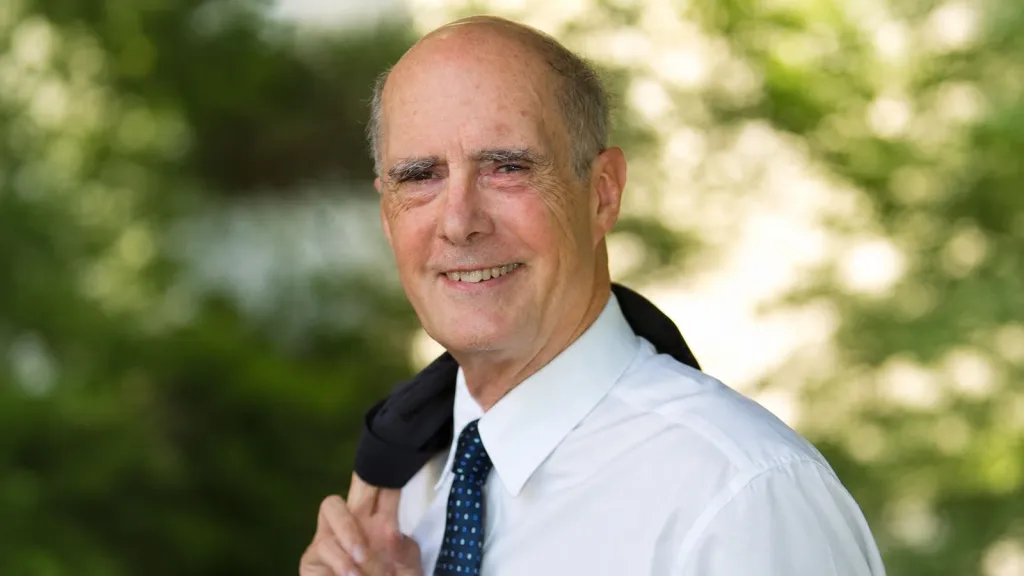
Strobe Talbott, the former Time magazine journalist who became one of the most influential American diplomats of the Bill Clinton administration, has died at the age of 80. Talbott, who played a central role in US-India negotiations following the 1998 nuclear tests by India and Pakistan, died peacefully at his home in East Hampton, New York, on Thursday after a long illness, according to his son, Devin Talbott.
Talbott’s death marks the passing of a figure who moved from journalism into senior government service and helped shape American foreign policy during a period of major geopolitical change. His diplomatic career included negotiations with India over nuclear non-proliferation, engagement with Russia after the collapse of the Soviet Union and efforts to strengthen international cooperation.
His most consequential diplomatic assignment for India was the series of discussions he led with then External Affairs Minister Jaswant Singh after the nuclear tests of May 1998. Although the negotiations did not persuade India to sign the global nuclear test ban treaty, they helped establish a foundation for closer engagement between New Delhi and Washington, culminating in President Clinton’s landmark visit to India in 2000.
Strobe Talbott’s Role in the 1998 India-US Nuclear Negotiations
Talbott became the United States’ principal diplomatic interlocutor with India after the nuclear tests conducted by New Delhi in May 1998. India’s tests at Pokhran prompted international concern and sanctions, while Pakistan carried out its own nuclear tests weeks later, intensifying fears of a nuclear arms race in South Asia.
The developments created one of the most serious diplomatic challenges between India and the United States in the post-Cold War period. Washington was concerned about nuclear proliferation and wanted India and Pakistan to accept stronger international restrictions on nuclear testing and weapons development.
Talbott was assigned to lead the American side of the negotiations. He described the situation in an interview with The New York Times as “an extraordinarily serious situation” of “immense importance, complexity and, I would say, danger”.
Over more than two years, Talbott met Jaswant Singh more than a dozen times. The discussions covered nuclear testing, non-proliferation, regional security and the broader relationship between the two countries. One of Washington’s central objectives was to secure India’s signature on a global test ban treaty.
India did not sign the treaty, and the negotiations did not achieve every American objective. However, the repeated high-level meetings helped both governments develop a more sustained diplomatic channel at a time when relations were strained by disagreements over nuclear policy.
How the Nuclear Talks Helped Prepare the Ground for Clinton’s 2000 India Visit
The Talbott-Singh negotiations became important beyond the immediate question of nuclear testing. They created an opportunity for officials in both countries to understand each other’s strategic priorities and discuss areas of disagreement through direct engagement.
The dialogue helped move India-US Relations away from the immediate tensions following the 1998 tests. It also contributed to a broader reassessment of the relationship in Washington, where India’s growing economic and strategic importance was receiving greater attention.
One of the most significant outcomes of this diplomatic engagement was the groundwork it laid for President Bill Clinton’s visit to India in March 2000. It was the first visit by a sitting US president to India in more than 22 years and represented an important moment in the evolution of bilateral relations.
Clinton’s visit helped signal that the two countries were prepared to build a relationship extending beyond their disagreements over nuclear policy. The engagement initiated during the Talbott-Singh talks became part of a longer diplomatic process that eventually contributed to the transformation of India-US relations.
Talbott’s contribution was therefore not simply about negotiating over a treaty. His role involved maintaining communication between two governments during a period of deep disagreement and helping create the conditions for a more constructive relationship.
From Yale and Oxford to Time Magazine
Before entering government, Talbott built a distinguished career in journalism, specialising in international affairs and Soviet-American relations. Born in Dayton, Ohio, in 1946, he studied at Yale University before moving to the University of Oxford.
At Oxford, he shared accommodation with Bill Clinton, who would later become the 42nd president of the United States. Their friendship began during their university years and continued throughout their professional lives.
Talbott’s entry into journalism came through an internship with Time magazine in Moscow. During that period, he was asked to help translate the leaked memoirs of Nikita Khrushchev, the Soviet leader who was removed from power in 1964.
The translation assignment brought him early recognition and helped him secure a position at Time. He went on to spend 21 years at the magazine, covering Soviet-American relations during a period that included some of the most consequential developments of the Cold War.
His reporting and analysis focused on the political, diplomatic and strategic relationship between Washington and Moscow. Over time, he rose to become Time’s Washington bureau chief and foreign-affairs columnist, establishing himself as a prominent journalist on international politics.
His experience covering the Soviet Union and American foreign policy later proved valuable when he moved into government service. Unlike many career diplomats, Talbott entered senior policymaking with decades of experience interpreting international developments for a global audience.
Clinton Invited Talbott to Join His Administration
Talbott’s transition from journalism to government followed Bill Clinton’s election as president. In 1994, Clinton contacted his longtime Oxford friend and invited him to join the administration’s foreign-policy team.
Talbott joined the State Department and quickly rose to become deputy secretary of state, serving under Secretary of State Warren Christopher and later Madeleine Albright. The position made him one of the most senior officials responsible for implementing American foreign policy.
His responsibilities extended well beyond South Asia. He played an important role in shaping the Clinton administration’s approach to Russia and other former Soviet republics following the dissolution of the Soviet Union in 1991.
The early 1990s were a period of major uncertainty for the countries emerging from the Soviet collapse. Washington was dealing with questions involving political transition, economic reforms, security arrangements and the future of relations with Moscow.
Talbott’s understanding of Soviet politics, developed during his years as a journalist, gave him a distinctive perspective on these challenges. He became an important voice in the administration’s efforts to manage relations with Russia and navigate the changing international order.
Bill Clinton Pays Tribute to His Longtime Friend
Former US President Bill Clinton paid tribute to Talbott after news of his death, describing him as a close friend and an exceptional public servant.
Clinton called Talbott “a good and brilliant man who made our world more peaceful and secure”. He also recalled their years together at Oxford, when Talbott was working on the translation of Khrushchev’s memoirs.
Clinton remembered that he was responsible for preparing breakfast for Talbott each day while his friend worked on the translation. Reflecting on their arrangement, he said that “somehow, I got the better end of the deal.”
Clinton and his wife, Hillary Clinton, said they were “deeply saddened” by the loss of “a wonderful friend, and a world-class human being”. The tribute highlighted the personal relationship that had continued from their university years into the highest levels of American politics and diplomacy.
Leading the Brookings Institution From 2002 to 2017
After leaving the State Department, Talbott continued to influence discussions on international affairs through his work at the Brookings Institution, a Washington-based nonprofit public policy think tank.
He served as the institution’s president from 2002 to 2017, overseeing a period of expansion in its research activities and international presence. Under his leadership, Brookings established outposts in China, India and Qatar, extending its engagement with policymakers and researchers beyond the United States.
Talbott also oversaw a major fundraising campaign linked to Brookings’ 100th anniversary in 2016. His tenure strengthened the institution’s position as an influential platform for research and debate on foreign policy, economics, governance and global affairs.
He also chaired the State Department’s Foreign Affairs Policy Board, maintaining his involvement in discussions about American diplomacy after leaving direct government service.
His work at Brookings reflected a continued interest in the relationship between research, public policy and international cooperation. Rather than stepping away from public affairs after his diplomatic career, he remained involved in shaping debates about the challenges facing the United States and the wider world.
Author of More Than a Dozen Books
Talbott was also a prolific author who wrote more than a dozen books during his career. His writing covered American foreign policy, international relations, Russia and the political developments that shaped the modern world.
His final book, Our Founders’ Warning: The Age of Reason Meets the Age of Trump, was published in 2020. The work reflected his continued engagement with American political institutions and the country’s changing political environment.
His writing career complemented his experience in journalism, diplomacy and policy research. Across these roles, Talbott focused on explaining complex international developments and examining how political decisions shaped relations between countries.
Personal Life and Family
Talbott was born in Dayton, Ohio, in 1946. He is survived by his sons, Devin and Adrian, and six grandchildren.
His first wife, Brook Shearer, died in 2009. He later married author Barbara Lazear Ascher. His son Devin confirmed that Talbott died peacefully at his home in East Hampton, New York, following a long illness.
A Lasting Diplomatic Legacy in India-US Relations
Talbott’s career connected journalism, government service and international policy research. While his work covered several major geopolitical issues, his role in the negotiations following India’s 1998 nuclear tests remains particularly significant for the history of India-US relations.
At the time, the two countries faced a serious diplomatic disagreement over nuclear weapons and non-proliferation. India was unwilling to accept restrictions that it considered inconsistent with its security interests, while the United States sought to prevent further nuclear testing and strengthen international arms-control arrangements.
The negotiations did not produce a treaty agreement, but they kept diplomatic channels open and helped both sides move towards a broader relationship. The subsequent Clinton visit in 2000 demonstrated how sustained engagement could create opportunities even when major policy differences remained unresolved.
Talbott’s legacy in this context lies in his ability to maintain difficult conversations and help transform a period of confrontation into one of greater diplomatic engagement. His death at 80 closes a chapter in the careers of several influential figures who shaped American foreign policy after the Cold War, but his contribution to the evolution of India-US ties remains an important part of his public record.
For breaking news and live news updates, like us on Facebook or follow us on Twitter and Instagram. Read more on Latest World on thefoxdaily.com.





COMMENTS 0