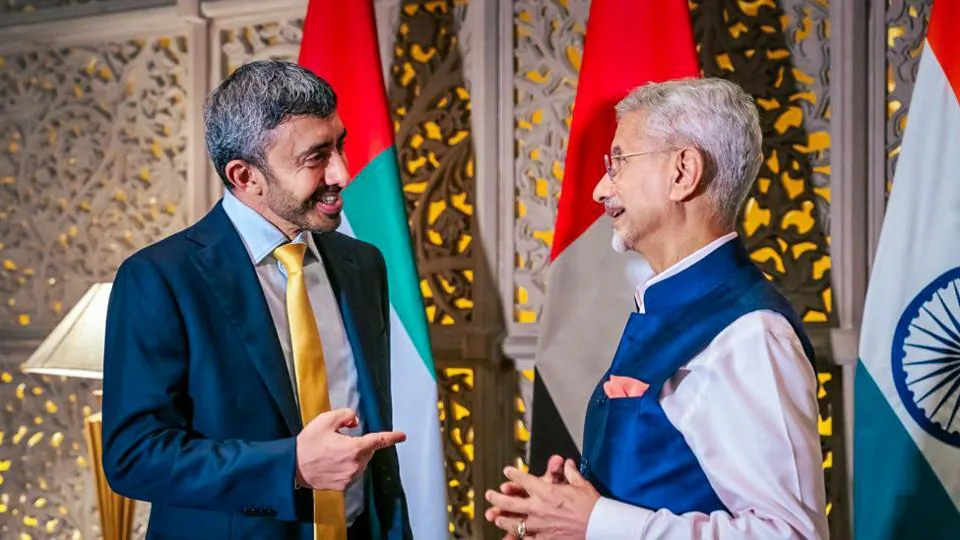
India and the United Arab Emirates are looking to strengthen their strategic partnership as regional tensions in West Asia raise concerns about peace, energy security and international trade. During a meeting in Mumbai on Tuesday, External Affairs Minister S Jaishankar and his UAE counterpart, Sheikh Abdullah bin Zayed Al Nahyan, reviewed bilateral relations and discussed opportunities to expand cooperation across several sectors.
The meeting highlighted the importance both countries attach to maintaining regional stability while building stronger economic and diplomatic ties. Jaishankar expressed deep concern about the situation in the Gulf and emphasised the need for dialogue, diplomacy and the uninterrupted movement of essential goods.
Sheikh Abdullah, who arrived in Mumbai on Monday, said the UAE wanted to build an even closer relationship with India. His remarks reflected Abu Dhabi’s interest in expanding cooperation beyond established areas such as trade and investment to include culture, education and people-to-people connections.
The diplomatic engagement comes as India and the UAE continue to deepen a relationship that has become increasingly important to their economic and strategic interests. Bilateral trade has exceeded $100 billion, while cooperation in defence, energy, technology and logistics has taken on a broader strategic dimension.
India and UAE Express Concern Over West Asia Situation
Regional security was a central theme of the discussions between Jaishankar and Sheikh Abdullah. With continuing uncertainty in West Asia creating concerns for regional stability and international commerce, India reiterated its support for diplomatic efforts aimed at reducing tensions and restoring peace.
At the beginning of the meeting, Jaishankar said the situation in the Gulf remained a matter of deep concern. He stressed that India and the UAE would continue working together and support initiatives that promote dialogue and diplomacy.
India’s position reflects its interest in a stable regional environment. West Asia is important to India’s energy supplies, commercial relationships and connectivity with international markets. Disruptions affecting the region can create wider uncertainty for businesses, shipping and the movement of essential commodities.
Jaishankar also underlined the importance of keeping trade routes open and ensuring that essential goods can move safely. He said India continued to support the free, safe and unimpeded flow of trade, energy and fertilisers.
These priorities extend beyond bilateral commerce. Energy supplies and fertilisers are important to India’s economic activity and agricultural sector, while secure shipping routes help businesses maintain supply chains and fulfil international orders. Regional instability can complicate these movements and increase uncertainty for countries that depend on international trade.
For India and the UAE, maintaining communication during periods of regional tension is therefore an important part of their broader diplomatic relationship. Both countries have economic interests that depend on stable trade and transport networks, giving them a shared reason to support efforts to reduce tensions.
The meeting also demonstrated the role of bilateral diplomacy in addressing challenges that extend beyond any single country. Although the discussions reaffirmed support for dialogue, the broader regional situation remains dependent on developments involving multiple actors and diplomatic initiatives.
UAE Seeks a Closer and More Diverse Partnership With India
Sheikh Abdullah said the UAE was keen to strengthen its relationship with India across a wider range of areas. While the two countries already maintain substantial economic and diplomatic links, the Emirati leadership wants to expand the partnership further.
“We are very close but we want to be closer,” Sheikh Abdullah said, underlining the UAE’s ambition to deepen cooperation.
He also described the UAE as honoured to be among India’s largest trading partners and expressed interest in developing a closer, stronger and more diverse relationship. His remarks highlighted the importance Abu Dhabi places on its engagement with New Delhi.
The emphasis on diversification is significant because India-UAE relations are no longer defined by trade alone. Investment, energy, defence, technology, logistics, education and cultural exchanges have all become important parts of the bilateral agenda.
Sheikh Abdullah specifically identified people-to-people ties, culture and education as areas in which the two countries could do more. These fields can support the long-term relationship by encouraging greater interaction between students, professionals, businesses and cultural institutions.
Education partnerships can create opportunities for academic cooperation and professional development, while cultural exchanges can strengthen understanding between communities. Greater engagement between people can also complement government-level agreements and commercial partnerships.
The UAE’s interest in closer ties also reflects the importance of India as a major economic partner. India’s large domestic market, expanding technology sector and international commercial links provide opportunities for Emirati businesses seeking to diversify their investments and partnerships.
For India, stronger relations with the UAE can support trade, investment, access to regional markets and cooperation in strategically important sectors. The two countries have therefore developed a relationship in which economic interests and diplomatic priorities increasingly overlap.
India-UAE Trade Crosses the $100 Billion Mark
Economic cooperation remains one of the strongest foundations of the India-UAE partnership. Jaishankar said bilateral trade had surpassed $100 billion following the signing of the Comprehensive Economic Partnership Agreement, or CEPA, in 2022.
The agreement was intended to strengthen economic links by improving market access and creating opportunities for businesses in both countries. Since its signing, the partnership has continued to expand despite global economic pressures and challenges arising from regional instability.
The UAE is currently India’s third-largest trading partner, after China and the United States, according to the supplied information. The scale of two-way trade reflects the importance of the Emirates to India’s commercial relationships and the role of Indian businesses in the UAE economy.
Trade agreements can support commercial growth by reducing barriers and making it easier for companies to access foreign markets. However, the full benefits depend on businesses using the available opportunities, maintaining competitive products and services, and navigating the regulatory requirements of both countries.
For Indian exporters, the UAE offers access to an important regional commercial centre with links to markets across West Asia and beyond. For Emirati companies, India provides a large market with demand across sectors such as energy, technology, consumer goods and infrastructure-related services.
The growth in bilateral trade also demonstrates why both governments are interested in maintaining a stable business environment. Regional tensions can create uncertainty for transport routes, energy markets and supply chains, potentially affecting companies that rely on cross-border commerce.
By reaffirming their commitment to economic cooperation, India and the UAE are signalling that their long-term commercial relationship remains a priority despite these external challenges.
Growing Investment Reflects Business Confidence
Trade is only one component of the economic relationship. Jaishankar said two-way investments had continued to grow, reflecting confidence among businesses in each other’s economies.
Investment ties can deepen economic cooperation by connecting companies, financing new projects and supporting the development of long-term commercial relationships. Unlike individual trade transactions, investments can create lasting links between businesses and markets.
For investors, confidence depends on several factors, including market opportunities, regulatory conditions, economic prospects and the ability to manage risk. Strong diplomatic relations can help establish a foundation for cooperation, although individual investment decisions remain dependent on commercial considerations.
India and the UAE have an interest in ensuring that businesses can identify opportunities in both markets. Continued government engagement can help maintain communication on economic priorities and support the broader environment in which cross-border investment takes place.
The $100 billion trade milestone also provides a platform for further cooperation. As businesses build on existing commercial relationships, investment and services can complement goods trade and create opportunities across multiple sectors.
However, sustaining growth will require continued engagement by companies as well as governments. Businesses must assess demand, comply with local rules and identify projects that offer commercially viable returns. The diplomatic partnership can support these efforts, but economic outcomes will ultimately depend on implementation and market conditions.
Defence, Energy and Technology Gain Strategic Importance
Jaishankar said cooperation between India and the UAE in defence, energy and technology was acquiring a strategic character. The remark reflects the expanding scope of a relationship that increasingly encompasses areas connected to national security, economic resilience and technological development.
Energy cooperation is particularly important because reliable supplies are essential to economic activity. India’s interest in maintaining the safe movement of energy products is closely connected to its broader concerns about regional stability and the security of international trade routes.
For both countries, dialogue on energy can complement their wider economic partnership. Cooperation in this field can also involve commercial relationships and discussions about how to maintain reliable connections between producers, markets and consumers.
Defence cooperation adds another dimension to bilateral relations. Engagement in this area can support communication between governments and defence institutions, while creating opportunities to discuss shared security concerns. The precise scope of future cooperation will depend on the priorities and arrangements agreed by both sides.
Technology is another important area for potential growth. India has a substantial technology and digital-services sector, while the UAE has pursued economic diversification and investment across emerging industries. Cooperation can create opportunities for businesses and institutions seeking to develop capabilities, exchange expertise or establish partnerships.
Logistics also featured in Jaishankar’s description of the relationship. Efficient transport and supply-chain networks are essential to a partnership built on significant trade and investment. Better connectivity can help businesses move goods, manage deliveries and maintain access to markets.
By placing these areas within a wider strategic framework, India and the UAE are indicating that their relationship extends beyond immediate commercial transactions. The objective is to build a partnership that can support economic interests while allowing both countries to maintain regular dialogue on regional and international developments.
Why the Indian Community in the UAE Matters
Jaishankar thanked Sheikh Abdullah and the UAE leadership for ensuring the well-being of the Indian community in the Emirates. The UAE is home to approximately 4.5 million Indians, making the community an important human link between the two countries.
The presence of such a large Indian population gives people-to-people relations a central place in bilateral ties. Indian residents contribute to a wide range of economic activities in the UAE, while maintaining family, cultural and commercial connections with India.
For many households, cross-border ties involve employment, remittances, education and regular travel. These connections mean that developments affecting the safety and well-being of Indian residents in the UAE have practical consequences for families and communities in India.
Consular cooperation and communication between governments are therefore important aspects of the relationship. They can help address concerns involving citizens abroad and support coordination when regional conditions become uncertain.
Jaishankar’s remarks placed the welfare of Indian residents alongside trade, energy and diplomacy, highlighting that bilateral relations involve people as well as institutions and businesses.
Sheikh Abdullah’s emphasis on culture and education points towards further opportunities to strengthen these social connections. Exchanges involving students, professionals and cultural organisations can help sustain long-term links between the two societies.
While economic agreements establish formal structures for cooperation, the people who live, work and study across borders help give the relationship its everyday significance.
A Series of High-Level Visits Has Reinforced Bilateral Engagement
The meeting in Mumbai forms part of a broader pattern of high-level engagement between India and the UAE. Several senior Emirati leaders have visited India during the year as both countries have sought to reinforce their relationship amid uncertainty in West Asia.
UAE President Sheikh Mohamed bin Zayed visited India in January. In February, Sheikh Khalid, the Crown Prince of Abu Dhabi, led the UAE delegation to the AI Impact Summit. He also led the UAE delegation to the BRICS Summit in September, according to the supplied information.
Prime Minister Narendra Modi visited the UAE in May, providing another opportunity for engagement between the two governments.
These visits demonstrate the importance both sides attach to maintaining direct political communication. High-level meetings can provide opportunities to review existing commitments, identify areas for further cooperation and discuss regional developments that affect shared interests.
They also help sustain momentum across multiple policy areas. Trade and investment agreements may establish the framework for economic cooperation, while meetings between political leaders can help maintain attention on implementation and new priorities.
At the same time, diplomatic visits do not automatically translate into specific economic or strategic outcomes. Progress depends on follow-up discussions, decisions by the relevant institutions and the willingness of businesses and other stakeholders to act on identified opportunities.
The latest meeting between Jaishankar and Sheikh Abdullah should therefore be viewed as part of an ongoing process of engagement rather than an isolated diplomatic event.
Jaishankar Describes the Meeting as Productive
Following the discussions, Jaishankar said on social media that he had held a productive meeting with Sheikh Abdullah, who also serves as the UAE’s deputy prime minister. He said the two sides had undertaken a comprehensive review of bilateral relations.
Jaishankar highlighted the breadth of cooperation between the countries, pointing to trade, investment, energy, technology, logistics, defence, education and people-to-people ties.
The wide-ranging agenda reflects the increasingly interconnected nature of the relationship. Economic growth, regional security, technology and social connections are not separate issues for countries with extensive commercial and human links. Developments in one area can affect priorities in another.
For example, regional instability can raise concerns about energy and logistics, while strong commercial relationships create incentives to maintain diplomatic communication. Likewise, investment and technology partnerships can strengthen economic links beyond the traditional exchange of goods.
The meeting’s emphasis on both immediate regional concerns and long-term cooperation suggests that India and the UAE want to preserve their strategic engagement while expanding the areas in which they work together.
What the Meeting Means for India-UAE Relations
The discussions in Mumbai underscore the importance of the India-UAE relationship at a time when West Asia faces continuing uncertainty. Both countries have reasons to support regional stability, protect commercial connections and maintain communication on issues that affect their economic interests.
For India, the UAE is a major trading partner, an important destination for Indian residents and a significant partner in areas such as energy, investment and logistics. For the UAE, India offers extensive commercial opportunities and a partner with growing importance across technology, services and international trade.
The relationship also has a strong human dimension, with approximately 4.5 million Indians living in the Emirates. Cooperation on their well-being complements the economic and diplomatic ties that connect the two countries.
Moving forward, the challenge will be to convert high-level commitments into sustained results. Expanding trade and investment requires continued commercial engagement, while deeper cooperation in defence, technology, education and culture depends on practical initiatives and institutional follow-through.
Regional developments will remain an important factor. India’s call for dialogue and diplomacy, along with its emphasis on the safe movement of trade, energy and fertilisers, reflects the importance it attaches to stability in the Gulf.
Sheikh Abdullah’s statement that the UAE wants to be closer to India captures the broader direction of the partnership. With bilateral trade exceeding $100 billion and cooperation extending across an increasingly diverse range of sectors, both countries are seeking to build on an established relationship and make it more comprehensive.
The Mumbai meeting reaffirmed that ambition while highlighting a shared interest in keeping diplomatic channels open during a period of regional uncertainty. The next stage will depend on how effectively both sides translate that commitment into stronger economic links, practical cooperation and continued support for regional stability.
For breaking news and live news updates, like us on Facebook or follow us on Twitter and Instagram. Read more on Latest India on thefoxdaily.com.





COMMENTS 0