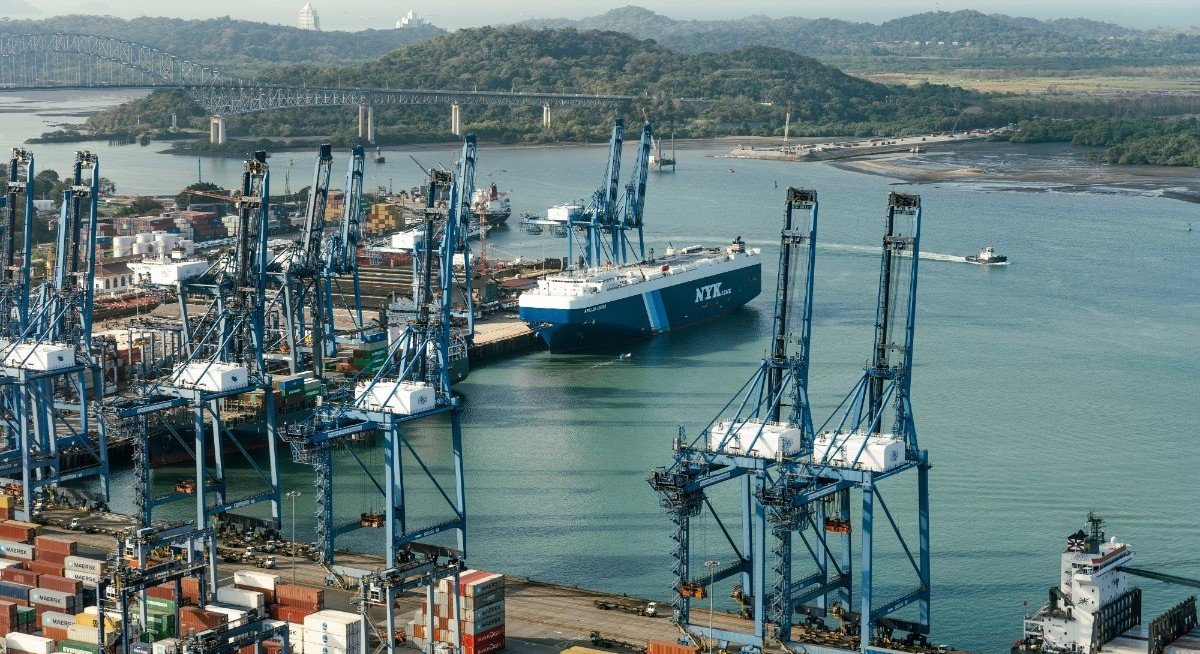
Hong Kong-based conglomerate CK Hutchison has launched a new arbitration proceeding against Panama, seeking more than US$1.5 billion in damages over the seizure of two ports located at either end of the Panama Canal.
The latest legal action adds another layer to a dispute that has already drawn in Panama, china and the United States. At the centre of the conflict are the Balboa and Cristobal ports, which had been operated by a CK Hutchison subsidiary for decades before Panama took control of the facilities following a ruling by the country’s Supreme Court.
CK Hutchison said the latest proceedings concern its rights under an investment protection treaty. The company alleges that Panama breached those protections through what it described as sovereign actions targeting a long-standing ports concession.
The case is separate from an earlier arbitration brought by CK Hutchison’s subsidiary, Panama Ports Company, which is seeking at least $2 billion over the loss of its contractual rights.
Together, the cases demonstrate how the dispute has evolved from a disagreement over a ports concession into a much broader legal and geopolitical confrontation involving one of the world’s most important maritime trade routes.
Why CK Hutchison is seeking more than $1.5 billion
CK Hutchison said it had begun fresh arbitration proceedings against Panama after what it described as a breach of investment protections.
The company alleges that Panama carried out sovereign acts targeting its decades-old concession to operate the two ports. CK Hutchison characterized the actions as part of a “state attack campaign” against its assets in the country.
The latest case is important because it is based on treaty rights, rather than simply the contractual rights associated with the port concession.
That distinction could have significant legal implications. A commercial concession generally establishes rights and obligations between the operator and the government. An investment treaty, by contrast, can provide protections for qualifying foreign investments against certain forms of government action.
CK Hutchison’s new arbitration therefore seeks to establish that Panama’s actions violated protections available to the company’s investment, independently of the contractual dispute being pursued by Panama Ports Company.
The amount being sought is more than $1.5 billion, although launching an arbitration claim does not mean that the full amount will ultimately be awarded.
What happened to the Balboa and Cristobal ports?
The dispute centres on two ports that sit at opposite ends of the Panama Canal.
Balboa is located on the Pacific side of the canal, while Cristobal is on the Atlantic side. Their locations give them strategic importance because vessels moving through the canal depend on infrastructure and logistics services at both ends of the waterway.
CK Hutchison’s subsidiary, Panama Ports Company, had operated the facilities since 1997.
The company later secured a renewal of its concession for another 25 years in 2021. That long operating history became a central part of CK Hutchison’s argument that Panama’s subsequent actions amounted to an attack on an established investment.
The situation changed dramatically after Panama’s Supreme Court ruled that the concession was unconstitutional.
Following the ruling, Panama seized the two ports in February, bringing CK Hutchison’s long-running operation of the facilities to an end.
The takeover became the foundation for the subsequent arbitration claims.
Why the Panama Canal ports became part of US-China tensions
The legal dispute cannot be separated from the wider geopolitical debate surrounding the Panama Canal.
The canal itself is owned and managed by Panama. CK Hutchison did not own the canal. Its subsidiary operated the two ports at either end under a concession.
That distinction became particularly important after Donald Trump returned to the White House.
Trump alleged that China was “running” the Panama Canal, raising concerns about Chinese influence over a waterway that is critical to international trade.
Panama rejected the idea that China controlled the canal, and the country’s government has repeatedly emphasized its own sovereignty over the waterway.
Nevertheless, the presence of a Hong Kong-based company operating major port facilities made the issue politically sensitive in Washington.
For the United States, the canal has enormous strategic and commercial importance because it provides a shortcut between the Atlantic and Pacific oceans. For China, access to global shipping routes and overseas logistics infrastructure is an important component of its broader international trade interests.
That made the ownership and operation of ports near the canal more politically significant than an ordinary commercial concession dispute.
CK Hutchison’s proposed $23 billion ports sale
The controversy also affects a much larger Business transaction.
CK Hutchison had announced an agreement last year to sell its global ports business, including the two Panama facilities, in a deal valued at approximately $23 billion.
The proposed buyer group included US investment firm BlackRock.
The transaction attracted intense attention because it involved strategically located ports and a Hong Kong conglomerate with longstanding business interests around the world.
But the deal has made little progress amid geopolitical tensions and legal challenges involving China, the United States and Panama.
The Panama dispute therefore has implications beyond the compensation claims. It could also affect the future structure of CK Hutchison’s global ports portfolio and the proposed ownership of strategically important infrastructure.
Why China’s reaction matters
Beijing and Hong Kong previously criticized Panama over the takeover of the ports.
The involvement of CK Hutchison has added another dimension to the dispute because the company is based in Hong Kong and is controlled by the family of billionaire Li Ka-shing.
China’s broader concerns about foreign control of strategically important infrastructure have become increasingly significant as competition between Beijing and Washington intensifies.
The Panama Canal is particularly sensitive because of its importance to international commerce and its historical connection to the United States.
As a result, decisions about port operations around the canal can attract attention far beyond Panama’s domestic legal system.
Panama Ports Company is already seeking at least $2 billion
The latest CK Hutchison case is not the first arbitration connected to the ports.
In March, Panama Ports Company separately launched international arbitration proceedings seeking at least $2 billion in compensation from Panama.
The subsidiary argued that the takeover of its port operations was unlawful.
CK Hutchison said those proceedings were continuing to make progress.
The company has emphasized that the new arbitration announced Thursday is different from that earlier case.
The distinction is based on the legal rights being asserted. Panama Ports Company’s earlier case concerns contractual rights, while CK Hutchison’s latest proceeding concerns treaty protections for its investment.
This means the two cases can proceed separately and potentially address different aspects of Panama’s actions.
CK Hutchison has another arbitration involving Maersk
The legal battle does not end with the two cases against Panama.
In April, the subsidiary launched another arbitration proceeding involving Danish shipping and logistics company Maersk after Maersk took over some of its port operations in Panama.
Maersk said at the time that it did not believe it was liable for the claims.
This dispute adds a commercial dimension to the broader conflict because the future operation of the ports is no longer simply a question between CK Hutchison and the Panamanian government.
The transition of port operations involves other major players in the international shipping industry, increasing the number of parties potentially affected by the outcome.
A timeline of the Panama ports dispute
| Year/Period | Development |
|---|---|
| 1997 | CK Hutchison’s subsidiary, Panama Ports Company, began operating the Balboa and Cristobal ports. |
| 2021 | The port concession was renewed for another 25 years. |
| Last year | CK Hutchison announced a proposed $23 billion sale of its global ports business, including the two Panama ports, to a consortium involving BlackRock. |
| February | Panama seized the Balboa and Cristobal ports after the country’s Supreme Court ruled that the concession was unconstitutional. |
| March | Panama Ports Company began separate arbitration proceedings seeking at least $2 billion in compensation. |
| April | The subsidiary launched arbitration proceedings against Maersk over some of the port operations it took over. |
| Thursday | CK Hutchison announced fresh treaty-based arbitration against Panama seeking more than $1.5 billion. |
Why the legal distinction between the cases matters
At first glance, CK Hutchison’s multiple claims may appear to be different versions of the same dispute. Legally, however, they concern different rights and parties.
The earlier case by Panama Ports Company is based on its contractual relationship with Panama. The new CK Hutchison case is based on protections the parent company says it has under an investment treaty.
The arbitration involving Maersk is different again because it concerns another company that became involved in operating parts of the port infrastructure after the takeover.
These distinctions could determine which tribunals hear the cases, what evidence is relevant and what forms of compensation can potentially be sought.
They also mean that the resolution of one proceeding may not automatically settle all of the others.
What is at stake for Panama?
For Panama, the dispute is about more than the immediate operation of two ports.
The government must defend its decision to take control of facilities following the Supreme Court’s ruling while also managing the potential financial consequences of international arbitration.
If arbitration tribunals ultimately find against Panama in one or more cases, the country could face substantial compensation obligations.
There is also a broader investment question.
Foreign companies considering infrastructure investments typically pay close attention to the stability of concessions, government obligations and the legal protections available when disputes arise. A prolonged dispute involving a major international investor could therefore become relevant to how future investors assess Panama.
At the same time, Panama has its own legal and sovereign arguments for the actions it took, particularly following the Supreme Court ruling that found the concession unconstitutional.
The arbitration proceedings will ultimately have to examine those competing claims under the applicable legal frameworks.
What is at stake for CK Hutchison?
For CK Hutchison, the dispute threatens a longstanding presence in one of the world’s most strategically important maritime locations.
The company is pursuing multiple legal avenues to recover compensation and protect its interests.
The outcome could also influence the fate of the proposed $23 billion global ports transaction.
A major unresolved dispute over two of the assets included in such a transaction can complicate negotiations, valuation and regulatory approvals. The longer the uncertainty continues, the more difficult it may become for the parties involved to determine the commercial value and future ownership of the affected assets.
That makes the arbitration cases important not only for compensation but also for the future of CK Hutchison’s ports business.
Why the dispute matters beyond Panama
The case is a useful example of how infrastructure can become entangled with Geopolitics.
Ports are commercial assets, but their location can give them strategic significance. That is particularly true when they are positioned next to a major international shipping route such as the Panama Canal.
The dispute also reflects the growing overlap between economic competition and National Security concerns involving China and the United States.
A ports transaction that might once have been assessed primarily on financial grounds can now attract scrutiny because of questions about ownership, strategic access and geopolitical influence.
For Panama, the challenge is maintaining control over its sovereign infrastructure while managing international investment relationships. For CK Hutchison, the issue is protecting the value of an investment built over decades. For the United States and China, the dispute touches on wider competition over strategically important global infrastructure.
Could the arbitration settle the dispute?
The latest proceedings are likely to take time, and launching arbitration does not mean a settlement or award is imminent.
The parties will have to address questions of jurisdiction, applicable treaty protections, the legality of Panama’s actions, the value of the claimed losses and other issues relevant to the proceedings.
A negotiated settlement remains possible in many commercial and investment disputes, but the supplied information does not establish whether Panama and CK Hutchison are currently pursuing such an agreement.
The immediate development to watch is therefore the progress of the arbitration cases and the legal arguments presented by both sides.
What happens next in the Panama ports dispute?
CK Hutchison’s new claim means the legal pressure on Panama is increasing.
The company is now pursuing a treaty-based claim worth more than $1.5 billion while its subsidiary continues with a separate compensation case of at least $2 billion. There is also an arbitration proceeding involving Maersk over port operations.
The combined disputes create a complicated legal landscape around the Balboa and Cristobal ports.
The broader outcome could depend on decisions by the relevant arbitration tribunals, Panama’s legal position following the Supreme Court ruling and the future of CK Hutchison’s proposed global ports sale.
For the moment, the central issue is no longer simply WHO operates two Panama Canal ports. The dispute has become a test of how sovereign decisions, foreign investment protections and geopolitical interests interact when strategically important infrastructure is involved.
CK Hutchison’s demand for more than $1.5 billion is therefore another major step in a dispute that now stretches across investment law, international shipping and the increasingly competitive relationship between the United States and China.
For breaking news and live news updates, like us on Facebook or follow us on Twitter and Instagram. Read more on Latest World on thefoxdaily.com.

COMMENTS 0