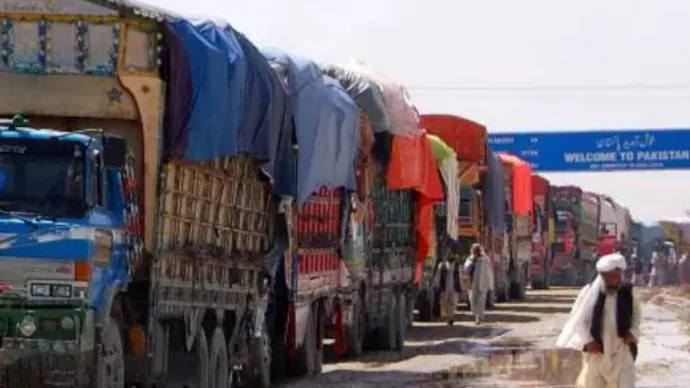
Pakistan has temporarily suspended commercial trade at two key border crossings with Iran, leaving hundreds of freight vehicles carrying essential commodities stranded and raising concerns over liquefied petroleum gas (LPG) supplies and prices. The disruption affects the Gabd-Rimdan and Taftan crossings in Balochistan, with officials from both countries holding consultations to resolve the situation.
The suspension was announced under a notification issued by Pakistan’s Ministry of Commerce on Friday. Pakistani authorities cited security and smuggling concerns, while Iran attributed the disruption to technical issues. The differing explanations have added uncertainty for traders awaiting the resumption of cross-border commercial operations.
Shahid Rind, adviser to the Balochistan chief minister on media affairs, said the temporary closure was intended to improve security and administrative coordination on both sides of the border. He added that discussions were underway between Pakistani and Iranian officials, with trade expected to resume soon.
Why Pakistan Suspended Trade at the Iran Border
Pakistan’s decision to halt commercial operations at Gabd-Rimdan and Taftan was linked to concerns about border security, smuggling and administrative management.
Rind described the measure as necessary to improve the security situation and administrative affairs on both sides of the border. According to him, the suspension was intended to strengthen the effectiveness of the crossings while addressing problems affecting cross-border movement.
The two crossings are important routes for commercial exchanges between Pakistan and Iran. Their closure has interrupted the movement of goods and left transport operators and traders facing uncertainty over when their shipments can proceed.
Pakistan and Iran share a border connecting Pakistan’s Balochistan province with Iran’s Sistan and Baluchestan province. Trade across this frontier supports the movement of energy products, agricultural goods and other commodities, making prolonged disruptions potentially costly for businesses and consumers.
Although Pakistani officials have indicated that the suspension is temporary, the duration of the disruption remains unclear. The restoration of commercial operations will depend on resolving the issues identified by the authorities.
Pakistan and Iran Give Different Reasons for the Closure
The two countries have offered different explanations for why commercial operations were suspended, highlighting the need for further coordination between their authorities.
Pakistan has pointed to security and smuggling concerns, describing the suspension as a measure to improve border management. Iranian Foreign Ministry spokesperson Esmail Baghaei, meanwhile, attributed the disruption to technical issues, according to Iran’s state-run IRNA news agency.
Baghaei also described the closure as temporary and said consultations were taking place to resolve the problem and restore normal operations.
The difference between the two explanations does not necessarily mean that the countries are unable to reach an agreement. Both sides have indicated that discussions are underway. However, the precise nature of the issues affecting the crossings has not been fully detailed in the available statements.
The Quetta Chamber of Commerce and Industry (QCCI) reported a broader disruption, saying trade and commercial activities had been suspended across all border crossings between Pakistan and Iran.
Following the suspension order, the chamber advised businesses engaged in trade with Iran to stop placing new import and export orders until further notice. The advice reflects the uncertainty facing traders who cannot be certain when shipments will move or when normal commercial arrangements can resume.
Hundreds of Freight Vehicles Stranded With Essential Goods
The suspension has left hundreds of freight vehicles carrying essential commodities stranded on both sides of the Pakistan-Iran border. The affected shipments reportedly include LPG, rice, fresh fruit and other goods used by households and businesses.
The disruption is creating logistical problems for transport operators and traders. Goods that cannot cross the border may face delays in reaching their intended markets, while businesses must manage uncertainty over delivery schedules and the handling of waiting cargo.
Fresh produce can be particularly vulnerable to delays because its quality and market value may deteriorate if transportation is interrupted for an extended period. Energy supplies and other essential commodities also face potential distribution challenges when established trade routes become unavailable.
The suspension does not appear to have halted every form of movement at the border. Iran’s WANA news agency reported that passenger traffic through the Rimdan-Gabd crossing remained operational even as commercial activities were suspended.
This distinction is important because a restriction on freight and commercial operations does not automatically mean that passenger movement has also stopped. The available information indicates that commercial traffic has been affected more directly, although arrangements may differ between crossings.
Pakistan Faces Potential LPG Supply and Price Pressures
One of the main concerns arising from the trade suspension is its potential effect on Pakistan’s LPG supply. The Gabd-Rimdan crossing has emerged as an important route for energy imports, making the interruption significant for a market that depends on regular deliveries.
According to a report by Dawn, more than 4,000 tonnes of LPG are imported daily through the route. If commercial movement remains suspended, the disruption could complicate the arrival and distribution of these supplies.
LPG is widely used for cooking and other household and commercial purposes. Any interruption to an important supply route can create pressure on availability, particularly if alternative sources or transportation arrangements cannot quickly compensate for delayed deliveries.
The suspension could also affect market prices. When supplies become less accessible while demand continues, traders may face higher procurement and transportation costs. Those pressures can eventually be reflected in prices paid by consumers.
However, an immediate or nationwide price increase cannot be established from the suspension alone. The actual effect will depend on how long the crossings remain closed, the volume of available stocks, the availability of alternative supply routes and the speed at which commercial operations resume.
The reported daily LPG import volume highlights why the Gabd-Rimdan route matters, but it does not establish that all of those supplies have stopped reaching Pakistan. The scale of the eventual impact will depend on the extent to which importers can maintain deliveries through other arrangements.
Taftan Disruptions Add to Border Trade Uncertainty
The suspension at Taftan is another concern for traders because the crossing has already experienced disruptions amid unrest in Balochistan.
Taftan connects Pakistan with Iran through the Mirjaveh crossing and is an established route for cross-border movement. Interruptions there can complicate commercial logistics, particularly when another important crossing is also unavailable for trade.
The simultaneous suspension of commercial operations at Taftan and Gabd-Rimdan reduces the routes available to businesses seeking to move goods between the two countries. This can leave freight operators with fewer options while they wait for official instructions.
The additional pressure on trade is particularly relevant for shipments that depend on predictable transportation schedules. Delays can affect delivery commitments, inventory planning and the cost of keeping vehicles and cargo waiting at border points.
For businesses that regularly import or export goods across the frontier, the QCCI’s advice to pause fresh orders provides a precautionary response to the uncertainty. Until authorities clarify when trade can resume, new transactions could expose traders to additional delays and logistical risks.
Pakistan-Iran Border Has Four Official Crossings
The 909-kilometre border between Pakistan’s Balochistan province and Iran’s Sistan and Baluchestan province has four official crossings: Taftan-Mirjaveh, Gabd-Rimdan, Mand and Chadgi.
These crossing points support commercial and other cross-border movement between the neighbouring countries. Their importance extends beyond individual shipments because they form part of the wider transport network used by traders to move goods between the two markets.
The temporary suspension at Gabd-Rimdan and Taftan has disrupted commercial movement along two of these routes. The QCCI’s statement that trade has been suspended across all crossings suggests that the impact on businesses may extend beyond the two locations identified in Pakistan’s initial announcement.
However, the available reports do not provide a complete operational breakdown for every crossing. The extent of restrictions at Mand and Chadgi, including whether particular categories of movement remain permitted, should therefore be distinguished from the specifically reported closures at Gabd-Rimdan and Taftan.
The reported continuation of passenger traffic through Rimdan-Gabd also indicates that restrictions on commercial movement may not apply identically to every category of traffic.
What Happens Next for Border Trade?
The immediate priority for Pakistan and Iran is to resolve the issues preventing normal commercial operations and provide clarity to traders and transport operators.
Both governments have indicated that consultations are underway. Pakistan has emphasised security and administrative concerns, while Iran has referred to technical problems. A clearer explanation of the outstanding issues, along with an announcement on the reopening of the crossings, would help businesses plan their shipments and manage existing cargo.
The duration of the suspension will be a key factor in determining its economic impact. A short interruption may mainly result in temporary delays and additional transport costs. A prolonged closure could place greater pressure on supply chains, particularly for LPG and perishable agricultural products.
For consumers, the main concern is whether delayed imports will affect the availability and cost of essential goods. LPG prices are a particular focus because of the reported volume of energy imports moving through Gabd-Rimdan. Nevertheless, the final effect will depend on supply conditions and how quickly trade resumes.
For now, hundreds of freight vehicles remain affected by the suspension, while businesses have been advised to hold off on fresh orders. Until Pakistani and Iranian officials resolve the outstanding issues and clarify the reopening arrangements, uncertainty is likely to continue for traders relying on the two countries’ cross-border routes.
For breaking news and live news updates, like us on Facebook or follow us on Twitter and Instagram. Read more on Latest World on thefoxdaily.com.






COMMENTS 0