- The Remark That Sparked the Political Spin
- Trump Quickly Redirected the Narrative Toward Biden
- Why Xi’s “Thucydides Trap” Reference Matters So Much
- The Summit Revealed Two Very Different Political Priorities
- Trump Is Trying to Reframe the “American Decline” Debate
- The Optics of the Beijing Summit Matter Globally
- Xi Appears to Be Pursuing Stability Without Surrender
- The Domestic Political Impact Could Be Significant
- Conclusion: A Diplomatic Summit Became a Battle Over America’s Narrative
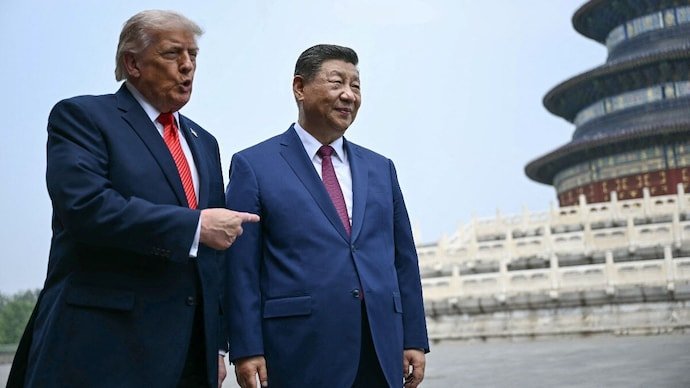
US President Donald Trump turned a potentially uncomfortable geopolitical observation into a domestic political message on Friday, reframing Chinese President Xi Jinping’s remarks about American decline as criticism aimed not at the United States itself, but specifically at former President Joe Biden’s administration.
The moment quickly became one of the most closely watched political exchanges emerging from the ongoing Trump-Xi summit in Beijing, highlighting how international diplomacy and domestic political narratives are increasingly intertwined.
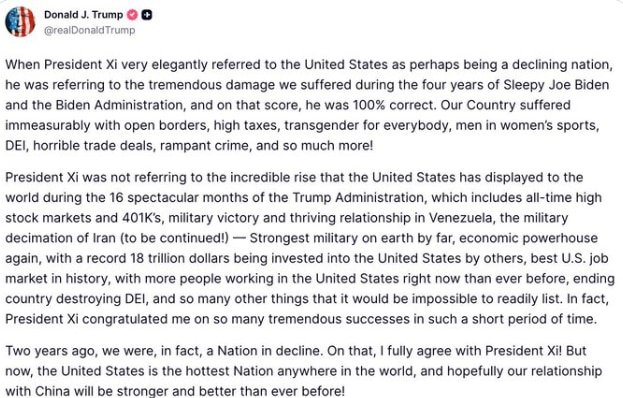
Posting on Truth Social ahead of the second day of talks with Xi, Trump wrote that when the Chinese leader referred to America as “perhaps being a declining nation,” he was talking about “the tremendous damage” caused during Biden’s presidency.
“On that score, he was 100% correct,” Trump declared, once again using the nickname “Sleepy Joe Biden” while contrasting the previous administration with what he described as America’s current resurgence under his leadership.
The White House later amplified Trump’s message, reinforcing the administration’s effort to frame the summit not only as a diplomatic event, but also as evidence of restored American strength.
The Remark That Sparked the Political Spin
One important detail remains unclear: Xi Jinping never publicly used the exact phrase “declining nation” during the summit’s visible proceedings.
That uncertainty has fuelled intense speculation about whether the remark was made privately during closed-door discussions or whether Trump was broadly interpreting Xi’s broader geopolitical comments.
What Xi did publicly discuss, however, was the concept of the “Thucydides Trap” one of the most important theories in modern International Relations.
During his remarks in Beijing, Xi asked whether china and the United States could avoid falling into this historical pattern, which describes the dangerous tensions that arise when a rising power challenges an established dominant power.
The concept originates from ancient Greek historian Thucydides and was later popularised by Harvard political scientist Graham Allison.
In simple terms, the theory argues that conflict often becomes likely when an emerging power threatens the position of an existing superpower.
Xi’s use of the phrase carried enormous geopolitical significance because it subtly acknowledged the central reality shaping modern Global Politics: China’s rise and America’s response to it.
Trump Quickly Redirected the Narrative Toward Biden
Rather than treating Xi’s comments as criticism of the United States broadly, Trump strategically personalised the issue.
His response followed a familiar political formula:
- Distance current America from past problems
- Attribute decline to Biden-era policies
- Present his presidency as a national comeback story
- Reinforce his image as a leader respected by foreign powers
Trump claimed the United States had experienced an “incredible rise” during what he described as “16 spectacular months” of his presidency.
He pointed to stock market gains, employment numbers, investment announcements, Military strength and international influence as evidence that America was once again dominant globally.
“Two years ago, we were, in fact, a Nation in decline,” Trump wrote. “But now, the United States is the hottest Nation anywhere in the world.”
The statement reflected Trump’s long-standing political approach of framing national recovery through the lens of his own leadership brand.
Why Xi’s “Thucydides Trap” Reference Matters So Much
While Trump focused on domestic political messaging, Xi’s remarks revealed a much broader strategic concern.
The “Thucydides Trap” has become a central framework in discussions about US-China rivalry because it captures fears that competition between the two powers could eventually spiral into confrontation.
| Concept | Meaning | Why It Matters Today |
|---|---|---|
| Thucydides Trap | Conflict between rising and established powers | Used to describe US-China tensions |
| Rising Power | China’s expanding economic and military influence | Challenges existing US dominance |
| Established Power | United States’ global leadership position | Seeks to maintain strategic advantage |
| Strategic Competition | Economic, military and technological rivalry | Defines modern geopolitics |
Xi’s comments about “great changes unseen in a century” also carried strategic weight.
That phrase has become increasingly common in Chinese political messaging and typically refers to Beijing’s belief that the post-World War II international order largely shaped by American power is undergoing historic transformation.
In other words, China increasingly sees itself not merely as a participant in the global system, but as a force reshaping it.
The Summit Revealed Two Very Different Political Priorities
The Trump-Xi summit has exposed a fascinating contrast in political messaging styles.
Xi’s language has focused heavily on historical change, global balance shifts and long-term strategic transformation.
Trump, meanwhile, has consistently redirected those discussions toward domestic political branding and economic performance narratives.
This difference reflects the political realities both leaders face.
Xi Jinping’s Priorities
- Project China as a rising Global Power
- Promote stability with the US
- Avoid direct confrontation
- Strengthen China’s international legitimacy
- Manage economic uncertainty at home
Donald Trump’s Priorities
- Present himself as restoring American dominance
- Blame Biden for past instability
- Show personal diplomatic influence
- Reassure markets and investors
- Project economic confidence
The summit therefore became both a diplomatic event and a political communications exercise.
Trump Is Trying to Reframe the “American Decline” Debate
The idea of “American decline” has circulated in academic and geopolitical discussions for decades.
Critics point to:
- Political polarization
- Rising debt levels
- Manufacturing challenges
- Foreign policy setbacks
- China’s rapid economic growth
Supporters of the US position argue that America still retains enormous advantages in Innovation, military capability, financial influence and global alliances.
Trump’s Beijing comments fit into a broader effort to redefine that debate politically.
Rather than accepting decline as structural or long-term, he portrayed it as temporary and specifically tied to the Biden administration.
This framing allows Trump to position himself not merely as a president managing competition with China, but as the leader reversing national decline altogether.
It is a powerful political narrative because it combines nationalism, economic messaging and personal leadership branding into one argument.
The Optics of the Beijing Summit Matter Globally
The summit’s symbolism extends far beyond the bilateral relationship.
Countries around the world are closely watching how Washington and Beijing manage their increasingly complicated rivalry.
The images of Trump and Xi exchanging compliments and discussing cooperation stand in sharp contrast to the aggressive rhetoric seen during earlier phases of the US-China trade war.
However, beneath the warmer tone remain deep disagreements involving:
- Taiwan
- Technology restrictions
- Military influence in Asia
- Trade imbalances
- Supply chain security
- Artificial intelligence competition
That is why Xi’s references to historical transitions and Trump’s insistence on American resurgence both matter.
They reflect two competing visions of the future global order.
Xi Appears to Be Pursuing Stability Without Surrender
One important aspect of the summit is China’s apparent effort to stabilise ties with Washington while still asserting its long-term ambitions.
Beijing understands that open confrontation with the United States would create enormous economic risks, particularly while China continues dealing with slower growth, weak consumer confidence and investment concerns.
At the same time, Xi’s rhetoric suggests China has no intention of accepting permanent American dominance.
The message emerging from Beijing appears carefully balanced:
- Avoid direct conflict
- Maintain economic engagement
- Expand China’s global influence
- Push for recognition as an equal superpower
This balancing strategy explains why the summit combined diplomatic warmth with subtle strategic messaging.
The Domestic Political Impact Could Be Significant
Trump’s response to Xi may also resonate strongly within American domestic politics.
By turning a geopolitical observation into criticism of Biden, Trump reinforced one of his central campaign themes: that America weakened under Democratic leadership and recovered under his presidency.
The White House’s rapid amplification of the message suggests the administration sees political value in the exchange.
It also demonstrates how international summits increasingly function as domestic political stages.
Modern diplomacy is no longer just about negotiations between governments. It is also about shaping public perception, financial confidence and media narratives in real time.
Conclusion: A Diplomatic Summit Became a Battle Over America’s Narrative
The Trump-Xi summit in Beijing was already politically significant because it symbolised a dramatic thaw in tone between the world’s two largest powers.
But Xi’s comments about global power shifts and Trump’s rapid attempt to redirect them toward Biden transformed the meeting into something even larger: a debate over America’s trajectory itself.
Xi framed the moment as part of a historic global transition.
Trump reframed it as proof that American decline was temporary and politically reversible.
That difference captures the broader geopolitical reality shaping the modern world.
China increasingly believes the global order is shifting away from unchallenged American dominance. The United States, meanwhile, remains determined to demonstrate that its power, influence and economic leadership are far from fading.
The smiles and diplomacy in Beijing may have softened the tone temporarily, but the underlying competition over who defines the future global order remains very much alive.
For breaking news and live news updates, like us on Facebook or follow us on Twitter and Instagram. Read more on Latest World on thefoxdaily.com.




COMMENTS 0