- Trump’s Style Usually Relies on Dominance
- China Is One of the Few Countries That Can Push Back
- The Trade War Changed Washington’s Understanding of China
- Rare Earths and Supply Chains Give China Massive Influence
- Why Trump Brought America’s Biggest CEOs to Beijing
- The Iran Factor Also Changed the Equation
- China Now Projects Itself as an Equal Power Center
- Trump’s Change in Tone Is Also Strategic
- The Relationship Is Now Defined by Rivalry and Dependence
- Even Symbolism Matters in Beijing
- Conclusion: China Forces a Different Kind of Diplomacy
Donald Trump is rarely associated with restraint.
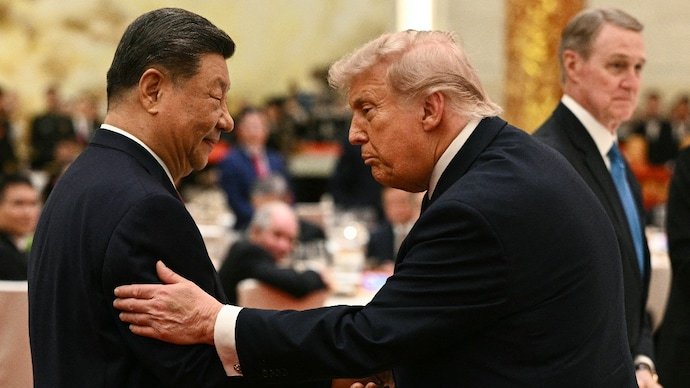
Whether confronting allies, criticizing rivals, or dominating press conferences, Trump has built much of his political identity around projecting strength, unpredictability, and confrontation. Yet during his latest visit to Beijing, something appeared different.
The sharp rhetoric softened.
The aggressive body language disappeared.
The improvisational attacks were largely absent.
Instead, viewers saw a more measured Trump standing beside Chinese President Xi Jinping careful with his words, controlled in tone, and unusually diplomatic.
The contrast was impossible to ignore.
It immediately raised an important geopolitical question:
Why does China bring out a toned-down version of Trump?
The answer lies in the changing balance of Global Power.
Unlike many leaders Trump has publicly challenged or embarrassed, China is not a smaller ally dependent on Washington’s protection. It is a rival superpower with enormous economic influence, technological ambitions, Military strength, and the ability to impose real costs on the United States.
In Beijing, Trump faces a government that can hit back.
Trump’s Style Usually Relies on Dominance
Trump’s political and diplomatic approach has often relied on creating pressure through unpredictability and public confrontation.
Over the years, he has repeatedly used:
- Public criticism
- Aggressive negotiation tactics
- Media spectacles
- Personalized attacks
- Shock-value Diplomacy
Many of these moments happened on American soil, where Trump controlled the stage and political atmosphere.
Examples frequently cited include:
- Publicly pressuring foreign leaders during White House meetings
- Confrontational trade negotiations
- Highly theatrical diplomatic exchanges
- Dominating media coverage through unpredictability
Trump’s style often works best when the power imbalance favors the United States.
But China changes that equation.
China Is One of the Few Countries That Can Push Back
The key difference with China is simple:
Beijing has leverage Washington cannot easily ignore.
China today is not merely a regional power. It is a global economic and geopolitical center with influence across trade, Manufacturing, technology, energy, and supply chains.
Unlike smaller countries that rely heavily on US military or financial support, China has the capacity to retaliate economically and strategically.
That changes diplomatic behavior on both sides.
Trump understands that aggressive posturing toward Beijing carries real consequences for:
- American companies
- Financial markets
- Supply chains
- Technology access
- Energy prices
- Global trade stability
This creates a more cautious dynamic than Trump typically encounters with allied nations or weaker economies.
The Trade War Changed Washington’s Understanding of China
Trump’s earlier trade war with China fundamentally reshaped perceptions in both countries.
Initially, Washington believed tariffs and economic pressure would force Beijing into major concessions.
But China responded aggressively with:
- Reciprocal tariffs
- Export restrictions
- Supply-chain pressure
- Economic countermeasures
The standoff revealed an uncomfortable reality for Washington:
America and China are deeply economically intertwined.
Despite efforts to reduce dependence, many US industries still rely heavily on Chinese manufacturing, rare earth minerals, electronics production, and industrial supply chains.
The trade war demonstrated that economic confrontation with China also creates pain inside the United States.
That lesson appears to shape Trump’s more restrained approach today.
Rare Earths and Supply Chains Give China Massive Influence
One of China’s biggest strategic advantages is its dominance in critical industrial supply chains.
China plays a major role in:
- Rare earth mineral processing
- Battery production
- Electronics manufacturing
- Solar equipment
- Electric vehicle supply chains
- Industrial materials
These sectors are essential not only for consumer technology but also for Defense systems, renewable energy infrastructure, and advanced manufacturing.
This gives Beijing powerful economic leverage.
For example, restrictions on rare earth exports could directly affect American industries ranging from semiconductors to military hardware.
Trump’s delegation itself reflected this dependence.
The presence of CEOs like Elon Musk, Tim Cook, and Jensen Huang highlighted how deeply American technology giants remain connected to Chinese markets and supply systems.
Why Trump Brought America’s Biggest CEOs to Beijing
Trump did not travel to China alone.
He arrived with some of America’s most influential corporate leaders, including executives from:
- Tesla
- Apple
- Nvidia
- Meta
- Goldman Sachs
- Visa
- Mastercard
That business-heavy delegation revealed the true stakes behind the visit.
Many of these companies urgently need:
- Regulatory approvals
- Market access
- Supply-chain stability
- Technology permissions
- Investment clarity
China remains one of the world’s largest consumer and industrial markets.
For many US corporations, maintaining stable relations with Beijing is no longer optional it is essential.
This reality naturally moderates Washington’s tone.
| Area Where China Holds Leverage | Why It Matters to the US |
|---|---|
| Rare earth minerals | Critical for electronics and defense industries |
| Manufacturing supply chains | Supports global production networks |
| Consumer market size | Major revenue source for US corporations |
| Energy influence through Iran ties | Affects global oil prices and inflation |
| Electric vehicle ecosystem | Central to future automotive competition |
| AI and semiconductor demand | Important for US tech companies |
The Iran Factor Also Changed the Equation
Another major reason for Trump’s softer tone involves the ongoing Iran crisis.
China maintains close strategic and economic ties with Tehran, making Beijing one of the few global powers with influence over Iran.
The conflict surrounding the Strait of Hormuz has become a major concern for Washington because disruptions in Gulf shipping directly affect:
- Global oil prices
- Fuel inflation
- Shipping markets
- Economic stability
Trump’s administration has struggled to force Iran into concessions despite military pressure and sanctions.
That makes China diplomatically important.
Beijing’s agreement with Washington that the Strait of Hormuz must remain open signaled rare strategic alignment between the two powers.
It also revealed that the United States likely needed China’s cooperation more than it publicly admitted.
China Now Projects Itself as an Equal Power Center
One of the biggest geopolitical shifts of the past two decades is China’s growing confidence in presenting itself as a peer competitor to the United States.
Beijing increasingly positions itself not as a junior global actor but as:
- An alternative economic center
- A technological superpower
- A military force
- A diplomatic heavyweight
- A defender of multipolarity
This shift changes diplomatic psychology.
China expects to be treated as an equal power, not as a country pressured into compliance.
Trump appears to recognize that reality.
The carefully choreographed Beijing summit reflected mutual awareness that open hostility could destabilize markets, energy flows, and global business confidence.
Trump’s Change in Tone Is Also Strategic
Trump’s softer tone should not necessarily be viewed as weakness alone.
It may also reflect strategic calculation.
At the moment, the United States faces multiple economic and geopolitical pressures, including:
- Inflation concerns
- Market volatility
- Energy-price instability
- Global supply-chain disruptions
- Technological competition
Under those conditions, avoiding a major escalation with China may serve American interests as well.
Trump likely understands that confrontation with Beijing can rapidly affect stock markets, fuel prices, and corporate confidence all politically sensitive issues.
This creates incentives for tactical restraint.
The Relationship Is Now Defined by Rivalry and Dependence
Perhaps the most important insight from Trump’s Beijing visit is that US-China relations are no longer simple.
The two countries are simultaneously:
- Economic partners
- Strategic rivals
- Technology competitors
- Supply-chain dependents
- Military adversaries in some regions
That creates a highly unusual relationship where confrontation and cooperation coexist.
Trump’s toned-down behavior reflects that complexity.
Unlike past eras where the United States clearly dominated the global system, Washington now faces a competitor powerful enough to resist pressure and shape outcomes independently.
Even Symbolism Matters in Beijing
Diplomacy with China is also deeply symbolic.
Beijing carefully choreographs major visits to project stability, control, and parity.
Every handshake, speech, seating arrangement, and public statement carries political meaning.
For Trump, appearing excessively confrontational in Beijing could risk:
- Market instability
- Diplomatic embarrassment
- Business fallout
- Strategic escalation
That is why the tone of the summit appeared far more controlled compared with many of Trump’s previous international encounters.
Conclusion: China Forces a Different Kind of Diplomacy
Donald Trump’s noticeably restrained behavior in Beijing reflects more than personal diplomacy. It reflects the changing structure of global power.
China today possesses enough economic influence, technological strength, geopolitical reach, and strategic leverage to force even the most aggressive American leaders into a more measured approach.
From rare earth minerals and AI competition to global supply chains and the Iran crisis, Beijing now holds cards Washington cannot easily dismiss.
Trump’s softer tone therefore reveals something larger than one diplomatic visit.
It signals how the rise of China has changed the rules of international power Politics.
The United States may still remain the world’s dominant military and financial power, but China has become strong enough that confrontation now carries real costs for both sides.
And in modern Geopolitics, that reality changes behavior even for Donald Trump.
For breaking news and live news updates, like us on Facebook or follow us on Twitter and Instagram. Read more on Latest World on thefoxdaily.com.






COMMENTS 0