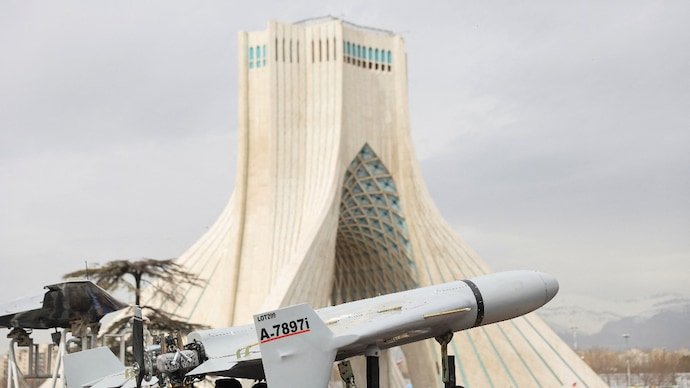
- The Rise of Low-Cost Drone Warfare
- Why Cheap Drones Are a Big Problem for Expensive Militaries
- Oversaturation: The Key Tactical Advantage
- The Financial Strain on the United States
- Psychological and Strategic Impact
- The Search for Solutions: Can the US Adapt?
- A Broader Shift in Warfare Doctrine
- Real-World Impact: What This Means Globally
- Conclusion: The $35,000 Disruption That Changed the Game
The image of modern warfare has long been dominated by billion-dollar Fighter Jets, precision-guided missiles, and cutting-edge defence systems. But in today’s conflicts, a far simpler weapon is quietly rewriting the rules: low-cost attack drones.
Iran’s growing use of inexpensive unmanned aerial vehicles particularly the widely deployed Shahed drones has created an unexpected strategic dilemma for the United States and its allies. These drones, often costing as little as $20,000 to $50,000, are forcing defenders to respond with systems that can cost hundreds of thousands or even millions per interception.
The result is a stark imbalance: a cheap offensive tool triggering an expensive defensive reaction. And that imbalance is reshaping how wars are fought.
The Rise of Low-Cost Drone Warfare
Iran’s drone strategy is built on a simple but powerful idea: overwhelm advanced systems with volume rather than sophistication.
Unlike traditional military hardware, these drones are:
- Built using commercial-grade components
- Relatively easy to mass-produce
- Designed for one-way “suicide” missions
Despite their simplicity, they are far from ineffective.
With a range of up to 2,000 kilometres, a speed of around 180 km/h, and the ability to carry approximately 40 kilograms of explosives, Shahed drones are capable of striking deep and causing significant damage.
Insight: This marks a shift from precision warfare to attrition through scale a tactic that prioritizes quantity over technological superiority.
Why Cheap Drones Are a Big Problem for Expensive Militaries
The challenge is not just the drones themselves it’s the cost of stopping them.
Modern air defence systems are designed to intercept high-speed missiles and advanced aircraft. Using them against slow, low-cost drones creates a mismatch.
| Category | Offensive Drone | Defensive Interceptor |
|---|---|---|
| Cost | $20,000 – $50,000 | $100,000 – $1M+ |
| Production | Mass-produced | Limited, complex |
| Strategy | Swarm attacks | Individual interception |
Core Problem: Even if every drone is successfully intercepted, the defender may still lose economically.
Oversaturation: The Key Tactical Advantage
One of the most effective aspects of Iran’s drone strategy is oversaturation.
By launching large numbers of drones simultaneously, attackers can:
- Overwhelm radar and tracking systems
- Force defenders to make rapid, costly decisions
- Increase the probability of at least some drones getting through
In the early phase of the Conflict, more than 1,000 drones were launched in just one week. Even advanced defence networks struggle under such pressure.
Comparison Insight: This tactic is similar to cyberattacks like DDoS flood the system until it fails.
The Financial Strain on the United States
The economic implications are staggering.
In just the first six days of the conflict, the United States reportedly spent around $11.3 billion. Within weeks, estimates suggest total costs reached $25–35 billion, with a significant portion attributed to air defence operations.
This highlights a critical vulnerability: even the world’s most advanced military can face unsustainable costs when confronting low-cost, high-volume threats.
Unique Angle: Warfare is no longer just about firepower it’s about cost efficiency per engagement.
Psychological and Strategic Impact
Beyond financial costs, the widespread use of low-tech drones carries symbolic weight.
For decades, U.S. military dominance has been associated with technological superiority. The ability of a relatively inexpensive system to challenge that perception has broader implications:
- It weakens the narrative of unmatched military power
- Encourages other nations to adopt similar tactics
- Lowers the barrier to entry for asymmetric warfare
Insight: The real disruption is not the drone itself it’s the democratization of military capability.
The Search for Solutions: Can the US Adapt?
Recognizing the challenge, the U.S. is exploring alternative defence strategies.
1. Interceptor Drones
Instead of using expensive missiles, smaller interceptor drones are being developed to neutralize incoming threats at lower cost.
2. Electronic Warfare
Jamming signals or disabling drone navigation systems offers a non-kinetic solution.
3. Directed Energy Weapons
Laser-based systems could provide a cost-effective way to counter swarm attacks in the future.
One example under discussion includes the deployment of interceptor platforms capable of short-range engagements, though their real-world effectiveness remains uncertain.
Prediction: The next phase of military Innovation will focus heavily on low-cost defence systems rather than high-end offensive weapons.
A Broader Shift in Warfare Doctrine
The implications of Iran’s drone strategy extend far beyond a single conflict.
Military planners worldwide are now rethinking core assumptions:
- High-cost systems are not always the most effective
- Volume can outperform precision in certain scenarios
- Future wars may prioritize affordability and scalability
This represents a fundamental shift toward asymmetric warfare, where weaker forces exploit cost and flexibility to counter stronger opponents.
Real-World Impact: What This Means Globally
The ripple effects of this strategy are already visible:
1. Increased Drone Adoption
More countries are investing in low-cost UAV programs.
2. Defence Budget Reallocation
Funds may shift from traditional systems to counter-drone technologies.
3. Changing Battlefield Dynamics
Future conflicts may involve swarms of autonomous or semi-autonomous systems.
Insight: The battlefield is becoming less about individual superiority and more about system-level efficiency.
Conclusion: The $35,000 Disruption That Changed the Game
Iran’s use of low-cost drones has exposed a critical weakness in modern military strategy: expensive defence systems are not always sustainable against cheap, scalable threats.
What makes this development significant is not just the Technology but the strategy behind it. By leveraging affordability, mass production, and simplicity, Iran has demonstrated how smaller investments can yield outsized impact.
For the United States and its allies, the lesson is clear: adapting to this new reality is no longer optional.
Looking ahead, the future of warfare will likely be defined not by who has the most advanced weapons, but by who can balance effectiveness with cost.
And in that equation, the humble drone may prove to be one of the most disruptive forces of the 21st century.
For breaking news and live news updates, like us on Facebook or follow us on Twitter and Instagram. Read more on Latest World on thefoxdaily.com.





COMMENTS 0