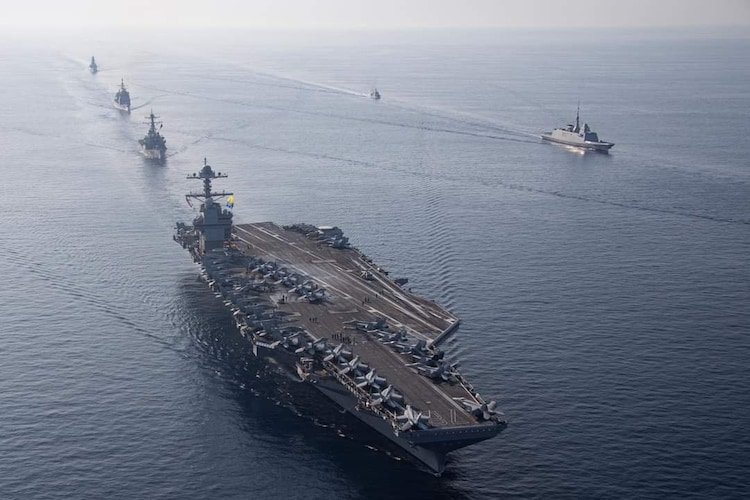
The United States has shifted one of its aircraft carriers into the Middle East as the USS George Washington replaces the USS Abraham Lincoln, maintaining an American carrier presence in the region while the Lincoln begins its journey home after a deployment lasting more than 250 consecutive days at sea.
The handover comes as the US continues Military operations connected to the Iran conflict and enforces a reimposed blockade on Iranian ports around the Strait of Hormuz. At the same time, the movement has created a temporary gap in America’s aircraft-carrier presence in Asia, where the US military is closely watching China’s increasingly assertive behaviour.
The deployment change therefore has two dimensions. In the Middle East, Washington is maintaining carrier-based military capability despite uncertainty over how long the current Iran-related mission will continue. In the Indo-Pacific, the departure of the George Washington means the region is temporarily without a US carrier strike group.
But the immediate focus is also on the sailors returning aboard the Abraham Lincoln. The carrier’s unusually long period at sea has generated reports about crew stress, Mental health concerns and shortages of basic supplies, adding a personnel-welfare issue to what is already a demanding military deployment.
USS George Washington arrives as Abraham Lincoln heads home
US Central Command said the USS George Washington arrived in the Middle East on Wednesday and has begun operating in the region. The carrier had previously been associated with the US military’s Asia-Pacific presence.
The arrival allows the US Navy to maintain a carrier-based capability in the Middle East while the Abraham Lincoln leaves the region.
The exact timing of the Lincoln’s return to the United States was not immediately clear, including whether the ship would make a port call before reaching its home base. The journey back is expected to take more than a month.
The Lincoln departed its home port in San Diego in November and reached the Middle East in January. Its deployment subsequently stretched beyond 250 uninterrupted days at sea, making it an unusually lengthy period for a carrier crew.
Aircraft carriers are designed to operate for extended periods, but the demands of sustained deployment can accumulate over time. Sailors must maintain aircraft, propulsion systems, weapons, communications equipment and other complex systems while also carrying out continuous operational duties.
The human cost can be less visible than the military activity itself.
Why the Abraham Lincoln’s deployment raised crew welfare concerns
Reports from aboard the Lincoln have highlighted concerns involving crew stress, mental health and shortages of food and hygiene products.
Several Democratic lawmakers have asked the US Department of Defence to provide greater accountability over the conditions reported aboard the carrier.
The reports have been disputed by Defence Secretary Pete Hegseth, who described them as “completely misrepresented.” President Donald Trump has also played down concerns about the ship’s lengthy deployment.
Trump described the nearly nine-month period at sea as a “good period of time” and argued that US carriers have remained deployed for even longer periods in the past. He also said he had spoken with a retired admiral who described the Lincoln as well maintained, although he did not identify the officer.
The disagreement illustrates an important distinction in military deployments: a ship can remain operationally effective while its crew simultaneously experiences significant fatigue and pressure.
For a carrier strike group, readiness depends not only on the condition of aircraft and machinery but also on the sailors responsible for operating and maintaining them.
US military leadership praises Lincoln’s crew
US Central Command leadership has publicly praised the sailors who served aboard the Lincoln.
Admiral Brad Cooper, the head of US Central Command, visited the carrier after speaking with its crew. In an editorial published in The Wall Street Journal, Cooper praised the sailors’ performance during the deployment and said they were now going home.
After visiting the carrier, Cooper also highlighted the leadership’s focus on mental health and resilience.
He described the deployment as one of the most operationally intense and consequential periods of the modern era.
Those comments underscore the scale of the mission even as questions remain about how long the crew was required to sustain that operational tempo.
Why prolonged carrier deployments are difficult
An aircraft carrier is effectively a floating military base. Thousands of sailors live and work aboard the ship, while carrier-based aircraft must be maintained and prepared for missions around the clock.
Long deployments can therefore create pressure in several areas at once.
- Personnel fatigue: Extended periods away from home can affect sleep, morale, family relationships and mental resilience.
- Operational tempo: Continuous missions require sailors and aviation personnel to maintain a high level of readiness for long periods.
- Equipment wear: Aircraft, engines, electrical systems and other machinery require constant maintenance during extended operations.
- Logistical demands: Food, medical supplies, hygiene products, spare parts and other necessities must be replenished despite the ship’s distance from home.
- Leadership pressure: Commanders must balance operational requirements with crew welfare and long-term readiness.
The Lincoln’s experience highlights why carrier rotations are important. Replacing one carrier with another does not necessarily mean that the US military is reducing its regional commitment. Instead, it can allow a new crew and ship to assume the mission while the returning force receives maintenance and recovery time.
Iran keeps pressure on the US Navy in the Middle East
The carrier handover is taking place against the backdrop of continuing US military activity connected to Iran.
The US Navy is enforcing a reimposed blockade on Iranian ports in the Strait of Hormuz, one of the world’s most strategically important maritime corridors.
The Strait of Hormuz connects the Persian Gulf with the Gulf of Oman and the wider Arabian Sea. Its strategic importance means that military activity around the waterway can have consequences far beyond the immediate region.
For the US Navy, maintaining a carrier presence in the Middle East provides a mobile platform for air operations, surveillance and other military missions. Unlike a fixed military base, an aircraft carrier can move with changing operational requirements.
However, maintaining such a presence requires significant personnel and equipment resources, particularly when the underlying mission has no clearly stated end date.
Hegseth has said that the United States could maintain the blockade “indefinitely”. The Trump administration has not publicly provided a clear timetable for winding down the broader military campaign.
That uncertainty is important for sailors because an open-ended mission makes rotation planning more difficult and increases the risk of extended deployments.
George Washington joins USS George H.W. Bush
The George Washington is not operating alone in the region. It has joined the USS George H.W. Bush in the Middle East.
The presence of multiple US carriers underscores the scale of Washington’s current regional commitment.
At the same time, however, the move creates a temporary carrier gap in Asia.
The George Washington had been part of the US military’s broader Asia-Pacific posture. Its redeployment to the Middle East means there is currently no American carrier strike group operating in the region.
The gap may be temporary if the US Navy sends another carrier strike group to the Indo-Pacific in the coming months, but the timing remains important because Washington continues to regard the region as a major strategic priority.
Why the temporary Asia carrier gap matters
The absence of a US carrier strike group does not mean that American military forces have left Asia. The United States maintains extensive military infrastructure, aircraft, ships, personnel and alliances across the Indo-Pacific.
Nevertheless, an aircraft carrier provides a distinctive form of military presence.
Carriers can operate without requiring access to a foreign airfield and can move closer to areas where military or humanitarian requirements emerge. Their aircraft can also provide capabilities that complement land-based forces.
That makes carrier deployments an important visible component of American deterrence in the region.
The temporary absence of a carrier is therefore noteworthy, particularly as China has become increasingly assertive across the Indo-Pacific.
The development also illustrates a wider challenge for US military planners: resources allocated to one theatre are not always available for another.
The strategic trade-off between the Middle East and Asia
The movement of the George Washington exposes a basic problem facing a global military power. The United States has security interests in multiple regions, but its most sophisticated assets, including aircraft carriers, are finite.
When a carrier is sent to the Middle East for an extended operation, it cannot simultaneously provide the same presence in the Indo-Pacific.
This does not automatically mean that one region is being abandoned for another. It does, however, demonstrate how prolonged conflicts can place pressure on force rotations.
The issue becomes more complicated when deployments continue without a defined end point. A single carrier can be replaced, but repeated rotations require additional crews, maintenance capacity, logistics and planning.
The Lincoln’s unusually long deployment is therefore relevant not only because of the reports about its crew but also because it demonstrates the broader strain created by sustained global operations.
What the Lincoln handover says about US naval readiness
The most important lesson from the carrier transition may be that military readiness is broader than simply keeping ships deployed.
A carrier that remains at sea for months can provide valuable operational capability. But a navy must also preserve the health, morale and technical readiness of the personnel and equipment that make that capability possible.
Sending the George Washington into the Middle East allows the Lincoln to begin its return journey. That rotation can provide the returning crew with an opportunity to recover while the ship undergoes whatever maintenance and preparation are required after its extended mission.
The challenge for the US Navy will be maintaining this cycle if the Middle East operation continues for an extended period.
What happens next for the USS Abraham Lincoln?
The immediate next stage for the Lincoln is its return voyage to the United States. The exact schedule and whether it will make a port stop were not clear from the information available.
Once home, attention is likely to focus on the condition of the ship and its crew after the prolonged deployment.
For sailors, the return is more than the end of a military mission. Extended deployments can require time to recover from sustained operational pressure, reconnect with families and address accumulated maintenance or administrative requirements.
For the Navy, the ship’s return also provides an opportunity to assess what the lengthy deployment revealed about staffing, supplies, maintenance and deployment planning.
Could the carrier gap in Asia be short-lived?
The current absence of an American carrier strike group in Asia may not last long. The US Navy could send another carrier to the Indo-Pacific in the coming months as part of its normal deployment cycle.
However, the timing will depend on operational requirements in the Middle East and the availability of other carrier strike groups.
This is where the two developments become closely connected. If the Iran-related mission remains intensive, the Navy may face continued pressure to keep major naval assets in the Middle East. If operational demands ease, more forces could become available for the Indo-Pacific.
The available information does not establish how long the current allocation will last, so the significance of the Asia gap should be viewed as a temporary force-posture issue rather than evidence of a permanent strategic withdrawal.
A carrier swap that reveals a bigger US military challenge
The arrival of the USS George Washington represents a straightforward operational handover: one carrier is replacing another so that the US can maintain its military presence in the Middle East.
But behind that routine rotation is a more complicated picture.
The Abraham Lincoln’s deployment lasted more than 250 uninterrupted days and generated public concern over crew stress, mental health and shortages of basic supplies. US military leaders have defended the crew’s performance, while lawmakers have sought greater accountability over the reported conditions.
At the strategic level, the George Washington’s move also temporarily reduces America’s carrier presence in Asia while the US remains engaged in a demanding Middle Eastern mission.
The central issue going forward will therefore be sustainability. The US Navy must balance operational demands in the Middle East with its commitments in the Indo-Pacific, while ensuring that ships and sailors can maintain high readiness without being subjected to unnecessarily prolonged strain.
For now, the George Washington keeps an American carrier in the Middle East and allows the Lincoln to head home. What happens next will depend largely on the trajectory of the Iran-related conflict, the Navy’s ability to rotate its forces and Washington’s competing demands across the world’s two strategically important regions.
For breaking news and live news updates, like us on Facebook or follow us on Twitter and Instagram. Read more on Latest World on thefoxdaily.com.






COMMENTS 0