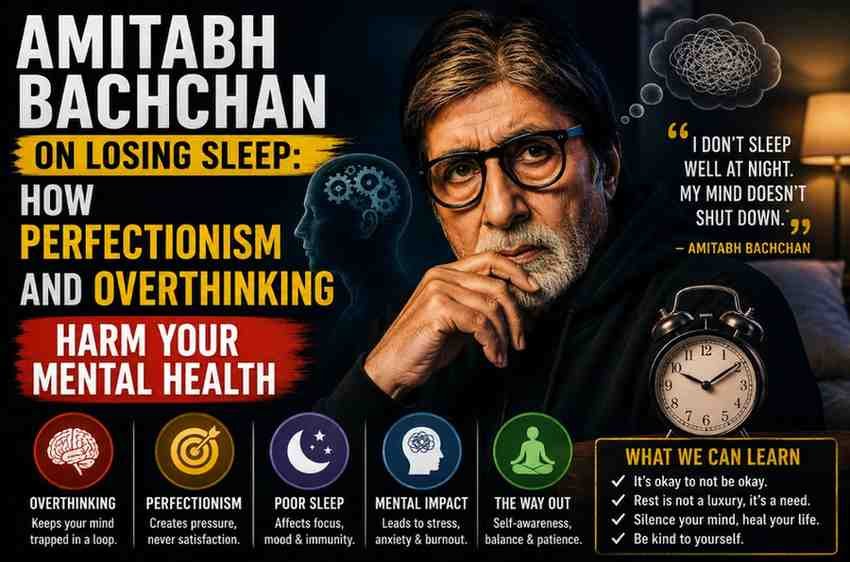
Introduction: What happens when striving for excellence turns into sleepless nights? When legendary actor Amitabh Bachchan shared that he lost sleep questioning whether his recent work could have been better, it sparked a deeper conversation about perfectionism and mental health. This isn’t just a celebrity experience—it’s something millions face silently. From students to professionals, the pressure to perform flawlessly often leads to work-related rumination, anxiety, and disrupted sleep. This article explores why perfectionism affects the brain, how it impacts well-being, and what you can do to break the cycle.
What Is Perfectionism—and When Does It Become Harmful?
Perfectionism is often seen as a positive trait—after all, who doesn’t want to do their best? But there’s a critical difference between healthy ambition and harmful perfectionism.
- Healthy striving: Motivates improvement and growth
- Maladaptive perfectionism: Creates fear of failure and constant self-doubt
Key insight: The problem isn’t wanting to do well—it’s never feeling like you’ve done enough.
When individuals continuously question their performance, even after completing a task, it can lead to mental exhaustion and emotional stress.
The Science of Work-Related Rumination
Work-related rumination refers to repeatedly thinking about work tasks, mistakes, or outcomes—even outside working hours. This mental loop keeps the brain in a state of alertness.
Why it disrupts sleep:
- The brain struggles to “switch off”
- Stress hormones like cortisol remain elevated
- The body stays in a semi-active state instead of relaxing
Critical insight: Your body may be in bed, but your mind is still at work.
Why High Achievers Are More Vulnerable
People who are deeply committed to their work—like Amitabh Bachchan—often set exceptionally high standards for themselves.
This can lead to:
- Over-analysis of performance
- Fear of criticism or failure
- Difficulty accepting “good enough”
Unique angle: Success can amplify perfectionism. The more you achieve, the more you feel pressured to maintain that standard.
How Perfectionism Affects Mental and Physical Health
Mental Health Impact
- Increased anxiety and stress
- Higher risk of burnout
- Reduced satisfaction even after success
Physical Health Impact
- Sleep disturbances
- Fatigue and low energy
- Weakened immune response over time
Why this matters: Chronic stress doesn’t just affect your mind—it impacts your entire body.
Sleep and Performance: A Critical Connection
Ironically, worrying about performance often leads to poorer results due to lack of sleep.
| Factor | Well-Rested Mind | Sleep-Deprived Mind |
|---|---|---|
| Focus | Sharp and consistent | Easily distracted |
| Decision-making | Clear and logical | Impulsive and error-prone |
| Emotional control | Stable | Irritable and reactive |
Insight: Losing sleep in pursuit of perfection often produces the opposite result—lower performance.
The Vicious Cycle of Perfectionism
Perfectionism creates a self-reinforcing loop:
- High expectations → Overthinking → Stress
- Stress → Poor sleep → Reduced performance
- Reduced performance → More self-doubt
Key takeaway: Without intervention, this cycle can become chronic and deeply ingrained.
Breaking the Cycle: Practical Strategies
1. Set “Good Enough” Standards
Define what success looks like before starting a task. This prevents endless re-evaluation.
2. Create a Mental Cut-Off Time
Set a boundary where work-related thinking stops for the day.
3. Practice Reflection, Not Rumination
Constructive reflection focuses on learning, while rumination focuses on flaws.
4. Improve Sleep Hygiene
- Avoid screens before bed
- Maintain a consistent sleep schedule
- Practice relaxation techniques
5. Reframe Mistakes
View them as part of growth rather than evidence of failure.
A Deeper Insight: Why “Perfect” Is an Illusion
Perfection is subjective and constantly shifting. What seems perfect today may feel inadequate tomorrow.
Powerful realization: Chasing perfection is like chasing a moving target—you never truly arrive.
Understanding this can help reduce the pressure to achieve unrealistic standards.
Real-World Impact: Why This Matters for Everyone
From students preparing for exams to professionals managing deadlines, perfectionism is widespread. In a competitive world, the pressure to excel can quietly turn into self-imposed stress.
Emerging trend: Mental health experts are increasingly recognizing perfectionism as a significant contributor to anxiety and burnout.
Future Outlook: A Shift Toward Sustainable Success
There is a growing awareness that success should not come at the cost of well-being. Organizations and individuals are beginning to prioritize balance over burnout.
Prediction: The future of productivity will focus more on mental sustainability rather than relentless perfection.
Conclusion: Excellence Without Exhaustion
Amitabh Bachchan’s experience highlights a universal truth: even the most accomplished individuals are not immune to self-doubt and overthinking.
Final takeaway: Strive for excellence—but not at the expense of your sleep and mental health.
Because in the long run, consistency, clarity, and well-being matter far more than chasing an impossible ideal of perfection.
For breaking news and live news updates, like us on Facebook or follow us on Twitter and Instagram. Read more on Latest Lifestyle on thefoxdaily.com.






COMMENTS 0