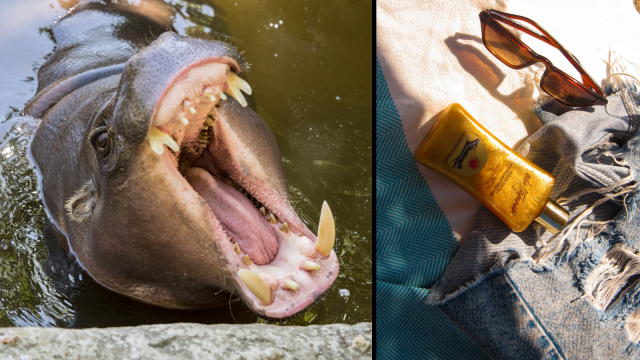
What if your body could produce its own sunscreen—one that not only blocks harmful UV rays but also hydrates your skin and protects against infections? It may sound futuristic, but in the dense forests of West Africa, the pygmy hippopotamus already does exactly that.
The pygmy hippo sunscreen mechanism has fascinated scientists for decades. These elusive animals secrete a special fluid from their skin that functions as an all-in-one survival system. Unlike conventional sunscreen lotions, this natural secretion combines UV protection, antimicrobial defense, and moisture retention in a single biological solution.
But how does this system work? Why did it evolve? And what can humans learn from it?
Understanding the Pygmy Hippo: A Rare and Remarkable Species
The pygmy hippopotamus is a smaller, more reclusive relative of the common hippo. Found primarily in the forests and wetlands of West Africa, it leads a semi-aquatic lifestyle but spends more time on land than its larger cousin.
This difference in habitat is crucial. While common hippos rely heavily on water to protect their sensitive skin, pygmy hippos must adapt to environments where direct sun exposure, humidity, and microbial threats coexist.
This is where their extraordinary skin secretion becomes essential.
What Is the “Natural Sunscreen” Made Of?
The pygmy hippo’s skin produces a viscous secretion often mistaken for sweat. In reality, it is a complex biochemical fluid containing unique pigments and compounds that serve multiple protective roles.
Key Components
- Pigmented acids: These compounds absorb ultraviolet radiation, acting as a natural UV filter
- Antimicrobial agents: Help prevent bacterial infections in cuts and abrasions
- Hydrating elements: Maintain skin moisture in humid yet variable environments
This multifunctional design makes it one of the most efficient natural defense systems found in mammals.
How the Secretion Works: A Triple-Action Defense
The pygmy hippo sunscreen system is remarkable because it solves multiple survival challenges simultaneously.
1. UV Protection
The secretion forms a thin layer over the skin that absorbs harmful ultraviolet rays. This reduces the risk of sun damage, which is especially important for animals with sensitive, hairless skin.
2. Moisturisation
Despite living in humid environments, pygmy hippos are prone to skin dehydration when exposed to air. The secretion locks in moisture, preventing cracks and dryness.
3. Wound Protection
In the wild, minor injuries are common. The antimicrobial properties of the secretion act like a natural antiseptic, reducing the risk of infection.
In essence, this fluid acts as a built-in skincare routine—something humans attempt to replicate with multiple products.
Comparison: Natural vs Human-Made Sunscreen
| Feature | Pygmy Hippo Secretion | Human Sunscreen Products |
|---|---|---|
| UV Protection | Natural pigment-based absorption | Chemical or mineral filters |
| Moisturisation | Integrated hydration | Requires separate moisturiser |
| Antimicrobial Action | Built-in protection | Usually absent |
| Application | Self-produced continuously | Needs reapplication |
| Adaptability | Environment-responsive | Static formulation |
The Evolutionary Advantage: Why This System Developed
Evolution rarely creates solutions for a single problem. The pygmy hippo’s skin secretion likely evolved as a response to overlapping environmental pressures:
- Sun exposure: Even forest canopies do not fully block UV radiation
- Humidity: Encourages bacterial growth on skin
- Physical terrain: Increases risk of cuts and abrasions
Instead of developing separate mechanisms for each challenge, pygmy hippos evolved a single, multifunctional adaptation. This efficiency is a hallmark of natural selection.
The Missing Insight: Why “Less Is More” in Biological Design
One of the most overlooked lessons from this phenomenon is the principle of biological minimalism.
Humans tend to solve problems by adding layers—more products, more chemicals, more steps. In contrast, nature often solves problems by integrating functions into a single system.
The pygmy hippo doesn’t need:
- A separate sunscreen
- A moisturiser
- An antiseptic cream
It produces one fluid that does it all.
This insight is increasingly influencing fields like biomimicry, where scientists design solutions inspired by nature.
Scientific Interest: What Researchers Are Exploring
The unique properties of pygmy hippo skin secretions have sparked interest in multiple research areas:
- Dermatology: Developing multi-functional skincare products
- Medicine: Creating antimicrobial treatments
- Material science: Designing UV-protective coatings
While direct application in humans is still under study, the potential is significant.
Real-World Implications: Beyond Curiosity
This discovery is not just a biological curiosity—it has practical implications.
For Skincare Industry
- Shift toward multifunctional products
- Inspiration for natural, bio-based formulations
For Medicine
- Potential development of infection-resistant treatments
- Improved wound care solutions
For Environmental Science
- Highlights the importance of biodiversity
- Reinforces the value of conserving rare species
Prediction: The Future of Bio-Inspired Skincare
As research advances, we may see a shift from single-purpose products to integrated skincare systems inspired by biology.
Future innovations could include:
- Self-replenishing skin barriers
- Hybrid products combining UV protection and healing properties
- Personalised skincare based on environmental conditions
The pygmy hippo may well influence the next generation of skincare science.
Challenges and Ethical Considerations
While the science is promising, it also raises important questions:
- How can researchers study these animals without harming them?
- Can synthetic alternatives replicate their secretion effectively?
- What role does conservation play in preserving such biological innovations?
Ethical research and sustainable practices will be critical moving forward.
Conclusion: Nature’s Smartest Skincare System
The pygmy hippo’s ability to produce its own sunscreen is more than just a fascinating fact—it’s a powerful example of how nature solves complex problems with elegant simplicity.
By combining UV protection, hydration, and antimicrobial defense into one system, this animal demonstrates a level of efficiency that human technology is only beginning to approach.
As science continues to ուսումնասիր and learn from such natural adaptations, one thing becomes clear: the future of innovation may lie in understanding the solutions that already exist in the wild.
In a world filled with multi-step routines and synthetic solutions, the pygmy hippo reminds us that sometimes, the best design is the simplest one.
For breaking news and live news updates, like us on Facebook or follow us on Twitter and Instagram. Read more on Latest Lifestyle on thefoxdaily.com.

COMMENTS 0