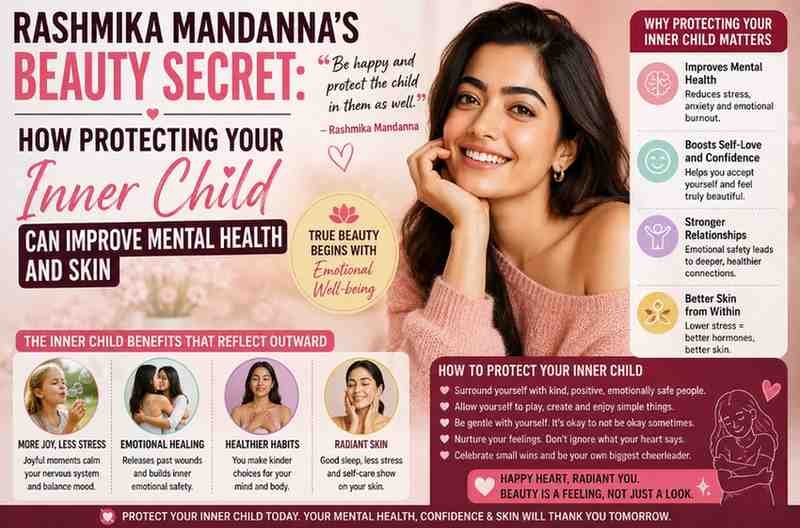
What makes someone truly beautiful? Is it flawless skin, the perfect skincare routine, or something much deeper? Actor Rashmika Mandanna recently offered a refreshingly different perspective by sharing a simple message on social media: “Be with people who will protect the child in you. Be happy and protect the child in them as well.”
While the statement appears simple, psychologists say it reflects an increasingly important concept in Mental Health healing and protecting the inner child. Instead of focusing solely on cosmetics or expensive beauty treatments, Mandanna’s message highlights the powerful relationship between emotional security, happiness, healthy relationships, and physical appearance.
Modern research continues to show that chronic stress, unresolved emotional trauma, and unhealthy relationships affect not only mental health but also skin quality, sleep, immunity, and overall well-being. As conversations around emotional wellness become more mainstream, Mandanna’s advice resonates because it shifts beauty from something external to something deeply rooted in emotional health.
Why Rashmika Mandanna’s Beauty Philosophy Is Resonating
Unlike traditional beauty advice that revolves around skincare products, makeup techniques, or diet plans, Mandanna’s perspective focuses on the emotional environment people create around themselves.
Her statement encourages individuals to:
- Choose emotionally supportive relationships.
- Protect innocence, curiosity, and joy.
- Prioritize happiness over perfection.
- Create emotionally safe spaces for others.
- Recognize that inner peace often reflects outwardly.
This approach aligns with growing awareness that emotional health influences everything from confidence and posture to facial expressions and stress-related skin conditions.
What Does “Protecting the Inner Child” Actually Mean?
The phrase “inner child” has become increasingly common in psychology, but many people misunderstand what it represents.
The inner child is not about behaving immaturely. Instead, it refers to the emotional memories, beliefs, fears, and unmet needs formed during childhood that continue influencing adult behavior.
These experiences shape how people:
- Build relationships
- Respond to conflict
- Handle rejection
- Trust others
- Express emotions
- Value themselves
If childhood emotional needs such as safety, affection, acceptance, or validation were inconsistently met, those experiences may continue affecting adult emotional responses.
Protecting the inner child means acknowledging these emotional patterns instead of ignoring them.
How Childhood Experiences Influence Adult Relationships
Psychotherapists explain that unresolved childhood wounds often appear in adulthood in subtle ways.
| Childhood Experience | Possible Adult Pattern |
|---|---|
| Fear of abandonment | Clinginess or anxiety in relationships |
| Constant criticism | Low self-esteem and perfectionism |
| Emotional neglect | Difficulty expressing emotions |
| Inconsistent affection | Trust issues and insecurity |
| Conditional love | People-pleasing tendencies |
These patterns often continue unconsciously until individuals become aware of them through self-reflection or professional therapy.
Healthy Relationships Don’t “Fix” People—They Help Them Heal
One of the biggest misconceptions about relationships is the expectation that a partner should heal every emotional wound.
Mental health experts emphasize that emotionally healthy relationships work differently.
Instead of rescuing one another, supportive relationships provide:
- Consistency
- Honest communication
- Respect for personal boundaries
- Emotional safety
- Reliable support during conflict
- Mutual accountability
These qualities gradually help the nervous system recognize safety, making emotional growth more sustainable.
Healing becomes a collaborative process rather than emotional dependence.
The Science Behind Happiness and Beautiful Skin
Mandanna’s message also highlights another fascinating area of research: the connection between emotional well-being and skin health.
The skin and brain remain closely connected throughout life because they develop from the same embryonic tissue during early development.
This relationship explains why stress often becomes visible on the skin.
Stress Raises Cortisol Levels
When the body experiences prolonged stress, it releases cortisol, commonly known as the stress hormone.
Persistently elevated cortisol can:
- Increase oil production
- Trigger acne breakouts
- Slow wound healing
- Reduce collagen production
- Increase inflammation
- Accelerate visible ageing
People experiencing chronic stress frequently notice that skincare products become less effective because the underlying issue is physiological rather than cosmetic.
How Negative Emotions Affect Physical Appearance
Holding onto resentment, chronic anxiety, or unresolved emotional conflict places the body in a prolonged stress response.
This can influence:
- Sleep quality
- Facial muscle tension
- Dark circles
- Skin inflammation
- Digestive health
- Hair health
- Overall energy levels
Over time, emotional exhaustion often becomes physically noticeable.
This is why emotional wellness has increasingly become part of holistic beauty approaches worldwide.
Beauty Isn’t Just About Skincare Anymore
The beauty industry has gradually evolved beyond creams and serums.
Today’s understanding of beauty includes:
- Mental wellness
- Sleep hygiene
- Nutrition
- Exercise
- Stress management
- Healthy relationships
- Purpose and self-confidence
Dermatologists increasingly acknowledge that emotional stress often contributes to recurring skin concerns alongside genetic and environmental factors.
How to Know If a Relationship Supports Your Emotional Well-Being
Psychologists often recommend paying attention to how your body responds around certain people.
Ask yourself:
- Do I feel emotionally safe?
- Can I express myself honestly?
- Do I constantly seek approval?
- Am I afraid of making mistakes?
- Do I feel respected?
- Can disagreements happen without fear?
If interactions consistently create anxiety rather than calm, the relationship may be affecting emotional health more than you realize.
Why Emotional Safety Matters More Than Constant Happiness
One overlooked aspect of healthy relationships is emotional safety.
Being emotionally safe doesn’t mean avoiding disagreements.
Instead, it means:
- Conflicts are resolved respectfully.
- Apologies are genuine.
- Communication remains honest.
- Boundaries are respected.
- People feel heard rather than dismissed.
This environment allows individuals to grow without constantly operating in survival mode.
The Growing Role of Therapy in Emotional Healing
Modern psychotherapy offers structured approaches that help people understand and change long-standing emotional patterns.
Among the commonly used approaches are:
Cognitive Behavioural Therapy (CBT)
CBT helps individuals identify negative thinking patterns and replace them with healthier, evidence-based beliefs.
Inner Child Work
This therapeutic approach focuses on recognizing childhood emotional wounds and responding to them with greater awareness and compassion.
Self-Compassion Practices
Instead of harsh self-criticism, self-compassion encourages treating oneself with the same kindness offered to loved ones.
These methods do not erase painful experiences but help reduce their influence over present-day decisions.
Small Daily Habits That Support Emotional Beauty
Protecting your inner child does not require dramatic life changes.
Simple daily practices can strengthen emotional resilience over time.
- Spend time with supportive people.
- Maintain healthy sleep routines.
- Set clear personal boundaries.
- Practice gratitude regularly.
- Limit unnecessary comparison on social media.
- Take breaks from chronic stress.
- Engage in hobbies that create genuine joy.
- Seek professional support when needed.
These habits collectively reduce emotional strain while improving overall well-being.
The Connection Between Confidence and Natural Beauty
Confidence cannot replace genetics, skincare, or healthy habits, but it often changes how people carry themselves.
Individuals who feel emotionally secure generally display:
- Relaxed facial expressions
- Better posture
- More authentic smiles
- Improved communication
- Greater resilience during stressful situations
These subtle qualities frequently shape how others perceive attractiveness.
Why This Conversation Reflects a Larger Wellness Trend
Mandanna’s message reflects a broader shift occurring across health, psychology, and beauty industries.
Consumers increasingly recognize that wellness extends beyond appearance.
Today’s conversations focus on balancing:
- Physical health
- Mental health
- Emotional intelligence
- Healthy relationships
- Self-awareness
- Long-term resilience
This integrated approach represents one of the most significant changes in modern wellness culture.
Comparison: Traditional Beauty Advice vs Modern Emotional Wellness
| Traditional Beauty Focus | Modern Holistic Beauty Focus |
|---|---|
| Makeup | Emotional well-being |
| Skincare products | Stress management |
| External appearance | Mental health |
| Cosmetic solutions | Healthy relationships |
| Quick fixes | Long-term emotional resilience |
| Perfect image | Authentic confidence |
What This Means for Everyday Life
Perhaps the most valuable takeaway from Mandanna’s message is that beauty is increasingly understood as a reflection of overall health rather than appearance alone.
People cannot eliminate every stressful experience, but they can choose healthier relationships, healthier emotional habits, and healthier ways of responding to life’s challenges.
Over time, those choices influence confidence, emotional resilience, physical health, and often the way people naturally present themselves.
Future Outlook: Emotional Wellness May Become the Next Beauty Standard
The future of beauty is likely to become even more holistic.
As mental health awareness continues expanding globally, conversations around skincare, nutrition, fitness, and emotional well-being are becoming increasingly interconnected.
Experts predict that future wellness strategies will place equal emphasis on psychological resilience, stress reduction, preventive healthcare, and healthy social connections rather than focusing solely on appearance.
In that sense, Rashmika Mandanna’s message represents more than a personal philosophy—it reflects a growing understanding that lasting beauty begins with emotional security, supportive relationships, and genuine happiness.
Conclusion
Rashmika Mandanna’s beauty advice stands out because it shifts attention from external perfection to internal well-being. Protecting the “inner child” is not about remaining childlike but about preserving emotional safety, joy, curiosity, and self-worth despite life’s challenges.
Scientific understanding increasingly supports the idea that emotional health affects physical appearance through stress hormones, sleep quality, inflammation, and overall wellness. Combined with healthy relationships, balanced habits, and appropriate self-care, emotional resilience becomes an important part of lasting beauty.
Ultimately, while skincare routines and healthy lifestyles remain valuable, genuine happiness, supportive relationships, and emotional healing may be among the most powerful beauty practices anyone can invest in—because confidence and peace of mind are qualities no cosmetic product can fully replicate.
For breaking news and live news updates, like us on Facebook or follow us on Twitter and Instagram. Read more on Latest Entertainment on thefoxdaily.com.






COMMENTS 0