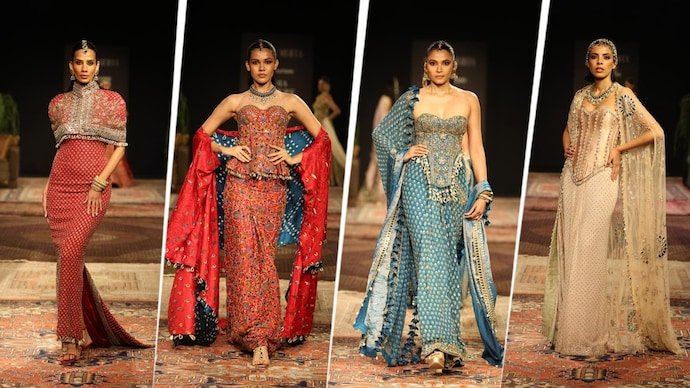
The spotlight at Hyundai India Couture Week 2026 was firmly on Arpita Mehta as she unveiled her debut couture collection—one that is already reshaping how we view Indian bridal Fashion. The central question driving conversations: Is bridal couture only for the bride anymore? Mehta’s answer is a bold no.
Who? Designer Arpita Mehta. What? Her first-ever couture showcase at ICW. When? 2026 edition of India’s premier couture platform. Where? New Delhi. Why does it matter? Because it challenges the long-standing bride-centric approach to wedding fashion. How? By designing a collection that celebrates the entire bridal ecosystem—friends, sisters, and family, not just the bride.
This shift is more than aesthetic—it reflects changing social dynamics, evolving wedding cultures, and a new generation of fashion-conscious participants.
Breaking Tradition: From “Bride-Centric” to “Bridal Collective”
For decades, Indian couture has revolved around the bride as the focal point. Heavy lehengas, intricate embroidery, and dramatic silhouettes were designed to command attention—often leaving the rest of the bridal party in supporting roles.
Arpita Mehta’s ICW 2026 collection disrupts this hierarchy. Instead of a single star, she creates an ensemble cast.
Key Shift in Philosophy
- Then: Bride as the sole visual anchor
- Now: A cohesive, stylish bridal gang
- Focus: Wearability, movement, and versatility
- Outcome: Fashion becomes participatory, not performative
This approach reflects modern weddings, where every attendee plays a visible and curated role.
The Collection: Designed for Real Moments, Not Just Runways
Mehta’s designs stand out because they are not created solely for visual drama—they are built for real-life celebration.
Core Elements of the Collection
- Fluid silhouettes: Allowing ease of movement across functions
- Lightweight embellishments: Balancing luxury with comfort
- Coordinated colour palettes: Enabling group styling
- Mix-and-match versatility: Pieces that transition across events
The result is a wardrobe that works across multiple wedding functions—from mehendi to cocktail nights—without compromising on style.
Context: Why Bridal Fashion Is Evolving
To understand the impact of this collection, it’s important to examine the broader shift in Indian weddings.
Key Drivers of Change
- Social media influence: Weddings are now highly documented events
- Destination weddings: Require versatile, travel-friendly outfits
- Younger demographics: Prefer comfort and individuality
- Group aesthetics: Coordinated looks enhance visual storytelling
In this context, designing for the entire bridal gang is not just innovative—it’s necessary.
Timeline: Evolution of Indian Bridal Couture
| Era | Trend |
|---|---|
| Pre-2000s | Traditional, heavy bridal wear with limited variation |
| 2000–2010 | Designer-led couture focused on opulence |
| 2010–2020 | Rise of celebrity weddings and personalised styling |
| 2020–2025 | Comfort-driven, pastel palettes, experimental silhouettes |
| 2026 onwards | Inclusive bridal fashion for entire wedding parties |
Arpita Mehta’s debut fits squarely into this next phase—where inclusivity meets couture.
Deep Analysis: Why This Collection Matters
1. Redefining Luxury
Luxury is no longer about heaviness or excess. It’s about ease, confidence, and adaptability. Mehta’s collection reflects this shift by prioritising how garments feel and function.
2. Democratizing Couture
By designing for multiple roles within a wedding, couture becomes more accessible—not in price, but in relevance. More people can see themselves in the narrative.
3. Enhancing Visual Storytelling
In the age of Instagram and wedding films, coordinated group aesthetics create stronger visual impact. This collection caters directly to that demand.
4. Sustainability Through Versatility
Outfits designed for multiple occasions reduce the need for excessive consumption, aligning with emerging sustainability concerns in fashion.
Comparison: Traditional Bridal Couture vs Arpita Mehta’s Approach
| Aspect | Traditional Couture | Arpita Mehta’s ICW 2026 Collection |
|---|---|---|
| Focus | Bride-centric | Bridal party inclusive |
| Design | Heavy, ornate | Light, fluid, wearable |
| Functionality | Limited to ceremony | Multi-event versatility |
| Experience | Visual admiration | Active participation |
This comparison highlights a fundamental shift from spectacle to experience.
Real-World Impact: What This Means for the Wedding Industry
For Designers
Expect more collections to move toward group-oriented design narratives, where coordination and cohesion are key selling points.
For Brides
Brides now have the opportunity to curate entire wedding wardrobes—not just for themselves, but for their inner circle.
For the Market
- Increased demand for coordinated outfits
- Growth in styling services for bridal parties
- Expansion of couture into multi-user wardrobes
Unique Insight: The Rise of “Collective Fashion Experiences”
Here’s a perspective often overlooked: weddings are becoming collaborative fashion events.
Instead of a single focal point, modern weddings operate like curated productions where:
- Every participant contributes to the visual narrative
- Outfits are planned as a group, not individually
- Fashion enhances shared memories, not just individual presence
Arpita Mehta’s collection taps directly into this cultural shift, positioning itself ahead of the curve.
Prediction: The Future of Bridal Couture
Based on current trends, the future of bridal fashion is likely to include:
- Modular outfits: Pieces that can be restyled across events
- Gender-fluid designs: Expanding inclusivity
- Tech-integrated styling: Virtual coordination tools
- Experience-driven collections: Focus on how clothing is worn, not just seen
Arpita Mehta’s ICW 2026 debut could very well be remembered as a turning point in this evolution.
Conclusion: A New Chapter in Indian Couture
Arpita Mehta’s debut at Hyundai India Couture Week 2026 is more than just a fashion moment—it’s a cultural shift.
By designing for the entire bridal gang, she redefines what couture means in a modern context. It’s no longer about dressing a bride for admiration—it’s about dressing a community for celebration.
As weddings continue to evolve, one thing is clear: the future of bridal fashion is collective, experiential, and deeply personal.
And with this collection, Arpita Mehta hasn’t just followed the trend—she’s helped set it.
For breaking news and live news updates, like us on Facebook or follow us on Twitter and Instagram. Read more on Latest Lifestyle on thefoxdaily.com.






COMMENTS 0