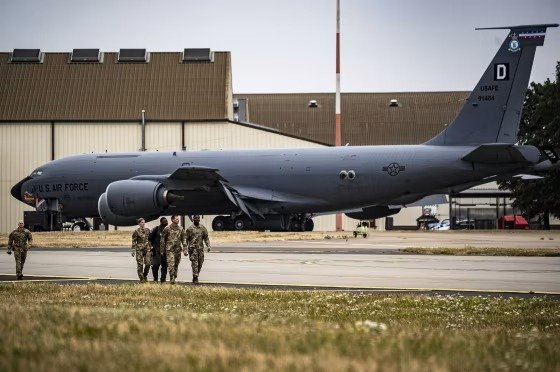
The United States has moved several military aircraft from RAF Mildenhall in eastern England as security measures at the British airbase were increased amid reported threats from Iran. The movements included at least eight aerial refuelling tankers and three Osprey aircraft, according to flight-tracking data.
A US official confirmed that aircraft had left the installation while personnel and facilities were operating under enhanced force protection measures. However, American officials have not publicly disclosed the precise nature of the threat or confirmed whether the aircraft movements were directly triggered by a specific Iranian operation.
The development comes amid heightened tensions between Washington and Tehran, previous security concerns at US Military installations in Britain and an ongoing conflict involving the United States, Israel and Iran. It also raises questions about how American forces are adjusting their deployments to protect personnel and military equipment while retaining operational flexibility.
US Relocates Tankers and Ospreys From RAF Mildenhall
At least eight aerial refuelling aircraft and three Ospreys departed RAF Mildenhall in Suffolk on Monday, according to flight-tracking information. The movements involved different aircraft types and destinations, suggesting that US forces redistributed some assets to other locations rather than withdrawing them from the region entirely.
Several Boeing KC-135 Stratotanker aircraft were reportedly relocated to military airbases in Germany and Spain. Another tanker moved to the vicinity of Glasgow Prestwick Airport in Scotland. The three Ospreys were transferred to nearby RAF Lakenheath, also in Suffolk.
The KC-135 Stratotanker is an aerial refuelling aircraft used to extend the operational range of military planes. Its ability to refuel other aircraft in flight supports a wide range of operations, including long-distance deployments and missions involving combat aircraft.
Ospreys are military aircraft with a distinctive tiltrotor design, allowing them to operate with the vertical take-off and landing capabilities of a helicopter while achieving greater forward-flight speeds. Their presence at overseas installations can support the movement of personnel and equipment.
The relocation of these aircraft does not, by itself, establish that an attack on RAF Mildenhall was imminent. Military aircraft routinely move between installations for operational, logistical and training reasons. The US military has also declined to provide detailed information about the movements, citing operational security.
US Officials Confirm Enhanced Security Measures
A US official told NBC News that aircraft had departed RAF Mildenhall while the base was operating under enhanced force protection measures. The official confirmed the increased security posture but declined to speculate about the exact threat that prompted the additional precautions.
In a separate statement, a US European Command official explained that American military aircraft regularly rotate between installations and operating locations. Such movements can take place for several reasons, including training activities and operational requirements.
The command also highlighted the agreements that govern the presence of US military aircraft at allied facilities. American aircraft operate from partner countries under access, basing and overflight arrangements established with those governments.
The official said further details about the movement of military assets would not be provided because of operational security considerations. Such restrictions are intended to prevent sensitive information about aircraft locations, deployments and military activities from becoming publicly available.
The United Kingdom‘s Ministry of Defence also declined to provide specific information about the movements. A spokesperson said the department does not routinely comment on the activities of other countries, adding that aircraft and other military assets move regularly according to operational requirements.
These statements leave the precise relationship between the reported threat and the aircraft relocations unclear. While the movements occurred alongside an increased security posture, officials have not publicly confirmed the intelligence behind the decision.
RAF Fairford Withdrawal Raised Earlier Iran-Related Security Concerns
The latest aircraft movements follow a separate decision by the United States to withdraw bombers from RAF Fairford in Gloucestershire several weeks earlier. That base had become the focus of security concerns following reports of a possible Iranian drone threat and an investigation into a suspected terrorist plot.
Two US officials previously told NBC News that aircraft were pulled from RAF Fairford after reports of a possible Iranian drone attack. The withdrawal also came after police foiled a suspected terror plot linked to Iran, according to the reporting surrounding the investigation.
The earlier incident and the latest movements at RAF Mildenhall have drawn attention to the security of American military installations across the United Kingdom. Both bases are part of the wider network of facilities used by US forces in cooperation with Britain.
However, the two developments should not automatically be treated as evidence of a single coordinated threat. The available information does not establish that the suspected plot at RAF Fairford and the security measures at RAF Mildenhall were connected.
Iran has denied involvement in any plot against RAF Fairford. Tehran has also warned that it would retaliate against any US attack and has threatened that its response could extend beyond the Middle East.
The distinction between confirmed security measures, suspected plots and allegations of Iranian involvement remains important. Investigations and military assessments can involve intelligence that is not publicly available, making it difficult to establish the full circumstances behind individual decisions.
Why US Military Bases in Britain Matter
American military installations in the United Kingdom provide important support for US operations in Europe and other regions. Facilities such as RAF Mildenhall and RAF Fairford allow American forces to position aircraft, personnel and equipment closer to areas where they may be required.
RAF Mildenhall, located in Suffolk, is an established US military installation. Its location and infrastructure support American air operations, including the deployment and movement of military aircraft.
RAF Fairford, meanwhile, has been used by the United States as a base for bomber operations. The installation has particular relevance when American forces need facilities capable of supporting long-range military aircraft.
The United States has used British bases in connection with strikes against Iran, making their security especially significant during periods of direct confrontation between Washington and Tehran.
These installations operate within the framework of US-UK defence cooperation. Their use involves agreements between the two countries, while British authorities retain responsibilities associated with the facilities and their national territory.
Moving aircraft between locations can help reduce the concentration of valuable military assets at a single installation. It can also allow commanders to adjust aircraft positioning in response to operational requirements or security assessments.
Nevertheless, aircraft movements do not necessarily indicate that military action is being prepared. They can form part of routine force management, particularly when tensions create a need for additional precautions.
Marco Rubio Says US Is Moving Personnel Away From Potential Threats
US Secretary of State Marco Rubio addressed concerns about reported Iranian threats against American diplomats overseas on Monday. He said Washington had responded by moving people away from potential danger.
Rubio emphasised that protecting American personnel and their families stationed abroad remained a priority. He said the administration would take action when it identified a potential threat that crossed a certain threshold.
His comments offered a broader indication of how the US government was responding to security concerns involving American personnel outside the country. However, Rubio did not publicly identify the specific intelligence or circumstances behind the aircraft movements at RAF Mildenhall.
The distinction matters because diplomatic security and military force protection involve different personnel, facilities and operational decisions. Both can be affected by threats from a foreign government or affiliated groups, but the public statements did not establish that every reported security measure was part of the same response.
For American officials, the challenge is to protect military personnel, diplomatic staff and infrastructure without revealing sensitive information that could help potential attackers or compromise ongoing operations.
Trump Says Negotiations With Iran Have Gained Momentum
The aircraft movements came as President Donald Trump said there was renewed momentum behind negotiations aimed at ending the war with Iran. The conflict began after the United States and Israel launched an attack on the Islamic Republic in February.
Speaking after a meeting with Qatar’s Prime Minister, Sheikh Mohammed bin Abdulrahman Al-Thani, Trump described Iran’s military capabilities as effectively defeated. He also indicated that further US attacks would not be necessary at that point.
However, Trump said Washington remained prepared to respond if circumstances changed. His remarks suggested that the administration was presenting diplomacy as a possible route to ending the conflict while maintaining military readiness.
The comments reflect the difficult balance facing the United States. Washington may seek negotiations to prevent further escalation, but it also has to account for potential retaliation, the safety of its forces and the security of its regional and international partners.
Iran’s warnings about retaliation have added to concerns about the possible geographical reach of the conflict. Tehran has threatened that any US attack could prompt a response extending beyond the Middle East, although the precise nature and scope of any potential action remain uncertain.
Could the Aircraft Relocations Signal a Wider Change in US Military Posture?
The movement of aircraft from RAF Mildenhall highlights the precautions American forces may take when security assessments change. Relocating aircraft to other facilities can reduce exposure at a particular base while allowing the military to retain access to important capabilities.
The decision to move several tankers to Germany and Spain, while transferring Ospreys to RAF Lakenheath, also demonstrates the flexibility available through the network of facilities used by US forces in Europe.
However, the available information does not establish whether the movements represent a temporary precaution, a wider change in deployment planning or a response to a specific intelligence assessment. US European Command has not provided details that would clarify the operational reasoning.
For the United Kingdom, the situation also highlights the security responsibilities associated with hosting foreign military forces during an international conflict. British installations can become strategically important to US operations, while also attracting greater attention when tensions with an adversary intensify.
Any assessment of a wider shift in US military posture will depend on further information, including whether aircraft return to RAF Mildenhall, whether additional assets are relocated and whether officials announce changes to force protection measures.
What Happens Next?
For now, the immediate focus is on the security situation at RAF Mildenhall and the locations where the relocated aircraft have been positioned. The US military has confirmed the enhanced security posture but has not disclosed the underlying threat assessment.
Further developments may depend on the progress of negotiations with Iran, intelligence assessments and the broader security environment affecting American personnel and installations overseas. Any renewed escalation could lead to additional protective measures, although no specific future movements have been announced.
The latest relocations do not confirm that an attack on a US base in Britain is imminent. They do, however, show that American forces are taking precautions amid heightened tensions and reported threats linked to Iran.
With Washington signalling both diplomatic interest and continued military readiness, the situation around US installations in Britain will remain closely tied to developments in the wider conflict. The key unanswered question is whether the aircraft movements are simply precautionary rotations or part of a more substantial adjustment to the US military’s security posture.
For breaking news and live news updates, like us on Facebook or follow us on Twitter and Instagram. Read more on Latest World on thefoxdaily.com.






COMMENTS 0