UK Foreign Secretary Ed Miliband has held his first meeting with Iranian Foreign Minister Abbas Araghchi in a year as tensions over the Strait of Hormuz intensified, with senior Iranian officials warning that the United States has only four to five days to respond to Tehran’s conditions for reopening the strategic waterway.
The meeting in New York took place against a backdrop of stalled diplomatic efforts between Iran and the US, rising oil prices and growing concern over the wider regional consequences of the confrontation. Iranian officials have made clear that Tehran is no longer presenting its conditions simply as a basis for further negotiations. Instead, they say Washington must take action first if it wants the Strait of Hormuz reopened.
Mohsen Rezaei, secretary of Iran’s Supreme National Security Council, publicly disclosed the apparent deadline in a Television interview on Wednesday evening. He said Iran had given the US four or five days to fulfil seven conditions and warned that Tehran would decide its next step if Washington failed to comply.
Rezaei did not specify what action Iran would take after the deadline. His comments nevertheless added a new element of urgency to an already volatile dispute involving the US, Iran, Israel and countries across the Gulf and wider Middle East.
Iran Says the US Must Act First
The most significant development in Tehran’s latest position is the insistence that Washington must take concrete steps before Iran will agree to reopen the Strait of Hormuz.
Rezaei, a recently promoted hardliner, said Iranian President Masoud Pezeshkian and Foreign Minister Araghchi travelled to New York to communicate conditions that had already been agreed internally rather than negotiate an entirely new framework.
According to Rezaei, there had been no discussion within Iran about removing or adding conditions. He presented the position as settled and said the next stage depended on whether the United States acted on Tehran’s demands.
“Talk is enough. Negotiations are enough. Now we must act,” Rezaei said, signalling a shift from diplomatic discussions towards demands for implementation.
He warned that if the United States did not fulfil Iran’s conditions, Tehran would neither reopen the Strait of Hormuz nor continue negotiations on the issue.
Rezaei said the seven conditions must be implemented “completely and all at once”. He added that the United States had been given “four or five days” to do so, after which Iran would determine its “next step”.
The lack of detail about what would happen after that deadline has added uncertainty to the situation. Iranian officials have not publicly specified what measures Tehran would take if Washington rejected the conditions or failed to act within the stated period.
What Is at Stake in the Strait of Hormuz?
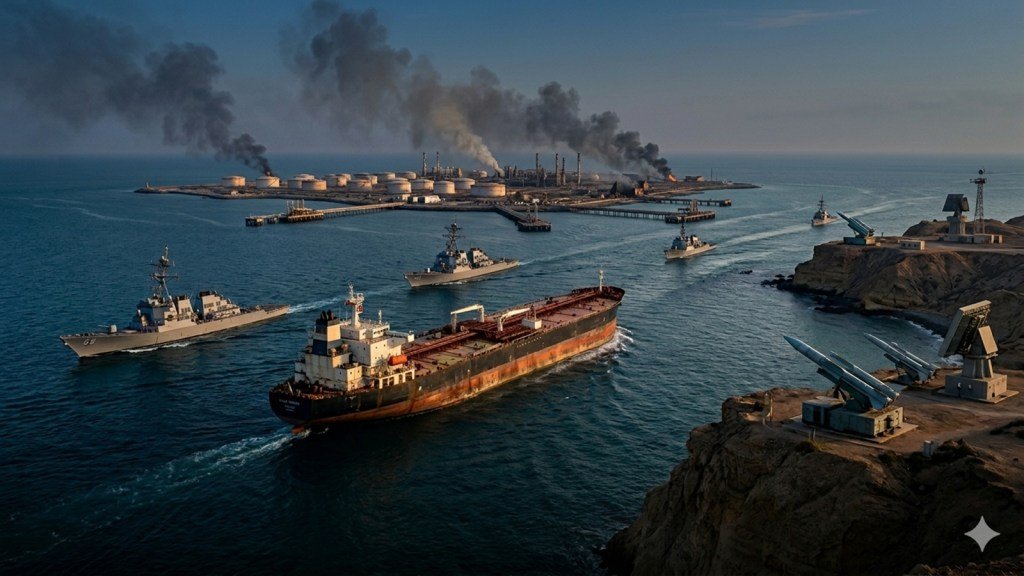
The Strait of Hormuz is a strategically important waterway connecting the Persian Gulf with the Gulf of Oman and the wider Arabian Sea. Its importance extends far beyond Iran and the United States because energy shipments passing through the region are closely connected to global oil markets.
Any prolonged disruption or uncertainty surrounding the waterway can therefore affect energy prices, shipping decisions and the broader economic outlook.
Brent crude was trading at around $107 a barrel on Thursday, underscoring the market sensitivity surrounding the confrontation. Oil prices can respond rapidly to expectations about supply disruptions, particularly when tensions involve a major energy-producing region and a maritime route central to international Trade.
For governments in the Gulf, the issue also carries direct security implications. A confrontation involving the Strait of Hormuz could have consequences beyond the immediate US-Iran dispute, potentially affecting neighbouring states, maritime traffic and other regional military fronts.
Miliband and Araghchi Meet as UK-Iran Relations Remain Tense
Miliband’s meeting with Araghchi was the first ministerial meeting between the UK and Iran in a year. It also came after the British government proscribed Iran’s Islamic Revolutionary Guards Corps as a terrorist organisation in July, a move that further strained already difficult relations between London and Tehran.
The UK foreign secretary used the meeting to make Britain’s position on the Strait of Hormuz clear. Miliband stressed the UK’s commitment to freedom of navigation and said Britain wanted a diplomatic solution to the crisis.
He also raised concerns about Iran’s activities affecting the UK, including threats against Jewish communities. Another issue raised was the case of a British couple sentenced to 10 years in prison in Tehran, with Miliband calling for British consular access to the pair.
The meeting therefore covered a wider range of bilateral and regional concerns rather than being limited to the immediate dispute over the waterway.
Miliband also stressed British support for Saudi Arabia, a UK ally involved in the wider regional security environment, including the conflict in Yemen.
US-Iran Talks Have Not Produced a Breakthrough
The Miliband-Araghchi meeting came after separate discussions involving Araghchi and Steve Witkoff, the US special envoy, on the sidelines of the UN General Assembly.
The talks focused on Iran’s conditions for reopening the Strait of Hormuz, the timing of any reopening and the period Washington had been given to respond.
However, European diplomats involved in the broader diplomatic effort have not detected a major breakthrough between Tehran and Washington.
US Secretary of State Marco Rubio has also cautioned against describing the Witkoff discussions as a major breakthrough. That assessment reflects the distance between the two sides despite their continued engagement.
It is understood that Araghchi, speaking largely through a Qatari mediator, presented the seven preconditions that Iran says must be addressed before it will reopen the strait.
Among those conditions are the lifting of US sanctions and an end to war on all fronts. The latter appears to refer in part to Israeli military activity in southern Lebanon, showing that Tehran’s demands extend beyond the immediate US-Iran confrontation.
Iran Links Hormuz to the Red Sea and Bab al-Mandab
The Strait of Hormuz is not the only maritime route being drawn into the confrontation.
Some officers within Iran’s Islamic Revolutionary Guards Corps have linked the Hormuz dispute to the Bab al-Mandab Strait, a strategically important waterway near Yemen that connects the Red Sea with the Gulf of Aden.
The Bab al-Mandab has already been central to regional maritime security concerns because of attacks and threats associated with the conflict in Yemen and the activities of Iran-backed Houthi forces.
Maj Gen Rahim Safavi, a senior Iranian military figure, warned that a new regional front could emerge if the United States launched another war.
Safavi specifically referred to the possibility of a conflict centred on the Red Sea and Bab al-Mandab. His comments indicate that Iranian military figures view maritime pressure in the Gulf and Red Sea as potentially connected elements of a wider confrontation.
Such a development would broaden the geographic scope of the crisis considerably. Instead of being concentrated around the Strait of Hormuz and the Persian Gulf, the confrontation could affect shipping routes extending toward the Red Sea and beyond.
Iran’s Seven Conditions Put Pressure on Washington
The seven conditions described by Iranian officials have become the central focus of the current diplomatic dispute. Tehran says the conditions were internally agreed and that the United States must implement them before the Strait of Hormuz can be reopened.
The reported demands include lifting US sanctions and ending military conflict across the regional fronts identified by Tehran. The reference to multiple fronts indicates that Iran is treating the maritime issue as part of a much broader political and military confrontation rather than as an isolated dispute over shipping.
By insisting that the conditions be met “completely and all at once”, Tehran has also rejected the idea of a gradual process in which individual measures are negotiated separately.
That position creates a difficult diplomatic structure. The United States would have to determine whether and how it could respond to conditions that encompass sanctions as well as wider regional military activity, while Iran has said it will not reopen the waterway before the requirements are fulfilled.
The stated four-to-five-day period adds another layer of pressure, although Iranian officials have not publicly explained how the deadline will be measured or what specific consequences will follow if it expires without an agreement.
Pezeshkian Uses UN Speech to Combine Defiance and Diplomacy
Inside Iran, President Masoud Pezeshkian’s address to the UN General Assembly was viewed as a political success by supporters because it combined a refusal to accept US pressure with an expressed willingness to pursue diplomatic engagement.
Pezeshkian used the speech to reject what he described as American bullying while also presenting diplomacy as an available route for resolving the confrontation.
He also proposed a new regional security architecture involving Gulf states. The proposal comes at a particularly tense moment, as relations between Iran and several Gulf countries remain affected by the wider conflict and military activity in the region.
The proposal suggests that Tehran is attempting to frame the crisis not only as a confrontation with Washington but also as an opportunity to reshape the regional security arrangements that have developed around US military involvement in the Gulf.
Iranian Military Leaders Signal Readiness for Further Conflict
While Pezeshkian has continued to emphasise diplomacy, senior Iranian military officials have simultaneously used much more confrontational language.
Maj Gen Ahmad Vahidi, commander-in-chief of the IRGC, praised the Iranian president’s UN speech and said Iran was not afraid of war.
His comments reinforced the message from other senior Iranian officials that Tehran does not view military escalation as something it must avoid at any cost.
The combination of diplomatic outreach and military warnings is a defining feature of Iran’s current position. Iranian officials are continuing to communicate through diplomatic channels while making clear that they are prepared to maintain pressure if their demands are not met.
That dual approach also complicates the task facing Western governments. Diplomatic discussions remain possible, but they are taking place alongside explicit warnings about maritime routes and the potential expansion of the conflict.
Why the Hormuz Deadline Matters
The four-to-five-day deadline announced by Rezaei is significant because it introduces a specific time frame into a dispute that had previously been dominated by open-ended negotiations.
It remains unclear whether the deadline represents a unified position across every part of Iran’s political and security establishment or how Tehran would respond once it expires. Rezaei presented the conditions as internally agreed, but the exact decision-making process that would determine Iran’s next move has not been publicly detailed.
There are also signs of internal debate over the direction of the confrontation. A faction within Iran is reportedly arguing that Tehran should escalate pressure rather than allow the crisis to remain in its current deadlock.
That debate matters because the consequences of escalation would extend well beyond the immediate US-Iran relationship. Any serious disruption affecting the Strait of Hormuz could have implications for energy markets, Maritime Trade and governments across the Gulf.
Diplomacy Continues Despite the Growing Pressure
The meeting between Miliband and Araghchi demonstrates that diplomatic channels remain active despite the increasingly hard-line rhetoric coming from Iranian security officials.
Britain is pressing for freedom of navigation and a diplomatic settlement while simultaneously raising bilateral concerns about Iranian actions and the detention of British nationals. The United States, meanwhile, has continued discussions with Tehran through Witkoff and diplomatic intermediaries.
Iran has made its position more demanding by insisting that Washington act before the Strait of Hormuz is reopened. The United States has not publicly indicated that it accepts Tehran’s seven conditions, while American officials have also played down expectations of an immediate breakthrough.
The result is a tense diplomatic stalemate in which communication continues but the core disagreement remains unresolved.
The next phase will depend on how Washington responds to Tehran’s stated conditions and how Iran interprets that response. For now, the Strait of Hormuz remains at the centre of a confrontation that links sanctions, regional wars, maritime security and the wider struggle over the future balance of power in the Middle East.
For breaking news and live news updates, like us on Facebook or follow us on Twitter and Instagram. Read more on Latest World on thefoxdaily.com.





COMMENTS 0