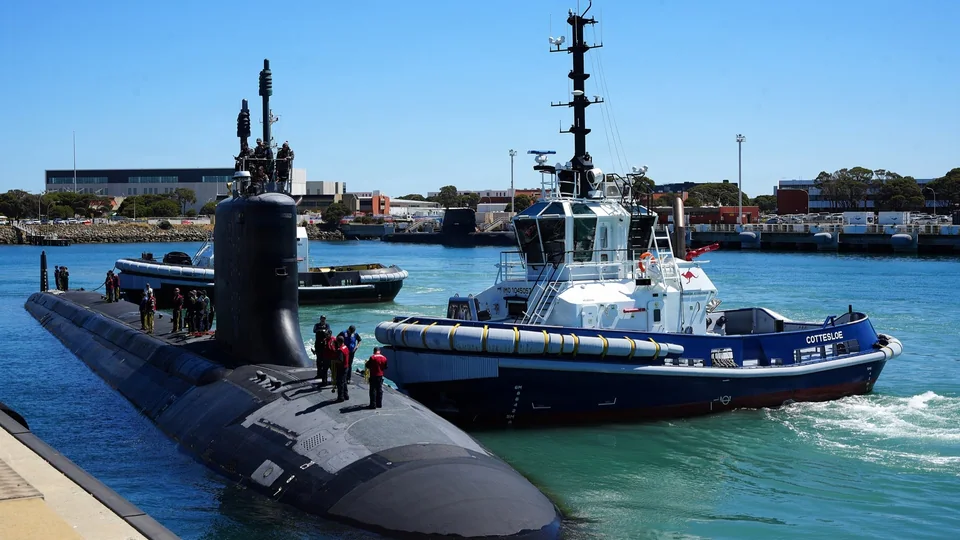
Australia is preparing to host American nuclear-powered attack submarines at HMAS Stirling in Western Australia, marking a major expansion of the US naval presence in the Indo-Pacific. The facility is expected to become the first new American submarine base established overseas in 53 years, giving Washington a strategically important location closer to Asian waters and strengthening military cooperation with Australia and Britain.
The transformation of Stirling is part of the AUKUS security partnership, a trilateral agreement announced in 2021. Under the arrangement, the three countries plan to strengthen their submarine capabilities through American submarine deployments, the eventual transfer of Virginia-class submarines to Australia and the joint development of a new generation of nuclear-powered vessels.
However, the preparations involve far more than building new piers and accommodation. From relocating marine life to installing specialised infrastructure and secure communications, Australia is making extensive changes to accommodate submarines that require highly specialised maintenance and support facilities.
Why America Is Establishing a New Submarine Base in Australia
HMAS Stirling, located on Garden Island near Perth in Western Australia, offers the United States a strategically valuable position in the Indo-Pacific. Its location provides American submarines with relatively convenient access to Asian maritime routes while placing them farther from some of the threats facing existing US facilities in the region.
One important advantage is its distance from conventional land-based Chinese missile systems. The facility is considered less exposed to such weapons than the American naval installation at Guam, although advanced military capabilities could still pose risks. Its position also allows American submarines to operate closer to important waters in Asia than they could from many existing US submarine bases.
For Washington, the development represents a significant change in how American submarine forces could be positioned during a potential conflict involving China. Instead of relying exclusively on bases in the United States and established Pacific locations, the US Navy will have a substantial operational presence in Western Australia.
The arrangement is also significant for Canberra. Hosting American submarines will give Australian personnel opportunities to work alongside US Navy crews, develop technical expertise and gain experience operating and maintaining nuclear-powered vessels.
Seahorses Had to Be Relocated Before Construction Began
The preparations at Stirling illustrate the unusual environmental and engineering challenges involved in expanding a naval facility for nuclear-powered submarines.
Before construction work could proceed, divers had to relocate 263 seahorses living along the coast. The fish are relatively weak swimmers and typically use their tails to attach themselves to rocks, piers and other underwater structures.
To protect them during the upgrade, divers moved the seahorses to nearby specially prepared grids made from reinforcing steel bars, commonly known as rebar. These structures provided alternative places for the fish to attach themselves while work continued around the naval base.
The construction itself requires substantial changes to the waterfront. At one pier, workers have been driving concrete piles into the seabed to strengthen the structure against the forces generated by large submarines in difficult weather conditions.
The work is necessary because the Virginia-class submarines expected to use the facility weigh approximately 7,000 tonnes. Their size and operating requirements demand infrastructure capable of supporting substantial vessels and specialised naval operations.
USS Colorado Arrives as Australia Prepares for American Submarines
An important step in the development came on October 28, when the American nuclear-powered attack submarine USS Colorado arrived at Stirling for maintenance work involving Australian personnel.
The visit provides an opportunity for Australian sailors and technical teams to gain practical experience working on a Virginia-class submarine. This training is central to the first phase of AUKUS, which is designed to prepare Australia for a future role in operating nuclear-powered submarines.
The USS Colorado is expected to return permanently to the rotational arrangement at Stirling towards the end of 2027. Its arrival demonstrates that the base is moving beyond construction and preparations towards supporting actual American submarine operations.
Under the broader plan, four American submarines are expected to operate from the Australian facility. Their presence will be organised through Submarine Rotational Force–West, commonly abbreviated as SRF-W and informally known as Surf West.
What Is Submarine Rotational Force–West?
Submarine Rotational Force–West is the name given to the American submarine deployment arrangement at Stirling. Although the submarines will officially rotate through the Australian facility rather than being permanently based there, their deployments will be considerably longer than short port visits.
Each American submarine is expected to operate from Stirling for periods of approximately one to two years. This will create a sustained US Navy presence in Western Australia while allowing the facility to remain under Australian control.
The arrangement represents a significant development beyond the original AUKUS plan. The decision to base four American submarines at Stirling was not part of the agreement’s initial design, but it has become one of its most important practical outcomes.
The facility will also support a new American command structure. A US Navy commodore will lead the newly established Submarine Squadron 3 from Stirling, overseeing American submarine operations associated with the deployment.
Secure communications infrastructure is being installed to allow the commander to communicate with the Pentagon through classified channels. The base is also being expanded to accommodate American personnel and their families.
Billions of Dollars Are Being Invested in the Stirling Upgrade
Preparing Stirling for nuclear-powered submarines requires a major financial commitment. Approximately $1.5 billion has already been spent on the development, with another $4.1 billion planned for future improvements.
The investment covers essential infrastructure, including stronger submarine berths, maintenance facilities, accommodation and specialised power systems. These upgrades are intended to ensure that the base can support visiting submarines during routine operations and maintenance periods.
One particularly important part of the work involves installing five different types of backup power. Nuclear-powered submarines carry their own reactors, but they still require auxiliary electricity systems to support essential functions.
Backup power is especially important when a submarine’s reactor is undergoing maintenance. Supporting systems must continue operating safely, reducing the risk of a serious technical failure while the main reactor is unavailable.
The development also includes facilities for the American sailors expected to serve at Stirling. Housing is being constructed for some of the approximately 1,200 US personnel associated with the deployment.
A dedicated grocery shop selling American products and snacks is also planned for US sailors and their families. Access will be restricted to authorised American personnel and their dependants. Other changes to the island’s facilities reflect the scale of the construction programme, including the replacement of a cricket oval with a basketball court while building work continues.
How AUKUS Plans to Give Australia Nuclear-Powered Submarines
The Stirling development is the first major operational milestone in the AUKUS partnership between Australia, the United States and Britain. Announced in 2021, the agreement is intended to improve the three countries’ ability to operate together and develop advanced defence capabilities.
Its submarine programme is structured around three broad stages.
Phase One: American Submarines and Australian Training
The first phase involves increasing the presence of American and British nuclear-powered submarines in Australian waters and establishing the rotational US submarine force at Stirling.
Australian sailors will train alongside American personnel, learning how to operate, maintain and support Virginia-class submarines. This practical experience is intended to prepare Australia’s naval workforce for the eventual introduction of its own nuclear-powered fleet.
The arrival of USS Colorado for maintenance work is an early example of this cooperation. Rather than relying entirely on theoretical training, Australian personnel can develop technical knowledge through direct involvement with operational submarines.
Phase Two: Australia Plans to Acquire Virginia-Class Submarines
In the second phase, Australia intends to purchase Virginia-class nuclear-powered attack submarines from the United States and operate them under the Australian flag. The first deliveries are planned for the early 2030s.
The arrangement is expected to give the Royal Australian Navy a more capable submarine force, but the proposed transfers face significant uncertainty. American shipbuilders must increase production to meet their own navy’s requirements while also supplying submarines to Australia.
If production targets are missed, the United States could struggle to deliver the vessels on the planned schedule. There is also a possibility that a future American administration could decide not to release submarines for export if domestic requirements take priority.
Phase Three: A New Submarine Designed by Australia and Britain
The final stage involves Australia and Britain jointly designing, building and operating a new class of nuclear-powered submarine. These vessels are expected to form the next generation of the two countries’ submarine fleets.
The first Australian submarine under this programme is expected to enter service in the 2040s. However, the schedule depends on the ability of both countries to expand their shipbuilding and nuclear industrial capabilities.
Britain’s plans involve building 12 submarines of the new AUKUS class, compared with the seven vessels originally planned. Delivering such an expanded programme will require substantial improvements in industrial capacity and workforce availability.
Why Nuclear-Powered Submarines Matter for Australia’s Defence
Australia currently operates conventionally powered diesel-electric submarines. Nuclear propulsion would provide a major change in the range and endurance of the country’s future submarine fleet.
Nuclear-powered submarines can remain submerged for extended periods without needing to surface regularly to recharge batteries. This gives them greater operational flexibility and allows them to travel much farther than conventional diesel-powered submarines.
For a country with Australia’s vast maritime interests, that capability is particularly important. Its naval forces must operate across enormous distances, including waters connecting the Indian and Pacific oceans.
Longer underwater endurance could allow Australian submarines to conduct extended patrols, monitor important maritime areas and operate farther from their home bases. These capabilities would strengthen Australia’s ability to contribute to regional security and deter potential threats.
There is an important distinction between nuclear-powered and nuclear-armed submarines. The AUKUS submarines are intended to use nuclear reactors for propulsion, not to carry nuclear weapons. The programme is therefore focused on developing nuclear-powered conventional attack submarines rather than introducing an Australian nuclear-weapons capability.
Why AUKUS Has Faced Political and Financial Controversy
Despite its strategic ambitions, AUKUS has remained controversial in Australia and among its international partners.
One source of tension was the way the agreement emerged. Australia had previously signed a contract to acquire French diesel-powered submarines. The decision to abandon that arrangement and pursue nuclear-powered submarines through AUKUS in 2021 triggered a major diplomatic dispute with France.
The scale of the new programme also became clearer after the agreement was announced. Building and maintaining nuclear-powered submarines requires highly specialised facilities, skilled workers, advanced technologies and a reliable industrial supply chain.
American and British shipyards were already facing pressure to meet existing submarine production requirements. AUKUS added another major commitment, requiring both countries to increase their manufacturing capacity over the coming years.
Australia has pledged financial support to help strengthen the industrial base behind the programme. It has already transferred approximately $2.6 billion of a total commitment of $6.2 billion.
Jennifer Parker of the Lowy Institute has described the contribution as a relatively small amount compared with the funding needed to increase submarine production, while emphasising its importance as a signal of Australia’s commitment.
The payments also demonstrate that Australia is prepared to invest in the industrial capabilities of its partners rather than simply wait for submarines to become available. Whether that funding will be sufficient to accelerate production remains uncertain.
Donald Trump’s Position Could Influence the Future of AUKUS
The future of AUKUS also depends partly on political decisions in Washington and London. Submarine production is a long-term commitment that will extend across multiple governments, making continued political support essential.
US President Donald Trump has so far largely avoided disrupting the agreement. He previously described the programme as moving at full speed, suggesting that his administration was willing to continue the partnership.
However, the agreement’s future cannot be separated from America’s domestic defence priorities. The US Navy needs sufficient submarines to maintain its own operational strength, and any production delays could create difficult choices over how available vessels are allocated.
If American shipyards cannot meet the required output, Australia could face delays in receiving its Virginia-class submarines. That would undermine one of the central promises of the partnership and potentially leave the country dependent on American rotational deployments for longer than expected.
The Biggest Risk: Can American and British Shipyards Build Enough Submarines?
The most significant challenge facing AUKUS may not be the construction of the Australian base but the ability of the three countries to deliver the submarines themselves.
American shipyards currently produce approximately 1.2 Virginia-class submarines annually. To meet the requirements of both the US Navy and Australia, production would need to increase to around 2.3 submarines each year by 2031.
That is a substantial expansion in a highly specialised industry. It requires more than additional investment in shipyards. Manufacturers must also secure components, expand their skilled workforce and coordinate complex supply chains.
The United States must balance Australia’s planned purchases against its own submarine requirements. If the production targets are not achieved, domestic demand could take priority over international commitments.
Britain faces a separate but equally serious challenge. Its shipyards and nuclear industry will have to deliver an expanded programme of 12 AUKUS-class submarines while maintaining the capabilities required for its existing naval commitments.
These industrial constraints create a risk that the programme’s timelines could slip. Australia could eventually have a modernised submarine base capable of hosting nuclear-powered vessels but still lack the domestically operated nuclear-powered fleet it expects to receive.
How AUKUS Is Expanding Beyond Submarines
Although nuclear-powered submarines are the most visible part of AUKUS, the agreement has also changed defence cooperation between the three countries in other areas.
Sharing the technology needed to build and operate nuclear reactors under the ocean requires an unusually high level of trust. The United States and Britain have therefore had to revise laws and regulations governing the transfer of sensitive defence technologies.
These changes have brought Australia into a particularly close circle of cooperation with Washington and London. Previously, Britain occupied a unique position in the sharing of some of America’s most sensitive submarine-related technologies.
The partnership has also helped open the door to wider collaboration in advanced fields such as artificial intelligence, quantum computing and hypersonic missiles. Much of this cooperation remains classified, limiting the amount of publicly available information about specific projects.
For Australia, this broader technology relationship is an important benefit of AUKUS. Even if submarine delivery schedules encounter difficulties, the agreement has already strengthened its access to advanced defence cooperation and closer links with two major military powers.
What the Stirling Base Means for the Indo-Pacific
The transformation of Stirling reflects a wider shift in the strategic importance of the Indo-Pacific. The United States is seeking to strengthen its ability to operate across the region, while Australia is investing in capabilities that could give it a greater role in regional security.
Locating American submarines in Western Australia provides the US Navy with an additional operating location closer to Asian waters. It also strengthens the practical military relationship between the two allies by creating a facility where personnel can train, maintain equipment and support extended deployments.
For China, the development is likely to be viewed within the broader context of increased US-aligned military cooperation in the region. Beijing has criticised aspects of AUKUS, while the three participating countries argue that the partnership is intended to strengthen their defensive capabilities.
The base’s significance will ultimately depend on how effectively it supports submarine operations and whether the wider AUKUS programme delivers the vessels promised to Australia.
Can Australia Deliver on Its Nuclear Submarine Ambitions?
Australia’s preparations at Stirling show that the country is moving towards a much deeper role in nuclear-powered submarine operations. The relocation of seahorses, construction of reinforced piers, installation of backup power and development of accommodation for American personnel all demonstrate the scale of the transformation.
The arrival of USS Colorado and the planned deployment of four American submarines represent tangible progress. They also give Australian sailors an opportunity to develop the expertise needed for the next stages of the programme.
However, the most difficult part of AUKUS may still lie ahead. Australia depends on American and British shipyards increasing production capacity, maintaining political support and meeting demanding construction schedules. Delays could affect the delivery of Virginia-class submarines and the development of the future AUKUS class.
For now, Stirling is becoming an important centre of American submarine operations in the Indo-Pacific. Whether it eventually becomes the home of a much larger Australian nuclear-powered fleet will depend on the industrial and political commitments made by all three partners over the next two decades.
For breaking news and live news updates, like us on Facebook or follow us on Twitter and Instagram. Read more on Latest World on thefoxdaily.com.





COMMENTS 0