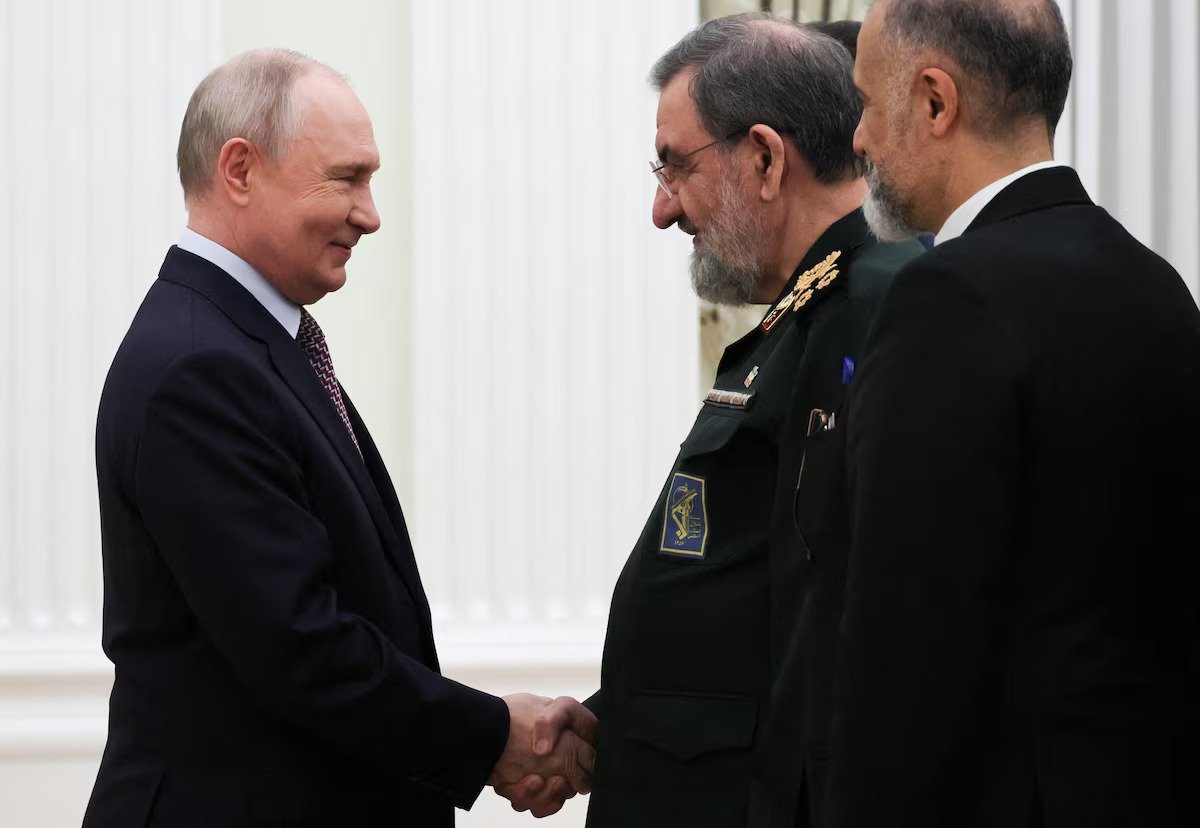
Russian President Vladimir putin met Iran’s top security official, Mohsen Rezaei, at the Kremlin on Thursday, November 5, as diplomatic efforts to end the conflict between Iran and the United States continued without a breakthrough. The meeting brought the two countries’ senior representatives together at a time when the future of the Strait of Hormuz, US sanctions and regional security remain central to negotiations.
Iranian state media reported that Rezaei delivered a message from Supreme Leader Ayatollah Mojtaba Khamenei to Putin. The Kremlin confirmed that the meeting took place but did not publicly disclose details of the discussions or the contents of the message. The encounter nevertheless highlighted the importance Tehran places on its relationship with Moscow while it faces pressure over the conflict and negotiations with Washington.
After the meeting, Rezaei said the discussions covered regional developments, the post-war period and possible security arrangements. He also raised a proposed gas pipeline connecting Russia and Iran, describing it as a project that could help address Iranian gas shortages and create opportunities for Russian gas exports to neighbouring countries.
Putin and Rezaei discuss regional security and the post-war period
Rezaei described the conversation with Putin as significant, particularly in relation to the security arrangements that could shape the region after the current conflict.
“Important regional issues were discussed with Mr Putin, and significant conversations took place regarding the post-war period and regional security arrangements,” Rezaei said after the meeting, according to Iranian state media.
The remarks suggest that the discussions extended beyond the immediate question of ending hostilities. Iran and Russia have overlapping interests in the Middle East, including regional stability, energy markets and their diplomatic positions toward the United States. However, neither the Kremlin nor the Iranian statement provided a detailed account of any specific agreements reached during Thursday’s meeting.
Images released by the Kremlin showed Putin meeting Rezaei alongside Russian presidential foreign policy aide Yuri Ushakov and Igor Kostyukov, head of Russia’s military intelligence agency. The presence of senior Russian officials underscored the high-level nature of the encounter, although it does not establish that particular military or security commitments were agreed.
The meeting also followed a telephone conversation between Putin and Rezaei on November 2, according to Iranian reporting. The repeated contact comes as Tehran seeks diplomatic support and continues to outline its conditions for any settlement with Washington.
Iran’s seven conditions remain a major obstacle to negotiations
One of the most important issues surrounding the meeting is Iran’s position on restarting negotiations with the United States. Rezaei said Tehran had communicated seven conditions to Washington and would not reopen the Strait of Hormuz or enter negotiations until those demands were met.
“We have told him [Putin] that on the issue of diplomacy, we have announced seven conditions to the Americans,” Rezaei said. He added that Iran would neither reopen the strategic waterway nor begin negotiations unless Washington implemented the conditions.
The statement reflects Tehran’s insistence that the next stage of diplomacy must involve concrete action from the United States rather than simply a return to talks. Iranian officials have argued that Washington must address their demands before Iran makes concessions on the strait or its wider negotiating position.
Iran’s reported demands include an end to the conflict, the release of frozen Iranian assets, the lifting of sanctions and an end to the US naval blockade. Other reported conditions concern compensation for war damage, the withdrawal or reduction of US military forces in the region and guarantees against renewed attacks. The full list and its precise wording have not been consistently detailed in every public statement.
For Washington, several of these demands involve major policy and security questions. Sanctions relief, the future of US military deployments and arrangements governing shipping through the Strait of Hormuz are not isolated issues. They are connected to wider disagreements over Iran’s regional role, its nuclear programme and the security of international maritime routes.
That makes the seven conditions a central negotiating obstacle. Even if both sides remain interested in avoiding a return to large-scale fighting, they disagree over which steps must come first and what each government must provide in exchange.
Why the Strait of Hormuz is central to the dispute
The Strait of Hormuz is one of the world’s most strategically important shipping routes. It connects the Persian Gulf with the Gulf of Oman and the wider Indian Ocean, making it a critical passage for oil and other energy shipments from the Middle East.
Any prolonged disruption to traffic through the strait can affect energy supplies, shipping costs and international markets. The waterway’s status has therefore become one of the most consequential issues in the negotiations between Iran and the United States.
Tehran has linked reopening the passage to the fulfilment of its conditions. This gives the strait a role beyond maritime security: it has become a central point of leverage in the diplomatic dispute.
The United States, meanwhile, has maintained pressure on Iran through measures including a naval blockade of Iranian ports. Tehran regards the blockade as one of the issues that must be addressed before negotiations can move forward.
The two sides also face a disagreement over the sequence of any possible agreement. Iran wants Washington to meet key demands before it reopens the waterway or returns to formal negotiations. US officials have continued to pursue a settlement through diplomatic channels, but the parties remain far apart on important terms. Reuters reported on November 3 that indirect negotiations were continuing through Qatari mediation, while major differences remained over sanctions, the blockade and the strait.
Qatari mediation has not yet produced a breakthrough
Diplomatic efforts to end the conflict have involved intermediaries, including Qatar. Rather than relying entirely on direct negotiations, messages and proposals have been exchanged through mediators as both sides attempt to establish whether a broader agreement is possible.
Recent discussions have focused on the future of the Strait of Hormuz, the US blockade on Iranian ports, sanctions and the possibility of restarting negotiations over Iran’s nuclear programme.
However, the diplomatic process has not resolved the fundamental disagreements. A senior Iranian official said the two sides remained far apart, while Rezaei’s latest comments made clear that Tehran was not prepared to resume negotiations on the terms currently available.
Reports on the mediation process have also indicated disagreements over the order in which commitments should be implemented. Iran has pushed for measures addressing the blockade and sanctions, while questions about its nuclear programme remain part of the wider dispute. The precise terms of any draft arrangement have not been publicly settled.
This leaves mediators with a difficult task: finding a sequence of steps that both governments could accept without either side appearing to surrender its principal demands.
Mojtaba Khamenei signals that Iran will not accept submission to the US
The Kremlin meeting came shortly after Supreme Leader Mojtaba Khamenei issued a written statement on Wednesday. In it, he said there should not be “even the slightest inclination towards submission” to the United States.
The statement reinforced the position being communicated by Rezaei: Iran is prepared to discuss diplomacy, but it does not intend to return to negotiations without addressing its stated conditions.
Rezaei’s role is significant because he serves as secretary of Iran’s Supreme National Security Council and represents the country’s supreme leader. Delivering Khamenei’s message directly to Putin gave the meeting an additional diplomatic dimension, although the contents of that message have not been made public.
For Moscow, maintaining communication with Tehran provides an opportunity to remain involved in discussions surrounding a major regional conflict. Russia has also continued to call for a political solution, while its relationship with Iran gives it a separate channel for understanding Tehran’s position.
However, the meeting should not automatically be interpreted as evidence that Russia has secured a mediation role or agreed to guarantee any future settlement. Public statements from both sides have not established such an arrangement.
Russia-Iran gas pipeline proposal adds an energy dimension
Alongside regional security and diplomacy, Rezaei said the meeting addressed plans for a gas pipeline from Russia to Iran. The proposed project could have implications for both countries’ energy sectors.
Iran has substantial natural gas resources, but domestic supply constraints and Infrastructure requirements have created challenges in meeting demand in some periods. A pipeline connection with Russia could potentially provide an additional source of supply, depending on its design, capacity, financing and implementation.
Rezaei also described a wider commercial possibility: Russia could use the arrangement to sell gas to countries neighbouring Iran. Such a system would give the project a regional dimension beyond direct energy trade between Moscow and Tehran.
For Russia, new routes and customers are important as it continues to navigate restrictions and changes in international energy trade. For Iran, cooperation could offer another way to strengthen energy links with a major regional partner.
Nevertheless, the reported discussion does not mean that the pipeline has been approved, financed or scheduled for construction. Important details including its route, capacity, investment requirements, delivery arrangements and participating countries were not provided in the available statements. The proposal should therefore be understood as an issue discussed by the two sides, rather than a completed energy agreement.
What the Putin-Rezaei meeting means for the wider region
The meeting took place at a moment when diplomatic decisions over Iran could have consequences extending well beyond the two countries directly involved. The Strait of Hormuz is important to international energy trade, while the conflict has placed additional pressure on regional security and shipping.
For countries that depend on energy imports, uncertainty over the waterway can create concerns about supply reliability, transport costs and market stability. A prolonged confrontation could also complicate trade and investment decisions across the Middle East.
Russia’s involvement adds another diplomatic factor. Moscow maintains relations with Tehran and has its own interests in regional security and energy cooperation. Its ability to communicate with Iranian leadership may give it insight into Tehran’s negotiating position, but the public record does not show that Putin’s meeting with Rezaei produced a concrete route to ending the conflict.
The proposed gas pipeline is a separate but related part of the relationship. If developed, it could deepen energy cooperation between Russia and Iran. Yet its commercial and technical feasibility will depend on details that have not been publicly established.
What happens next?
The immediate question is whether diplomatic intermediaries can narrow the gap between Washington and Tehran. Iran has made clear that it wants its seven conditions addressed before reopening the Strait of Hormuz or restarting negotiations. The United States has not publicly accepted the full set of demands.
Further discussions are likely to remain focused on the blockade, sanctions, the future of maritime traffic and the terms of any renewed nuclear negotiations. Each issue is linked to the others, making a limited agreement difficult unless both sides can settle on a workable sequence of commitments.
Putin’s meeting with Rezaei demonstrates that communication between Russia and Iran is continuing during this diplomatic period. But the Kremlin has not announced a specific agreement from the talks, and the contents of Khamenei’s message remain undisclosed.
For now, the meeting represents an important diplomatic contact rather than a breakthrough. Whether it contributes to a wider settlement will depend on developments in the US-Iran negotiations and on whether the two sides can move beyond their conflicting conditions for ending the conflict.
For breaking news and live news updates, like us on Facebook or follow us on Twitter and Instagram. Read more on Latest World on thefoxdaily.com.





COMMENTS 0