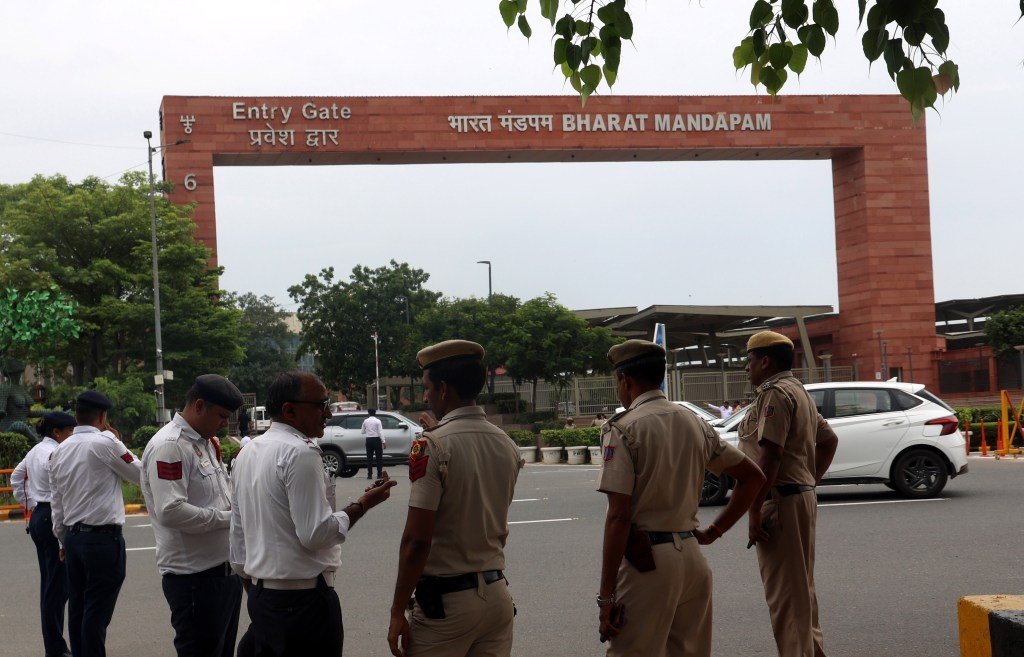
India is preparing for potentially important economic discussions with China on the sidelines of the 18th BRICS Summit in New Delhi on September 12-13, with technology imports, investment restrictions and supply-chain bottlenecks expected to feature prominently in the bilateral conversation.
Chinese President Xi Jinping is expected to attend the summit with a sizeable business delegation, creating an opportunity for New Delhi to raise concerns that have increasingly affected Indian manufacturers dependent on Chinese technology, components and raw materials.
Government consultations with industry groups indicate that the Indian side is considering highlighting restrictions imposed by Chinese Customs on high-tech items and specialised components. New Delhi may also seek greater reciprocity in easing investment and sourcing restrictions between the two countries.
The discussions come as India-China economic relations show signs of gradual improvement after several years of restrictions following the 2020 border crisis. Direct flights and border Trade have resumed in stages, restrictions on some Chinese investments have been eased and officials from both countries have held renewed discussions on economic ties.
Yet the latest engagement reveals an important contradiction. Political and commercial relations are thawing, but Indian companies continue to face significant vulnerabilities because critical parts of their manufacturing ecosystems remain dependent on China.
Why technology imports are becoming a major issue
The Commerce and Industry Ministry has been examining restrictions affecting key technology-related imports from China, particularly where delays could disrupt Indian manufacturing.
Officials have been consulting industry bodies ahead of the BRICS meeting to identify products and sectors where Chinese export controls are creating bottlenecks.
The concern is particularly strong in areas where India is trying to develop domestic manufacturing capacity while simultaneously expanding Infrastructure and renewable-energy systems.
Indian companies can often source alternative components from other countries, but replacing established Chinese suppliers is not always quick or commercially viable. In some cases, China remains dominant in specific technologies, intermediate goods and critical raw materials.
That creates a strategic vulnerability. India may want to reduce dependence on Chinese imports, but it cannot immediately eliminate them without risking higher costs, delayed projects or interruptions to industrial expansion.
Rare-earth magnets are already affecting Indian manufacturers
The Automobile industry has been one of the clearest examples of this vulnerability.
Indian automakers and component manufacturers have already had to find workarounds because of delays involving rare-earth magnets sourced from China.
Rare-earth magnets are important components in electric motors and several advanced industrial applications. Delays in supply can affect production schedules even when other parts of a vehicle or machine are available.
The issue illustrates why China’s export controls are being treated as more than a normal trade dispute. For industries attempting to build advanced manufacturing capabilities, the timely availability of highly specialised inputs can determine whether factories operate at full capacity.
India is therefore likely to push for mechanisms that make sourcing more predictable, particularly for products where China remains a dominant supplier.
India may seek reciprocity from Beijing
One of the likely themes of the bilateral economic discussion is reciprocity.
Indian policymakers have increasingly sought to ensure that market access is not one-sided. If Indian companies face investment restrictions, sourcing barriers or procedural delays in China, New Delhi wants similar concerns to be addressed when Chinese companies seek greater access to the Indian market.
The issue is particularly relevant because India has tightened scrutiny of investments from countries sharing a land border with it since 2020.
Those measures were introduced after the military confrontation along the Line of Actual Control and were designed partly to prevent opportunistic takeovers of Indian companies during the economic disruption caused by the Covid-19 pandemic.
The recent relaxation of some measures suggests that India now sees scope for calibrated economic engagement, but that does not mean the broader investment screening framework has disappeared.
Critical technologies are at the centre of the dispute
Indian industry has raised concerns about Chinese restrictions on a range of technologies and industrial inputs.
A senior renewable-energy executive with substantial China sourcing exposure said restrictions now affect areas including ingot and wafer technology, battery cells and battery-cell technology.
These products are important to industries such as solar manufacturing, energy storage and electric mobility, all of which are strategic sectors for India’s industrial policy.
Restrictions on such inputs can complicate India’s effort to move from assembling finished products toward developing deeper domestic supply chains.
If local manufacturers cannot reliably access advanced components or production technologies, plans for greater domestic value addition can become harder to execute.
HVDC technology is another strategic concern
The concerns extend into the Electricity transmission sector, where Indian industry says restrictions are affecting specialised equipment and technologies related to High Voltage Direct Current (HVDC) transmission.
HVDC systems are particularly useful for transmitting electricity over long distances while reducing certain transmission losses. They can also play an important role in connecting renewable-energy generation to distant demand centres and strengthening grid stability.
That gives HVDC technology strategic importance as India rapidly expands renewable-energy capacity.
A delay in obtaining critical transmission equipment can have consequences beyond a single company because power infrastructure projects often depend on multiple components arriving according to tightly coordinated construction schedules.
Why renewable energy is particularly exposed
India’s renewable-energy ambitions require large investments in solar power, batteries, transmission networks and grid modernisation.
Many of these sectors have supply chains that are heavily dependent on Chinese manufacturing.
China remains a major global producer of solar-related components, battery materials, cells and a wide range of industrial equipment.
India has spent years trying to build domestic capacity in these areas through manufacturing incentives and industrial policies. But creating a domestic ecosystem takes time, particularly when suppliers need access to specialised machinery and upstream technologies.
This is why Indian policymakers increasingly view supply-chain diversification as a strategic necessity rather than simply a commercial preference.
Industry warns that restrictions could slow domestic manufacturing
Industry representatives argue that China’s restrictions could undermine India’s effort to develop deeper domestic production capabilities.
The problem is not only whether Indian companies can buy a finished product from China. It is also whether they can access the machinery, technology and intermediate inputs required to manufacture those products domestically.
Without access to critical upstream technologies, the process of backward integration can become more difficult.
That is particularly important because India’s long-term industrial strategy aims to move beyond importing finished goods and toward domestic production of increasingly sophisticated components.
If those supply chains remain dependent on a single foreign source, India’s manufacturing competitiveness remains exposed to geopolitical disruption.
India is not the only country worried about China’s controls
The concerns raised by Indian companies fit into a much wider global debate over China’s control of strategically important supply chains.
Major economies have increasingly identified semiconductors, batteries, rare earths, solar technology and advanced manufacturing equipment as areas where excessive dependence on a single country could create national-security risks.
China’s importance in these supply chains means that restrictions can influence production decisions well beyond its own borders.
For India, the problem is particularly acute because the country is simultaneously trying to expand manufacturing while reducing strategic dependence on imports.
The two objectives can conflict in the short term. India needs Chinese inputs to expand quickly today, while its industrial strategy seeks to develop alternatives for tomorrow.
India-China trade is improving despite the tensions
Despite the concerns over technology restrictions, the overall trade relationship has shown signs of improvement.
India’s exports to China rose by more than 28% in April-June compared with the same period a year earlier, reaching approximately $5.55 billion.
The increase is notable because India has traditionally run a substantial trade deficit with China. A stronger export performance provides Indian businesses with at least some improvement in their access to the Chinese market.
The rise in exports also helped cushion Indian fishery exporters affected by tariff-related disruptions in the United States.
The trend suggests that the bilateral economic relationship is not simply moving in one direction toward decoupling. Instead, both countries continue to trade heavily even while managing political and strategic tensions.
Direct flights and border trade signal a thaw
The economic discussions come after several signs of a broader easing in India-China Relations.
India has moved toward reopening aspects of border trade through Nathu La, while direct air connections have also resumed.
People-to-people exchanges have gradually increased as well.
These changes indicate that both governments see value in restoring at least some normal economic and social connections after years of heightened tensions.
However, the pace of economic normalisation is likely to remain calibrated. New Delhi is still sensitive to the security implications of excessive dependence on Chinese capital and technology.
High-level trade talks are also resuming
The renewed engagement extends to senior government officials.
Chinese Ambassador to India Xu Feihong met Commerce Secretary Rajesh Agrawal on September 1, according to the Chinese Embassy in India.
The meeting covered bilateral economic and trade relations as well as other issues of mutual interest.
The Chinese Embassy described the relationship as showing positive momentum, pointing to the resumption of direct flights, border trade and greater people-to-people exchanges.
The meeting is significant because regular communication between senior trade officials provides a mechanism for addressing the practical problems that businesses face before those problems become major diplomatic disputes.
India and China restarted ministerial-level trade engagement
Another important development occurred earlier this year when Commerce and Industry Minister Piyush Goyal held bilateral talks with Chinese Commerce Minister Wang Wentao.
The meeting took place on the sidelines of the World Trade Organization’s 14th Ministerial Conference in Cameroon in April.
It was the first bilateral meeting at that level since India withdrew from negotiations for the China-led Regional Comprehensive Economic Partnership (RCEP) in 2019.
The resumption of direct ministerial trade discussions suggests that both governments are interested in rebuilding channels of economic communication even while strategic distrust remains.
Why a planned Commerce Ministry visit to Beijing was postponed
A senior Commerce Ministry official had been expected to travel to Beijing this week as part of the renewed trade engagement.
The visit was subsequently understood to have been postponed amid border-related discussions between India and China.
The development highlights how closely economic diplomacy remains connected to the security relationship.
Even when trade ties are improving, progress can be affected by developments along the disputed border.
That means businesses on both sides must continue to operate in an Environment where economic normalisation and strategic caution coexist.
India also faces the legacy of the 2020 border tensions
The investment restrictions introduced in 2020 were a direct response to the tensions following the deadly clash between Indian and Chinese troops along the Line of Actual Control.
The government subsequently required investors from countries sharing a land border with India to obtain prior approval for certain investments.
The policy was also intended to prevent opportunistic acquisitions of Indian businesses at depressed valuations during the Covid-19 disruption.
Those controls fundamentally changed the environment for Chinese companies seeking to invest in India.
The more recent easing of selected restrictions indicates that New Delhi is now willing to recalibrate the framework where it sees an economic or industrial benefit, but the original security concerns have not disappeared.
Power equipment shows how policy is changing
India’s approach can be seen clearly in the power sector.
In March, the government relaxed rules allowing state-owned Bharat Heavy Electricals Limited (BHEL) to procure 21 critical items from China for five years.
The decision recognised the practical difficulty of building major power infrastructure without access to certain specialised components available from Chinese suppliers.
It also reflected a more selective approach: rather than removing all restrictions on Chinese sourcing, the government has allowed specific imports considered necessary for strategic projects.
This is an example of the balancing act at the heart of India’s China policy.
Four Chinese power equipment companies received exemptions
In June, the Finance Ministry allowed four Chinese power-equipment manufacturers with production facilities in India to participate in government tenders for critical power projects.
The companies were TBEA Energy, Nanjing Electric India, New Northeast Electric India and Taikai Electric (India).
They received exemptions from public-procurement provisions that require companies from countries sharing a land border with India to register with the relevant authority before bidding for certain government contracts.
The decision recognised the distinction between Chinese companies operating manufacturing facilities inside India and companies simply supplying equipment directly from China.
It also demonstrated that India is willing to make targeted exceptions when they support critical infrastructure and domestic manufacturing objectives.
The challenge is reducing dependence without disrupting growth
India’s policy toward China therefore involves a difficult balancing act.
On one side is the strategic goal of reducing excessive dependence on a neighbouring country with which India has unresolved security disputes.
On the other is the economic reality that Chinese suppliers remain deeply embedded in many critical industrial value chains.
Rapidly replacing those suppliers could increase production costs and slow infrastructure expansion.
Allowing unrestricted dependence, meanwhile, could leave Indian industry exposed to sudden export controls, diplomatic disputes or global supply shocks.
The government’s emerging approach appears to favour selective de-risking rather than an immediate attempt to sever economic ties.
What India could ask China for at BRICS
The BRICS Summit provides a high-level setting for India to translate industry concerns into a political discussion.
New Delhi is expected to push for greater transparency and predictability around Chinese export procedures for critical technology and components.
It may also seek the removal of unnecessary customs delays and administrative bottlenecks affecting Indian companies.
Another possible objective is reciprocal treatment for Indian businesses seeking to invest or expand in China.
For India, the message is likely to be that improving bilateral trade requires not only larger trade volumes but also more balanced and predictable market access.
Why India needs a more diversified supply chain
The debate does not necessarily mean India should stop importing from China.
In many sectors, China remains one of the world’s most cost-competitive manufacturing bases, and eliminating Chinese inputs altogether could raise costs for Indian consumers and businesses.
The more practical goal is diversification.
India can continue importing from China while simultaneously developing alternative suppliers in Japan, South Korea, Europe, the United States, Southeast Asia and within India itself.
That approach reduces the risk that a sudden disruption from any single country can halt an entire production chain.
For strategic technologies, maintaining multiple sourcing options can become a form of economic security.
Global supply chains are becoming a strategic issue
The India-China debate reflects a broader transformation in global commerce.
For decades, companies largely focused on efficiency when choosing suppliers. Today, governments and businesses increasingly consider resilience and geopolitical risk alongside cost.
A supplier that offers the cheapest component is not necessarily the lowest-risk option if political tensions can suddenly interrupt shipments.
This shift is particularly important for technologies such as batteries, semiconductors, renewable-energy equipment and advanced power systems.
India’s push for domestic manufacturing should therefore be understood partly as an economic strategy and partly as a strategy for reducing exposure to geopolitical disruptions.
China also has an interest in stable trade with India
Despite their strategic differences, China and India have strong economic incentives to maintain trade.
India is a large and growing market for consumer goods, industrial equipment, electronics and manufacturing inputs.
China, meanwhile, benefits from access to Indian demand and from the continued integration of its companies into regional supply chains.
The recent increase in Indian exports to China also shows that the trade relationship can support Indian producers under the right circumstances.
This mutual dependence creates room for pragmatic negotiations even when broader strategic differences remain unresolved.
US tariff uncertainty is another reason India is reassessing trade
The renewed India-China economic engagement is also taking place against a backdrop of uncertainty over US trade policy.
Changing tariff structures in major markets can make export-oriented manufacturing more difficult and increase the importance of flexible supply chains.
For Indian policymakers, diversifying trade relationships can reduce the risks associated with overdependence on any one market.
That does not mean replacing the United States with China or vice versa. It means creating enough commercial alternatives for Indian industry to remain competitive when geopolitical conditions change.
India’s challenge is to build domestic capacity without closing itself off
There is a danger in responding to supply-chain dependence with excessive protectionism.
If India makes imported inputs too expensive before domestic alternatives are ready, Indian manufacturers can become less competitive rather than more competitive.
That is why the debate over Chinese imports is ultimately connected to India’s broader industrial strategy.
The objective should be to develop domestic manufacturing that can eventually compete globally, while allowing businesses access to the imported components they need during the transition.
Targeted support for critical industries can coexist with selective trade openness if policy is designed carefully.
What a successful China trade reset would look like
A successful reset would not necessarily mean a return to the pre-2020 relationship.
Instead, it could involve a more predictable economic framework in which both countries recognise strategic sensitivities while allowing legitimate commercial activity to continue.
For India, that would mean fewer unnecessary customs delays, greater transparency around export controls and improved access for Indian businesses operating in China.
For China, greater stability would mean continued access to one of the world’s most important growth markets and fewer sudden disruptions to its companies operating in India.
The challenge is creating rules that can withstand political disagreements rather than collapsing whenever relations deteriorate.
India-China trade: improving ties, persistent vulnerabilities
| Area | Current situation |
|---|---|
| Indian exports to China | Rose more than 28% year on year to about $5.55 billion in April-June |
| Critical imports | Indian industry remains dependent on China for several specialised technologies and components |
| Rare-earth magnets | Delays have created challenges for Indian automobile manufacturers |
| Renewable energy | Concerns include restrictions affecting ingot and wafer technology, battery cells and related technology |
| Power transmission | Industry has flagged restrictions involving HVDC and specialised equipment |
| Direct flights | Resumption is among the signs of improving bilateral ties |
| Nathu La trade | Border trade has resumed as part of the broader easing of economic links |
| Chinese power companies | Four firms with factories in India received exemptions for certain critical government tenders |
| Investment policy | India has made calibrated changes to restrictions on investment from countries sharing a land border |
| Key diplomatic forum | BRICS Summit in New Delhi on September 12-13 |
Why the BRICS meeting is strategically important
The upcoming BRICS Summit gives India an unusually visible platform for addressing practical trade issues directly with China.
Because Xi Jinping is expected to attend, the economic discussion can take place at the highest political level while business delegations bring direct industry concerns into the conversation.
This creates an opportunity for India to distinguish between areas where cooperation is possible and areas where strategic safeguards remain necessary.
The broader BRICS framework is also increasingly focused on trade, investment, technology and financial cooperation, making supply-chain issues highly relevant to the summit’s economic agenda.
The bigger issue is economic security, not just trade
The debate over Chinese technology imports is ultimately about more than customs procedures or the cost of individual components.
It is about whether India can build a resilient industrial Economy that remains functional when geopolitical relationships become difficult.
India wants to become a major manufacturing and technology power while simultaneously reducing vulnerabilities created by excessive dependence on one external supplier.
Achieving that requires domestic investment, alternative international supply chains and predictable access to critical imports during the transition.
The China relationship will remain a central part of that equation because the two economies are too deeply connected for an immediate separation to be realistic.
India’s China strategy is shifting from restriction to calibrated engagement
The pattern of recent policy decisions suggests that India is not abandoning the safeguards introduced after the 2020 border tensions, but it is becoming more selective in applying them.
Allowing BHEL to procure critical Chinese items and permitting selected Chinese power-equipment companies operating in India to participate in government tenders show that strategic projects can justify targeted exemptions.
At the same time, India’s concerns over Chinese export controls and investment access show that New Delhi wants greater reciprocity before economic ties can deepen substantially.
The approach can be described as controlled economic engagement: maintain trade where it supports Indian growth while reducing vulnerabilities that could become dangerous during a geopolitical crisis.
What to watch after the BRICS Summit
The most important indicator will be whether the bilateral discussions produce concrete changes rather than simply positive political statements.
Indian industry will be looking for improvements in customs processing, greater predictability in Chinese export licensing and easier access to critical technologies and components.
Indian businesses will also watch whether Chinese authorities become more receptive to investment and market access by Indian companies.
On the Indian side, future policy decisions could reveal whether the government continues gradually easing selected restrictions where Chinese participation supports domestic manufacturing and critical infrastructure.
The direction of those decisions will indicate whether the recent thaw develops into a more stable economic relationship or remains vulnerable to the next political or border crisis.
India-China trade talks enter a new phase
The upcoming BRICS Summit in New Delhi comes at a moment when India and China are attempting to rebuild parts of their economic relationship without ignoring the strategic tensions that remain between them.
India’s likely concerns are clear. Chinese restrictions on high-tech imports, rare-earth materials, battery technologies and specialised power equipment can affect Indian manufacturing and infrastructure projects. At the same time, Indian companies continue to face questions about market access and investment conditions in China.
Beijing, however, remains an indispensable trading partner in many sectors. India’s exports to China have risen sharply this year, direct flights and border trade have resumed, and senior officials from both sides are holding more frequent economic discussions.
That creates an opening for a pragmatic reset.
For India, the goal is unlikely to be a complete economic separation from China. The more realistic objective is to reduce critical dependencies, diversify sourcing and ensure that Chinese trade remains predictable even when political relations are difficult.
The September 12-13 BRICS Summit could provide an important test of whether that approach can produce concrete results. If India can secure fewer procedural bottlenecks, more transparent access to critical technologies and greater reciprocity for its companies, the meeting could mark a meaningful step toward a more balanced economic relationship with China.
But the deeper challenge will remain at home: building enough domestic capability and alternative global supply chains that India’s growth is never held hostage to restrictions imposed by any one external supplier.
For breaking news and live news updates, like us on Facebook or follow us on Twitter and Instagram. Read more on Latest Business on thefoxdaily.com.





COMMENTS 0