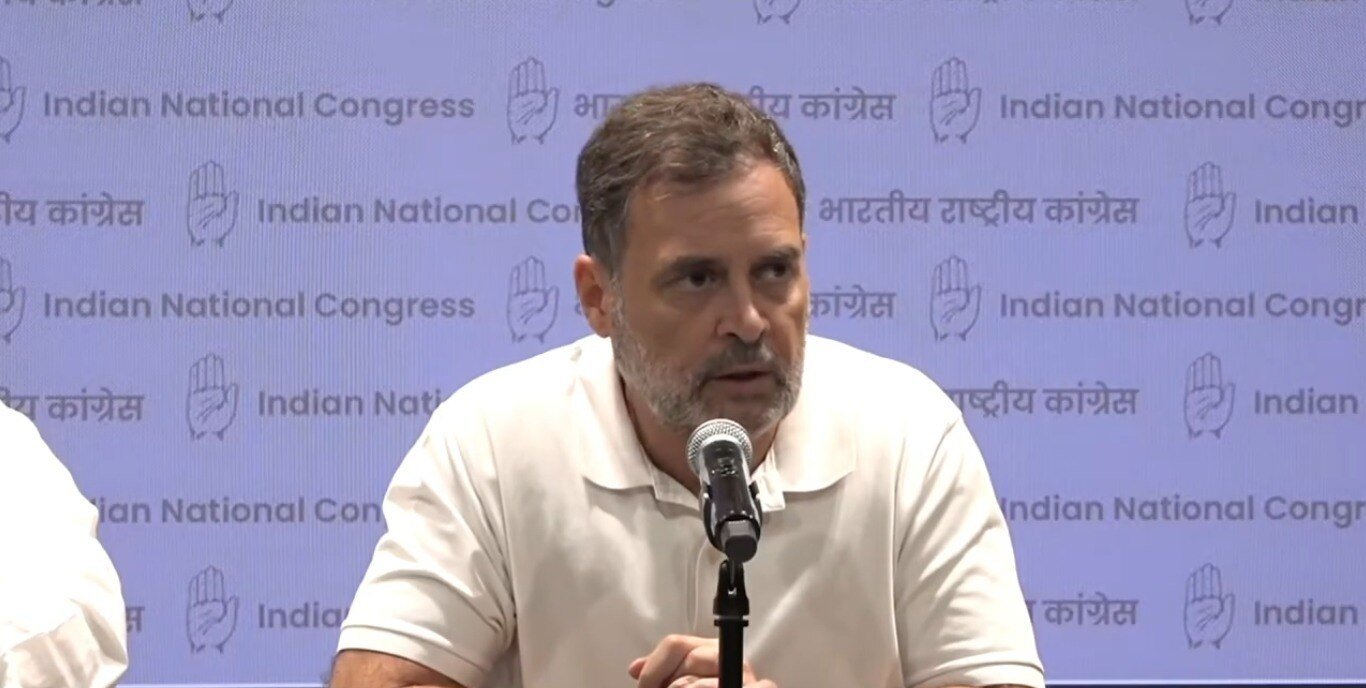
Rahul Gandhi has rejected the government’s offer of a discussion on student issues, demanding that Union Home Minister Amit Shah answer who authorised the alleged police action against protesting students in Delhi.
Leader of Opposition in the Lok Sabha Rahul Gandhi on Monday intensified the political confrontation over the alleged police action against students in Delhi, rejecting the government’s proposal for a broader discussion on student-related issues and insisting on a direct answer from Union Home Minister Amit Shah.
Gandhi said the Opposition’s demand was not for Shah to make a general speech in Parliament. Instead, he wants the Home Minister to clarify whether he authorised the police action against students protesting in Delhi on June 20 and, if not, identify the official or authority that did.
Speaking at a press conference alongside Congress president Mallikarjun Kharge, Gandhi said the Opposition wanted the question of responsibility addressed directly. He alleged that pellet guns and force were used against protesters and called for an explanation of who approved the action.
Rahul Gandhi demands direct answer from Amit Shah
Gandhi argued that the government’s offer of a discussion did not address what the Opposition considers the central issue.
According to Gandhi, the question before Parliament is whether Shah personally authorised the alleged firing on students. If he did not, Gandhi said, the Opposition wants to know which official within the Ministry of Home Affairs authorised the action.
“Did he order it or did he not order it?” Gandhi said, making the question of ministerial responsibility the centre of his criticism.
Gandhi also alleged that protesters were subjected to pellet-gun fire and lathi-charge. These allegations are at the centre of the political dispute and have been used by the Opposition to demand a detailed explanation from the government.
He argued that if Shah had authorised the action, he should be held responsible, while if he was unaware of it, questions would arise about his competence as Home Minister.
“If he ordered it, he is guilty of getting our children shot. And if he didn’t know about it happening, he’s incompetent. Either way, he should go,” Gandhi said.
Congress says responsibility must be established
Gandhi’s argument goes beyond demanding an explanation about the use of force. The Congress leader is seeking to establish a clear chain of responsibility within the government.
He said the Opposition wants to know whether Shah personally authorised the alleged police action or whether someone else in the Ministry of Home Affairs gave the order.
The issue has become a major point of contention between the government and the Opposition during the ongoing parliamentary session.
Gandhi also called for Prime Minister Narendra Modi to apologise over the alleged police action against students.
He accused the government of avoiding the Opposition’s central question and said the Congress was not interested in a general discussion that did not address the specific allegation of who authorised the police response.
Government offers discussion on student issues
The government’s position was presented by Parliamentary Affairs Minister Kiren Rijiju, who said the government was prepared to hold a detailed discussion on issues concerning students.
Rijiju said the government would respond to the points raised by the Opposition and that Shah would give the government’s response. He also appealed to Opposition MPs to allow the discussion to proceed without disruptions.
Rijiju urged lawmakers to listen to the Home Minister’s response and participate in what he described as a detailed discussion of the issues.
The government’s offer, however, failed to satisfy Gandhi.
Gandhi described the proposed discussion as a “fantasy conversation”, arguing that the Opposition was seeking a specific answer about the alleged police action rather than a general debate on student concerns.
The disagreement over the format and scope of the discussion has consequently become part of the larger parliamentary deadlock.
Kharge calls Opposition demands “non-negotiable”
Congress president Mallikarjun Kharge backed Gandhi’s position and described three issues being raised by the Opposition as non-negotiable.
According to Kharge, the first demand concerns the alleged use of pellet guns, tear gas and lathi-charge against students in Delhi. He said the Home Minister should explain why such measures were used.
The Congress has also raised allegations concerning donations connected with the Ram temple and has demanded accountability and a statement from the Prime Minister.
The third issue mentioned by Kharge is the alleged paper leak issue, which the Opposition wants discussed in Parliament.
Kharge said the Opposition would continue pressing the government on all three matters and accused the government of failing to respond to its demands for nearly two weeks.
Congress raises alleged Ram temple donation issue
The dispute in Parliament is not limited to the alleged police action against students.
Kharge repeated Congress allegations concerning donations associated with the Ram temple. He said the Prime Minister had announced and constituted the trust and argued that alleged irregularities involving donations required accountability.
Kharge called for those responsible for any wrongdoing to be punished and demanded a statement from the Prime Minister. He also linked the issue to the faith placed in the temple by devotees.
The allegations remain part of the Opposition’s political demands, while the government has not accepted the Opposition’s characterization of the matter as presented in the Congress leaders’ statements.
Rahul Gandhi backs protesting students in Jharkhand
Gandhi’s comments on student protests in Delhi came alongside his criticism of police action against job aspirants in Jharkhand.
Police in Ranchi used water cannons, tear gas and lathi-charge after protesters breached barricades while attempting to move toward the state Assembly. The protesters were demonstrating over alleged irregularities in recruitment examinations.
Gandhi condemned the use of force and said students have a right to peaceful protest. He called on the Jharkhand government to continue engaging with the protesters and address their grievances.
At his press conference, Gandhi reiterated that the Congress does not support violence against peaceful protesters, regardless of where such protests take place.
“As long as protests are peaceful, we are against any attack on it with violence,” he said.
Several protesters claimed they were injured during the police action after reaching the final barricade near Jagannathpur Temple on the road leading to the Jharkhand Assembly, which is currently in session.
Jharkhand issue carries an added political complication
Gandhi’s criticism of the police response in Jharkhand comes despite the Congress being part of the Hemant Soren-led state government.
That makes the issue politically sensitive for the party. Gandhi sought to draw a distinction between supporting peaceful protest and opposing violence against protesters, while calling on the state government to engage directly with the students.
His comments also fit into the broader argument he has made about student protests in Delhi: that governments should respond to grievances through dialogue rather than force when demonstrations remain peaceful.
The two incidents are nevertheless separate, involving different governments and different sets of allegations. The common political issue raised by Gandhi is the use of force against students and job aspirants during protests.
Parliament remains deadlocked over the issue
The disagreement comes as proceedings in both Houses of Parliament have faced repeated disruption over the Opposition’s demand for answers from Shah.
Opposition MPs have raised slogans targeting the Home Minister and staged demonstrations at Parliament’s gates. The Congress argues that the alleged police action against students is serious enough to require a comprehensive statement on the floor of the House.
Earlier on Monday, Congress General Secretary KC Venugopal wrote to Lok Sabha Speaker Om Birla seeking directions for Shah to make a detailed statement.
Venugopal described the alleged police action against students exercising their democratic rights as a matter of national concern. He specifically raised allegations involving police atrocities and the use of pellet guns.
He also argued that because the Delhi Police operates under the Ministry of Home Affairs, responsibility for the action ultimately rests with the Home Minister.
Why the dispute could affect the remaining Parliament session
The political confrontation comes with only four days of the Monsoon Session remaining, increasing pressure on both the government and Opposition to resolve the impasse.
Continued disruptions can limit the time available for debates and legislative business. The dispute over the student protests is therefore not only a political battle between Congress and the government but also an issue that could affect Parliament’s remaining schedule.
The Congress has issued a whip asking its MPs in both Houses to remain present on August 10, August 11 and August 12, citing important matters scheduled during the remaining days. The party has also asked its India bloc allies to ensure their MPs remain present.
That indicates the Opposition intends to maintain pressure during the final days of the session rather than allowing the issue to fade without a government response.
What happens next
The immediate question is whether the government and Opposition can agree on a format that allows the allegations surrounding the Delhi student protests to be discussed in Parliament.
The government has said it is ready for a detailed discussion and that Shah will respond to issues raised by the Opposition. Gandhi and Congress leaders, however, are demanding a direct explanation of the chain of command behind the alleged police action.
If the government provides the detailed response sought by the Opposition, the confrontation could move from repeated disruptions to a substantive parliamentary debate. If Congress continues to regard the government’s proposed discussion as insufficient, protests and disruptions could continue through the remaining days of the session.
The controversy also places attention on the evidence behind the allegations of pellet-gun use, tear gas and lathi-charge, as well as the question of who authorised the police response. Establishing those facts will be central to determining the political responsibility being demanded by the Opposition.
For now, Gandhi’s message is clear: the Congress wants the government to answer a specific question about the alleged action against protesting students, while the government says it is prepared to discuss student-related issues and provide a response through the Home Minister.
With the Monsoon Session nearing its end, the dispute over that unanswered question remains one of the key flashpoints between the government and Opposition in Parliament.
For breaking news and live news updates, like us on Facebook or follow us on Twitter and Instagram. Read more on Latest India on thefoxdaily.com.






COMMENTS 0