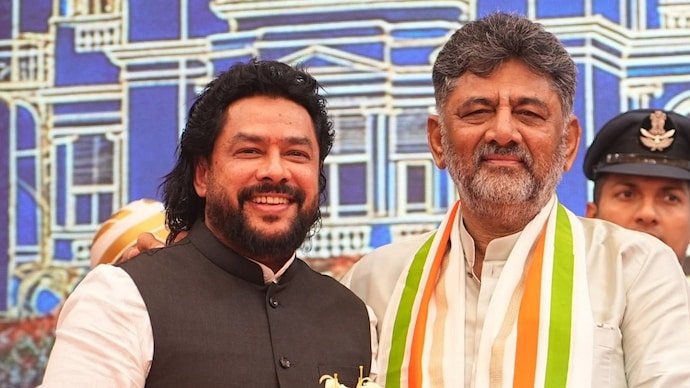
Karnataka Minister B Nagendra has offered to resign from the Cabinet amid mounting political pressure over the alleged Rs 89.63-crore Valmiki Corporation scam, opening a fresh chapter in a controversy that has followed the Congress government since 2024.
Nagendra conveyed his willingness to quit to Chief Minister DK Shivakumar on Wednesday, according to reports. The minister’s offer came after sustained demands from the Opposition BJP for his removal and a renewed campaign around the alleged misuse of funds belonging to the Karnataka Maharshi Valmiki Scheduled Tribes Development Corporation.
Shivakumar has asked Nagendra to wait while he discusses the matter with the Congress high command. That means the offer is not, by itself, a completed resignation. The immediate question is whether the party leadership will accept it and how the government responds to the intensifying Opposition campaign.
The political stakes are high because the allegations are no longer limited to an internal departmental controversy. The Central Bureau of Investigation has filed chargesheets naming Nagendra among 30 accused in cases linked to the alleged diversion of funds, while the Enforcement Directorate has separately investigated the money-laundering component.
Nagendra has denied wrongdoing and has maintained that he is confident of proving his innocence through the legal process. The allegations against him remain subject to judicial proceedings and have not been finally adjudicated.
Why B Nagendra is offering to resign now
Nagendra’s decision comes after the BJP sharply escalated its campaign against the Karnataka government. The Opposition has repeatedly demanded his resignation, arguing that a minister facing serious allegations connected to public funds should not remain in the Cabinet while the case is being pursued.
The BJP has also announced a padayatra from Raichur to Ballari beginning September 1, with Nagendra’s resignation among its central demands. The planned march adds a wider political dimension to an issue that has already disrupted proceedings in the Karnataka legislature.
For the Congress government, the timing is particularly sensitive. Nagendra had already resigned from the Cabinet in June 2024 when the controversy first erupted. He was later brought back into the government after DK Shivakumar became Chief Minister, and the issue has consequently returned to the centre of political debate.
The latest offer therefore creates a different situation from 2024. This time, the minister is offering to step aside after the CBI has completed a major part of its investigation and filed chargesheets, while the Opposition is using the case to question the government’s decision to re-induct him.
What is the Valmiki Corporation scam?
The Valmiki Corporation case concerns the alleged diversion of money belonging to the Karnataka Maharshi Valmiki Scheduled Tribes Development Corporation, an organisation intended to support the socio-economic development of Scheduled Tribe communities in Karnataka.
The controversy became public in May 2024 after corporation accounts officer P Chandrashekharan died by suicide and left behind a note alleging financial irregularities and unauthorised transfers of corporation funds.
Investigators subsequently examined how money moved out of corporation accounts. The CBI has alleged that Rs 89.63 crore was fraudulently diverted using forged cheques and RTGS transactions.
The investigation described a complex movement of funds rather than a single transfer. According to the CBI’s chargesheet, the diverted money was layered through approximately 600 bank accounts before being converted into cash, bullion and other assets.
The alleged use of multiple accounts is significant because such layering can make it more difficult to trace the original source of money. In this case, investigators have alleged that funds moved through a network involving officials, bank personnel, private individuals, intermediaries and fictitious entities.
How the alleged diversion was carried out
The CBI’s investigation provides a clearer picture of the alleged mechanism behind the Rs 89.63-crore diversion.
Investigators alleged that around Rs 187 crore had been consolidated in a Union Bank of India account belonging to the corporation. From that pool, Rs 89.63 crore was allegedly transferred through forged banking documents, cheques and RTGS instructions.
The investigation also identified 18 alleged fictitious bank accounts in Hyderabad. These accounts were reportedly opened in the names of Business entities using fabricated registration documents and KYC records.
Once the money entered the network of accounts, investigators alleged that it was moved through hundreds of transactions. The CBI has said that the funds were eventually converted into cash, bullion and luxury vehicles.
This alleged pattern matters because the case is not simply about whether money was withdrawn from a government-linked account. It also concerns how banking channels and multiple intermediary accounts were allegedly used to obscure where the funds went.
What investigators have alleged about Nagendra
Nagendra’s alleged role has been one of the most politically contentious parts of the case. The CBI’s June 2026 chargesheets named him among the accused along with his associate Nekkanti Nagaraj, corporation officials, government officials, bank officials, intermediaries and private individuals.
The agency has alleged that Nagendra was part of a wider conspiracy connected to the diversion. Reports on the chargesheet have also said investigators alleged that he received illegal gratification and benefited from a vehicle purchased through diverted funds.
These are allegations contained in the investigation and chargesheet, not findings of guilt by a court. Being named as an accused does not by itself establish criminal liability.
Why the CBI chargesheet changed the political equation
The CBI’s action in June 2026 significantly raised the political pressure on Nagendra.
The agency filed three separate chargesheets relating to alleged misappropriation involving the Valmiki Corporation, the Scheduled Tribes Welfare Department and the Karnataka German Technical Training Institute. Nagendra was named as an accused across the three proceedings.
The CBI said its investigation identified 30 people in connection with the alleged financial irregularities. The case was initially registered following a complaint by Union Bank of India and was later expanded after investigators identified alleged fraud involving other government-linked entities.
For the BJP, the chargesheet strengthened its argument that Nagendra should not hold ministerial office while facing prosecution-related proceedings. The party has used the case repeatedly in the Assembly and outside the legislature to attack the Congress government.
For the Congress, the issue presents a difficult balance between allowing the legal process to continue and managing the political consequences of keeping a minister under such sustained scrutiny.
Nagendra had already resigned once over the controversy
The current resignation offer has an important precedent.
In June 2024, Nagendra resigned as minister after the Valmiki Corporation allegations emerged. At the time, he was serving as the Tribal Welfare Minister in the Siddaramaiah-led Karnataka government.
The resignation was followed by investigations by multiple agencies. The ED pursued alleged money laundering, while the CBI investigated the underlying banking fraud.
Nagendra was later re-inducted into the Cabinet after DK Shivakumar became Chief Minister. His return meant that the political controversy did not end with his initial resignation. Instead, his re-entry into government became another point of attack for the Opposition.
That history helps explain why the latest offer carries greater political significance than an ordinary ministerial resignation. It raises questions about whether stepping down again would allow the Congress government to reduce political pressure while the court proceedings continue.
ED investigation adds another layer to the case
The Valmiki Corporation controversy has also involved the Enforcement Directorate, which investigated the alleged laundering and movement of the diverted money.
The ED’s investigation identified alleged fictitious accounts and examined the movement of funds through different entities and intermediaries. The agency also pursued assets it said were connected to the alleged proceeds of crime.
In December 2025, the ED said it had attached properties worth about Rs 8.07 crore in connection with proceeds allegedly linked to Nagendra. The agency’s action formed part of its separate investigation under the Prevention of Money Laundering Act.
The existence of parallel investigations is important because the CBI and ED are examining different aspects of the wider controversy. The CBI’s case focuses on alleged criminal diversion and banking fraud, while the ED’s proceedings concern the alleged laundering and handling of proceeds of crime.
What the Rs 89.63 crore figure actually represents
The frequently cited Rs 89.63 crore figure refers to the amount the CBI alleges was fraudulently diverted from corporation funds.
It should not automatically be treated as the total value of every financial irregularity investigated in connection with the broader controversy. Investigators have examined transactions involving other government entities and additional sums during the course of the probe.
This distinction matters because headlines can sometimes make the case appear simpler than it is. The core allegation involves the diversion of Rs 89.63 crore from the corporation, but the wider investigations have examined a larger network of transactions, accounts, assets and alleged beneficiaries.
| Key development | What happened |
|---|---|
| May 2024 | The Valmiki Corporation controversy emerged after accounts officer P Chandrashekharan died by suicide and left a note alleging financial wrongdoing. |
| June 2024 | B Nagendra resigned from the Karnataka Cabinet amid the controversy. |
| 2024 | The ED pursued the alleged money-laundering component and the CBI investigated the alleged banking fraud. |
| June 2026 | The CBI filed three chargesheets naming Nagendra and 29 others in connection with alleged fund misappropriation involving multiple government-linked entities. |
| August 2026 | Nagendra was re-inducted into the Karnataka Cabinet and later came under renewed BJP pressure for his resignation. |
| August 26, 2026 | Nagendra offered to resign amid intensified Opposition protests, with Shivakumar expected to consult the Congress high command. |
Why the controversy matters beyond Karnataka politics
The case has consequences beyond the question of WHO occupies a ministerial post.
The money at the centre of the controversy was intended for programmes benefiting Scheduled Tribe communities. Any diversion of such funds can therefore affect more than government accounting. It raises questions about whether the intended beneficiaries received the support for which public money had been allocated.
The case also highlights the importance of internal financial controls in government corporations. The alleged use of forged documents, unauthorised banking instructions and multiple accounts has drawn attention to the safeguards that are supposed to prevent public funds from being moved without proper authorisation.
For banks and government agencies, the investigation also underlines the importance of KYC verification, transaction monitoring and checks on unusual transfers. The CBI’s allegations involving multiple accounts and banking channels make the case relevant to the broader question of how financial institutions detect suspicious movement of public money.
The political battle is likely to continue
Nagendra’s offer to resign may reduce some immediate pressure on the Congress government, but it is unlikely to end the controversy.
The BJP has already announced a 10-day padayatra from Raichur to Ballari beginning September 1. The party plans to keep the alleged Valmiki Corporation scam among the central issues in its campaign against the state government.
The Opposition’s strategy is also aimed at keeping the issue connected to Nagendra’s political base in the Ballari region. That gives the controversy an electoral dimension in addition to its legal and administrative implications.
At the same time, the final decision on Nagendra’s ministerial position remains a political decision separate from the criminal proceedings. His resignation, if accepted, would not determine whether he is legally guilty or innocent. That question can only be resolved through the judicial process.
What happens next for B Nagendra and the Congress government?
The immediate next step is expected to be consultation between Chief Minister DK Shivakumar and the Congress high command over Nagendra’s offer.
If the resignation is accepted, the government could argue that Nagendra has chosen to step aside to avoid allowing the controversy to distract from its administration. If the offer is not accepted, the BJP is likely to continue arguing that the government is protecting a minister facing serious allegations.
The legal proceedings will continue independently of the political decision. The CBI chargesheet and ED investigation will have to progress through the appropriate legal process, where the evidence and allegations can be tested.
The most important distinction for readers is therefore between political accountability and criminal liability. A minister may resign because of political pressure without that constituting an admission of guilt. Conversely, remaining in office does not establish innocence.
For now, the central issue is whether the Congress leadership accepts Nagendra’s offer and whether that changes the political confrontation over the Valmiki Corporation case. With the Opposition preparing further protests and the legal investigation already producing chargesheets, the controversy is unlikely to disappear from Karnataka Politics anytime soon.
For breaking news and live news updates, like us on Facebook or follow us on Twitter and Instagram. Read more on Latest India on thefoxdaily.com.




COMMENTS 0