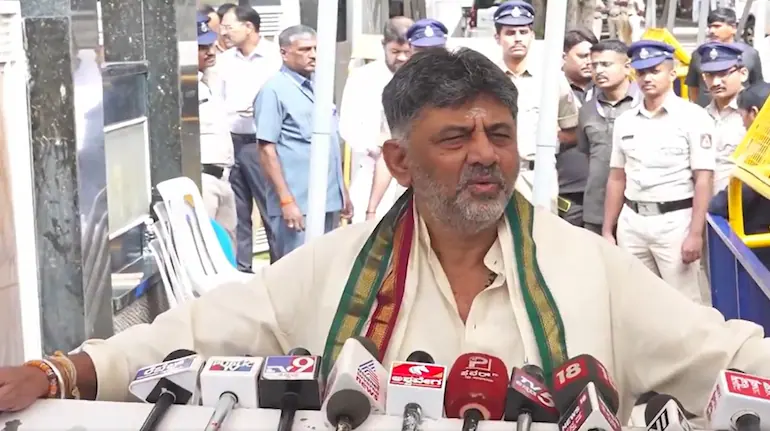
Karnataka Deputy Chief Minister DK Shivakumar has alleged that petrol sold at certain fuel stations in the state may contain ethanol in excess of the prescribed 20% limit under India’s E20 fuel programme. He has promised to present documents and findings from the state government’s investigation at a press conference on Monday.
The allegation comes amid complaints from motorists about reduced vehicle mileage, intermittent engine shutdowns and other performance problems. Shivakumar said the state government was examining these complaints and had begun collecting fuel samples and inspecting petrol dispensing equipment and vehicles.
The issue has brought renewed attention to India’s ethanol-blending programme, which aims to reduce dependence on imported crude oil and increase the use of domestically produced biofuels. However, the Karnataka government’s allegations and the Centre’s response have raised questions about fuel quality testing, retail distribution and the compatibility of vehicles with higher ethanol blends.
Importantly, the alleged excess blending has not yet been independently established. The Centre has rejected claims that E20 Petrol supplied by public sector oil marketing companies exceeds the approved limit, citing the results of its nationwide sample testing.
What DK Shivakumar Has Alleged About E20 Petrol
Speaking to reporters on Sunday, Shivakumar said the Karnataka government was investigating complaints that petrol sold at some retail outlets contained more ethanol than permitted. He maintained that the issue was based on consumer complaints and the state’s investigation rather than political considerations.
“This is not about being an Opposition party,” he said, arguing that the government had a responsibility to examine concerns raised by motorists and protect consumers.
According to Shivakumar, the complaints include vehicles delivering lower mileage than expected and engines stopping repeatedly during operation. He said the government had received reports involving thousands of vehicles, although the total number of independently verified cases has not been established.
The Chief Minister said samples had been collected from 67 locations across Karnataka and that the investigation was approximately 30% complete. Government teams were also examining fuel dispensing machines and vehicles as part of the exercise.
He alleged that the suspected irregularities could be taking place at the retail distribution level rather than necessarily at the point of fuel production. He claimed that the state had documents indicating excessive mixing at certain petrol pumps and promised to disclose evidence at the Monday press conference.
Shivakumar also suggested that the alleged practice could be motivated by financial gain because ethanol is generally cheaper than petrol. However, whether any outlet deliberately added ethanol beyond the approved level, and how such an irregularity might have occurred, remains to be established through laboratory testing and an official investigation.
Centre Rejects Karnataka’s Allegations, Cites 893 Compliant Samples
The Centre has pushed back against the allegations, saying E20 petrol supplied by public sector oil marketing companies meets the prescribed quality standards under the Bureau of Indian Standards specification IS 17021.
In a clarification issued on November 7, the Ministry of Petroleum and Natural Gas said 893 samples collected across 27 states and Union Territories were tested through the Oil Marketing Companies and the Centre for High Technology’s Quality Coordination Cell exercise. All 893 samples recorded ethanol content within the prescribed range of 19% to 21%.
The ministry also highlighted the results from Karnataka. All 56 samples tested in the state were found compliant, with ethanol content ranging from 19% to 20% and an average of 19.30%. The samples covered different locations and all three public sector oil companies: Indian Oil Corporation, Bharat Petroleum Corporation and Hindustan Petroleum Corporation.
The Centre’s findings directly contradict the Karnataka department’s reported results of 26% to 31% ethanol at selected outlets. The two sides are therefore presenting conflicting test findings, making the sampling process and laboratory methodology central to resolving the dispute.
Oil Companies Question Karnataka’s Testing Procedure
Indian Oil, BPCL and HPCL have disputed the reported findings, arguing that the October 2026 sampling exercise did not follow the statutory and technical procedures required for fuel-quality testing.
Under the Motor Spirit and High Speed Diesel Control Order, 2005, and the Marketing Discipline Guidelines 2024, a defined procedure governs sample collection, retention, testing and communication of results. The prescribed process requires six one-litre samples: two are handed to the dealer, two are retained by the oil company or department, and two are sent to an authorised laboratory.
The companies said samples from the September exercise were routed through the state-level coordinator to designated oil company laboratories. However, they alleged that the subsequent October exercise was conducted without the participation of oil company representatives. They also said they had not received the corresponding retained samples, complete outlet-wise details or laboratory reports needed to verify the results.
The companies further questioned the laboratory certificates cited by the Karnataka government. According to the Ministry of Petroleum and Natural Gas, the certificates mentioned ethanol percentage measured through gas chromatography but did not specify the applicable standard test method, dilution procedure or reference material used to correct the result.
These technical details matter because a laboratory result can only be meaningfully compared with the national fuel specification when the prescribed testing method is followed. Without the relevant documentation and counterpart samples, the reported figures cannot be independently assessed through the same procedure used in the national monitoring exercise.
The oil companies have sought complete sampling records and proposed joint sampling and independent testing under the prescribed standards. Such an exercise could help determine whether the differences arise from actual variation in fuel quality, sampling conditions or testing methodology.
What Is E20 Petrol and Why Does India Use It?
E20 petrol is a blend containing up to 20% ethanol and at least 80% petrol. Ethanol is an alcohol-based fuel generally produced from agricultural feedstocks such as sugarcane, maize and other crops. It can be blended with petrol and used in vehicles designed or approved for the corresponding fuel specification.
India’s Ethanol Blended Petrol Programme aims to reduce the country’s dependence on imported crude oil, support domestic agriculture and improve energy security. The programme has expanded gradually over the years, with average Ethanol Blending rising from approximately 1.53% in 2013-14 to around 19.2% in 2024-25. The government said the national 20% blending target was achieved during the 2025-26 ethanol supply year.
The policy has economic and environmental objectives. Greater domestic ethanol use can reduce the volume of petrol that needs to be produced from imported crude oil. It can also create an additional market for agricultural producers and ethanol manufacturers.
According to the Petroleum Ministry, the programme has generated foreign-exchange savings of more than Rs 1.97 lakh crore since the 2014-15 supply year and resulted in payments of over Rs 1.66 lakh crore to farmers. These are government-reported estimates of the programme’s wider economic contribution.
However, the benefits of ethanol blending depend on maintaining fuel quality and ensuring that the blend meets the applicable technical standards. The Karnataka controversy is therefore focused not on whether India should use ethanol-blended petrol, but on whether fuel at particular outlets may have exceeded the permitted specification.
Can E20 Petrol Affect Vehicle Mileage and Engine Performance?
Concerns about mileage and vehicle compatibility have become a major part of the national debate over E20 petrol. Ethanol has different energy content and combustion characteristics from conventional petrol. As a result, fuel efficiency can vary depending on the ethanol proportion, engine design and vehicle calibration.
The Petroleum Ministry has cited technical assessments involving the Automotive Research Association of India, the Society of Indian Automobile Manufacturers and an inter-ministerial committee. According to the ministry, vehicles calibrated for E20 may experience a mileage reduction of approximately 1% to 2%, while certain other vehicles could see reductions of around 3% to 6%, depending on their category and calibration.
These figures describe the expected impact of using fuel within the prescribed specification. They do not establish that every vehicle will experience the same reduction or that a particular engine failure is necessarily caused by ethanol blending.
Vehicle performance can also be affected by factors such as tyre pressure, traffic conditions, driving habits, engine maintenance and air-conditioner use. A sudden drop in mileage or repeated engine shutdowns should therefore be investigated rather than automatically attributed to E20 petrol.
The Karnataka government’s allegation is different from the general debate about the use of E20. It claims that certain samples may contain substantially more ethanol than the approved limit. If that is confirmed through a properly conducted investigation, the issue would concern fuel quality and compliance with the applicable standards.
What Could Happen If Petrol Contains More Than the Permitted Ethanol Level?
Fuel containing ethanol beyond the approved specification could raise concerns about whether it is suitable for vehicles designed and tested for the prescribed blend. The possible effects would depend on the actual ethanol concentration, vehicle design, fuel-system materials and duration of exposure.
Areas that may require technical examination include fuel pumps, filters, injectors, hoses, seals and other components that come into contact with fuel. However, the presence of a vehicle malfunction alone cannot prove that excessive ethanol was responsible. A diagnosis would need to consider the vehicle’s condition, maintenance history, fuel sample and other possible causes.
That distinction is important for motorists. A claim that petrol at a particular outlet contains more than 20% ethanol should be established through reliable laboratory testing. Similarly, a claim that a vehicle has suffered damage because of that fuel requires technical evidence connecting the fuel to the failure.
The Centre has said that its nationwide monitoring has not identified widespread vehicle breakdowns attributable to specification-compliant E20 petrol. It has also cited manufacturer service data and technical assessments to support the programme. Those findings do not, by themselves, settle the separate allegations concerning the specific Karnataka samples.
Why the Monday Press Conference Matters
Shivakumar’s promised presentation of evidence could provide more clarity on the Karnataka government’s investigation. The key questions will be whether the state releases outlet-wise test results, identifies the laboratories involved and explains the exact testing procedures used to calculate ethanol concentrations.
The government will also need to clarify how the samples were collected, stored and transported, and whether the process followed the requirements under the relevant fuel-control rules. Details of the 67 locations, the identity of the outlets and the availability of retained samples could help establish whether the findings can be independently reproduced.
The Centre and oil marketing companies have already called for joint sampling and independent testing. If the state shares the required records and both sides agree to a transparent verification process, the dispute could move from competing claims towards a technically defensible conclusion.
Any confirmed violation would then need to be examined under the applicable rules, with responsibility determined on the basis of evidence. Until that process is completed, the reported figures should be treated as allegations rather than an established finding that petrol across Karnataka contains excessive ethanol.
What Should Motorists Do Amid the E20 Controversy?
Motorists should avoid drawing conclusions about fuel quality from isolated social media posts or unverified claims. The dispute involves technical measurements, and the difference between a compliant blend and an allegedly excessive blend needs to be established through authorised testing.
Vehicle owners experiencing repeated engine shutdowns, unusual performance changes or a sudden drop in mileage should have their vehicles inspected by a qualified service centre. They can ask technicians to examine the fuel system and record any identified faults. Keeping fuel receipts and noting the outlet, date and time of refuelling may also help if a formal complaint becomes necessary.
Consumers who suspect adulteration or a fuel-quality violation can raise the matter with the concerned oil marketing company or the relevant state authorities. A complaint should include specific details about the outlet and the problem rather than relying only on a general allegation about ethanol blending.
It is equally important not to assume that all E20 petrol is unsafe. The national programme is based on a defined fuel specification, and the Centre says its monitoring results show compliance among the samples it tested. The Karnataka allegations, if substantiated, would point to possible irregularities at particular locations rather than automatically proving that the entire programme is defective.
What Happens Next in the Karnataka E20 Petrol Dispute?
The immediate focus is on the evidence promised by Shivakumar and the response from the Union Petroleum Ministry and oil marketing companies. The state has said its investigation is still in progress, while the Centre has questioned the methodology behind the reported results and offered a route for joint verification.
Three issues will be particularly important: whether the alleged ethanol levels can be reproduced using the prescribed BIS testing methods, whether the samples were collected according to statutory procedures, and whether any confirmed excess blending can be linked to specific outlets or suppliers.
The outcome could have implications for fuel-quality enforcement and consumer protection beyond Karnataka. A transparent investigation would help determine whether the state has identified genuine distribution-level violations or whether the reported results need to be reassessed because of testing and sampling concerns.
For now, neither the allegation of widespread excessive blending nor a direct link between the reported vehicle problems and ethanol levels above 20% has been conclusively established. The promised evidence and any subsequent joint laboratory testing will be central to determining what actually happened.
For breaking news and live news updates, like us on Facebook or follow us on Twitter and Instagram. Read more on Latest India on thefoxdaily.com.






COMMENTS 0