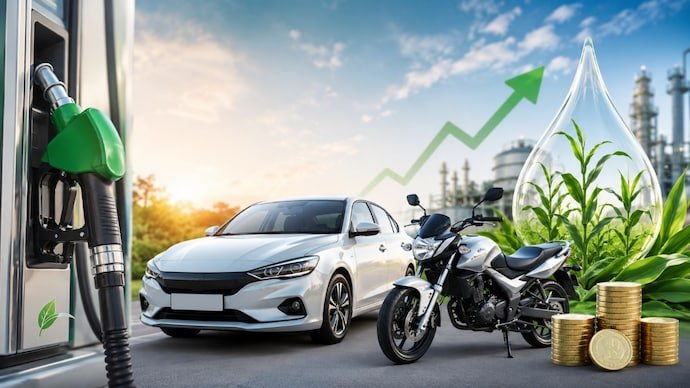
India has officially entered the E85 era. With the launch of Delhi’s first E85 fuel dispensing station, the country’s ambitious ethanol-blending strategy has moved beyond pilot programs and into a new phase focused on high-ethanol fuels and flex-fuel vehicles.
At Rs 82.12 per litre, E85 appears significantly cheaper than E20 petrol, which currently sells for around Rs 102 per litre in the national capital. For consumers struggling with rising transportation costs, a discount of nearly Rs 20 per litre sounds attractive. On the surface, it appears to be a win-win situation: motorists save money, India reduces crude Oil Imports, and farmers gain from increased demand for agricultural feedstocks.
Yet the experience of Brazil the world’s most successful ethanol-powered economy suggests that the real question is not how much fuel costs at the pump, but how much it costs to drive a kilometre.
The answer to that question may determine whether India’s ethanol revolution becomes a transformative energy success story or remains a niche experiment.
What Is E85 and Why Is India Promoting It?
E85 is a fuel blend containing up to 85 percent ethanol and 15 percent petrol. Unlike standard petrol, it requires specially designed flex-fuel vehicles capable of adjusting engine performance based on varying fuel mixtures.
India’s push toward ethanol is part of a broader strategy aimed at improving energy Security, reducing dependence on imported crude oil, lowering carbon emissions, and creating additional income opportunities for farmers.
India imports a substantial portion of its crude oil requirements, making the economy vulnerable to geopolitical disruptions, currency fluctuations, and global oil price shocks. Every increase in international oil prices directly affects transportation costs, Inflation, and government finances.
Ethanol offers an alternative because it can be produced domestically using agricultural feedstocks such as sugarcane, maize, damaged food grains, and other biomass resources.
The government’s Ethanol Blending program has already achieved significant milestones, with ethanol blending levels rising dramatically over the past decade.
India’s Ethanol Journey: From E10 to E85
India’s ethanol strategy has evolved rapidly in recent years.
| Phase | Objective | Impact |
|---|---|---|
| E10 | 10% ethanol blending | Initial reduction in fuel imports |
| E20 | 20% ethanol blending | Expanded biofuel adoption nationwide |
| E85 | High ethanol fuel for flex-fuel vehicles | Potential for deeper oil import substitution |
| E100 (Future) | Near-pure ethanol mobility | Long-term energy independence goals |
The introduction of E85 represents a major shift because it moves beyond blending ethanol into conventional petrol and creates a dedicated ethanol fuel ecosystem.
However, success requires more than simply offering a new fuel option.
Brazil: The Global Benchmark for Ethanol Success
When policymakers discuss ethanol-powered transportation, Brazil is almost always the reference point.
Over several decades, Brazil built one of the world’s most successful biofuel ecosystems. The country transformed ethanol from an alternative fuel into a mainstream transportation solution.
Today, most vehicles sold in Brazil are flex-fuel models capable of running on petrol, ethanol, or any combination of the two.
This flexibility gives consumers freedom to choose whichever fuel offers the best value at any given time.
Brazil’s success was not accidental. It resulted from a combination of government policy, extensive infrastructure investment, strong agricultural production, widespread fuel availability, and consumer-friendly economics.
Most importantly, ethanol consistently provided a financial advantage that motorists could clearly see.
The Famous “70 Percent Rule” That Could Decide India’s Success
One of the most important lessons from Brazil is known as the “70 percent rule.”
Ethanol contains less energy per litre than petrol. This means vehicles generally travel fewer kilometres using a litre of ethanol compared to a litre of petrol.
Because of this difference in energy density, Brazilian consumers typically compare fuel prices using a simple formula.
If ethanol costs less than 70 percent of petrol’s price, ethanol usually provides better value. If ethanol costs more than 70 percent of petrol’s price, the lower Fuel Efficiency often cancels out the apparent savings.
This rule has become deeply embedded in Brazilian consumer behavior and remains one of the most important benchmarks for evaluating ethanol economics.
Why a Rs 20 Discount May Not Be Enough
At first glance, India’s E85 pricing appears compelling.
With E85 priced at Rs 82.12 per litre and E20 petrol costing approximately Rs 102 per litre, motorists save nearly Rs 20 on every litre purchased.
However, the more important calculation is cost per kilometre travelled.
If a vehicle experiences a 20 to 30 percent reduction in fuel economy when using E85, much of the apparent saving could disappear.
For example, a motorist may spend less money filling the tank but require more fuel to travel the same distance.
In practical terms, consumers do not purchase litres they purchase mobility.
This distinction is critical because most drivers ultimately judge fuel value based on monthly transportation expenses rather than fuel pump prices.
A Simple Comparison of Fuel Economics
| Factor | Petrol (E20) | E85 |
|---|---|---|
| Approximate Price | Rs 102/L | Rs 82.12/L |
| Relative Energy Content | Higher | Lower |
| Fuel Efficiency | Higher | Potentially 20-30% lower |
| Cost Per Litre | Higher | Lower |
| Cost Per Kilometre | Depends on vehicle | May not be significantly lower |
This comparison highlights why consumer adoption may be slower than policymakers expect if the fuel price gap remains relatively narrow.
The Infrastructure Challenge: India’s Biggest Hurdle
Pricing is only one piece of the puzzle.
Brazil’s ethanol success was built on nationwide availability. Motorists could easily find ethanol pumps wherever they traveled, eliminating concerns about fuel accessibility.
India currently lacks that level of infrastructure.
Although the government plans to establish thousands of ethanol dispensing stations over the coming years, the network remains limited. Most consumers still have little or no access to E85 fuel.
This creates a significant adoption challenge.
Consumers are unlikely to purchase flex-fuel vehicles if fuel stations are difficult to find. At the same time, fuel retailers may hesitate to invest in ethanol infrastructure without sufficient vehicle demand.
This creates a classic chicken-and-egg problem that has affected alternative fuel transitions worldwide.
Will Automakers Fully Embrace Flex-Fuel Vehicles?
Vehicle availability could become another critical factor.
Brazil’s ethanol ecosystem works because flex-fuel vehicles dominate the market. Consumers can switch fuels without changing vehicles or modifying engines.
India is still in the early stages of flex-fuel vehicle adoption.
Several manufacturers have announced plans to introduce flex-fuel models, but production volumes remain relatively small compared to conventional petrol and diesel vehicles.
Without a large fleet of compatible vehicles, ethanol demand may remain limited regardless of pricing advantages.
Automakers will likely wait for stronger infrastructure growth before making large-scale investments, creating another challenge for policymakers.
Why India Still Needs Ethanol Even If Consumer Savings Are Modest
While consumer economics matter, ethanol serves broader national objectives that extend beyond individual fuel costs.
Reducing Oil Imports
India spends billions of dollars annually importing crude oil. Higher ethanol usage can reduce this dependence and improve trade balances.
Supporting Farmers
Increased ethanol production creates additional demand for agricultural feedstocks, potentially boosting rural incomes.
Improving Energy Security
Domestic fuel production reduces vulnerability to international supply disruptions and geopolitical crises.
Lowering Carbon Emissions
Biofuels can contribute to climate goals when produced sustainably and integrated effectively into transportation systems.
These strategic advantages explain why governments often support ethanol programs even when short-term consumer benefits are not overwhelming.
What Competitors Often Miss: The Consumer Psychology Factor
One aspect frequently overlooked in discussions about ethanol adoption is consumer psychology.
Most motorists are not energy economists. They rarely calculate energy density, combustion efficiency, or lifecycle emissions.
Instead, they ask simple questions:
- Does my vehicle run smoothly?
- Can I easily find fuel?
- Am I actually saving money?
- Will resale value be affected?
- Is the transition convenient?
If consumers cannot clearly see a financial advantage, adoption rates may remain slow regardless of environmental or strategic benefits.
Brazil succeeded because motorists consistently experienced tangible savings. That experience created trust and encouraged long-term adoption.
Could India Eventually Replicate Brazil’s Success?
The answer is yes but likely not immediately.
India possesses several advantages that could support long-term ethanol growth, including a large agricultural base, strong government support, growing energy demand, and increasing focus on energy independence.
However, matching Brazil’s success will require more than ethanol production targets.
India will need:
- Nationwide E85 availability.
- Affordable flex-fuel vehicles.
- Consistent pricing advantages.
- Consumer awareness campaigns.
- Reliable ethanol supply chains.
- Long-term policy stability.
Without these elements, ethanol could struggle to achieve mass-market adoption.
Future Outlook: The Next Five Years Will Be Crucial
Delhi’s first E85 fuel station represents an important milestone, but it is only the beginning of a much larger experiment.
The next few years will determine whether India can build a self-sustaining ethanol ecosystem capable of competing with conventional fuels on both economics and convenience.
Brazil’s experience offers a valuable lesson: consumers ultimately choose fuels based on value, not policy objectives. A lower price at the pump may attract attention, but long-term success depends on delivering genuine cost-per-kilometre savings.
At today’s prices, E85’s Rs 20-per-litre discount provides a promising starting point. Yet the economics remain finely balanced once ethanol’s lower energy content is considered.
If India can expand infrastructure, increase flex-fuel vehicle adoption, and maintain a meaningful price advantage, E85 could become a major pillar of the country’s energy future. If not, it may remain a niche product used primarily to support broader Energy Security goals.
The real test will not be how many ethanol pumps are opened, but how many drivers decide that ethanol genuinely saves them money. That lesson, more than any government target, is what Brazil’s success story teaches India today.
For breaking news and live news updates, like us on Facebook or follow us on Twitter and Instagram. Read more on Latest India on thefoxdaily.com.






COMMENTS 0