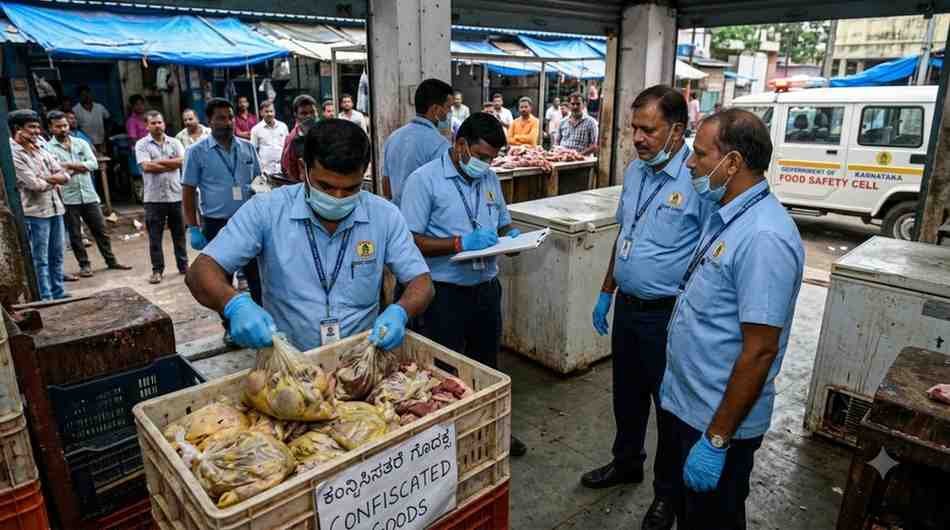
Food Safety officials shut the kitchen of an upscale rooftop lounge in Bengaluru and seized rotten meat, expired food and other items from premium eateries during a special inspection drive across the city.
The kitchen of an upscale rooftop lounge in Bengaluru was closed after food safety officials found it was being maintained in an “unhygienic” manner, officials said on Monday. During the same inspection drive, authorities seized rotten chicken and beef, some of it showing fungal growth, from high-end Restaurants in the city.
The inspections were conducted on Sunday at six premium restaurants in UB City and on Brigade Road as part of the Food Safety and Drug Administration Department’s ongoing checks for compliance with the Food Safety and Standards Act, 2006, and the Food Safety and Standards (Licensing and Registration of Food Businesses) Regulations, 2011.
At the rooftop lounge in UB City, inspectors also found packets of milk and curd that had expired around 10 days earlier.
45 kg of rotten chicken and beef seized
At another high-end restaurant in UB City, officials seized 45 kg of rotten chicken and beef, along with 6 kg of vegetable cutlets and 15 litres of used cooking oil.
The seized food items were found to be unfit for consumption and were discarded or destroyed according to procedure.
Other items seized during the inspections included 50 kg of duck meat, 5 kg of fish, 5 kg of green peas and 5 kg of mushrooms.
In total, officials said 132 kg of food items were seized and disposed of during inspections at the high-end restaurants.
60 three-star and five-star hotels inspected
The inspections formed part of a three-day special food safety drive that began on August 7 across all zones of Bengaluru Urban District and the Greater Bengaluru Area.
The operation covered three-star and five-star hotels, with the department saying that 60 such hotels in Bengaluru Urban District were inspected.
Officials collected 77 food samples and sent them to food laboratories for analysis. The samples included chicken, meat, fish, bread, mayonnaise, cooking oil, fresh oil, curd, pulses, chickpeas or chana, coriander, chutneys and marinated food products.
The samples will be analysed to assess their quality and compliance with applicable food Safety Standards.
Expired food and hygiene violations found
The department said inspectors identified several violations during the drive.
These included non-compliant labelling under FSSAI regulations, misbranding, storage of expired food products, improper storage of meat, fish and poultry, unhygienic food-handling conditions and fungal growth in vegetables.
Inspectors also found improper segregation of vegetarian and non-vegetarian food products.
The violations indicate that the concerns identified by officials extended beyond the condition of meat to food storage, labelling, handling and kitchen hygiene.
Notices issued to hotels
The department said notices had been issued to the hotels concerned following the inspections.
Recommendations have also been made for filing cases before the respective adjudicating officers for further action in accordance with the law.
The department said strict legal action would be taken against hotels and food Business operators found violating food safety rules.
Brigade Road burger outlet also inspected
Special inspections were also carried out at international food businesses operating in the Greater Bengaluru Area.
During an inspection at a popular burger outlet on Brigade Road, officials alleged that magnesium sulphite (MgSO3) was being used in connection with the treatment or purification of used frying oil.
The department said a notice was issued to the concerned food business operator under the applicable provisions.
Officials said the matter would be examined under prevailing food safety regulations and other applicable legal provisions, with further action to be taken based on the findings.
Food suppliers and warehouses checked
The inspection drive also extended beyond restaurants and hotels to godowns and warehouses supplying food to the establishments.
Officials collected samples from these facilities for laboratory analysis as part of the wider enforcement operation.
The department said the overall drive uncovered expired and rotten food, hygiene and storage lapses and other violations across food businesses in Bengaluru.
What did the Bengaluru food safety drive find?
| Category | Details |
|---|---|
| Hotels inspected | 60 three-star and five-star hotels |
| Food samples collected | 77 samples sent for laboratory analysis |
| Total food seized | 132 kg |
| Rotten chicken and beef | 45 kg seized at a UB City restaurant |
| Other seized items | Duck meat, fish, vegetables, cutlets and used cooking oil |
| Reported violations | Expired food, poor storage, misbranding, labelling and hygiene lapses |
Why the inspections matter
The food safety drive highlights the importance of proper storage, handling, labelling and preparation practices in restaurants and hotels.
The discovery of expired dairy products, rotten meat and fungal growth prompted immediate action by officials, while laboratory testing of the collected samples will provide further information about the quality and safety of food products from the inspected establishments.
The inspection of warehouses and suppliers also allows authorities to examine food safety conditions further up the supply chain.
What happens next?
The 77 food samples collected from hotels and other samples taken from warehouses and food businesses will be analysed by food laboratories.
Authorities will also examine the violations recorded during the inspections and determine further action under applicable food safety regulations.
Notices have already been issued to establishments where violations were identified, and cases may be filed before the relevant adjudicating officers.
The department has said strict legal action will follow against food business operators found to be violating food safety rules.
The Bengaluru drive has therefore resulted in the closure of one restaurant kitchen, the seizure and disposal of 132 kg of food products, laboratory testing of multiple samples and regulatory notices to establishments where violations were detected.
Further action will depend on the laboratory findings and the outcome of the regulatory process.
For breaking news and live news updates, like us on Facebook or follow us on Twitter and Instagram. Read more on Latest India on thefoxdaily.com.






COMMENTS 0