The Election Commission has ordered strict verification and legal action against those found submitting false objections through Form 7, following allegations of bulk filings aimed at deleting eligible voters from Karnataka‘s Electoral Rolls during the ongoing Special Intensive Revision.
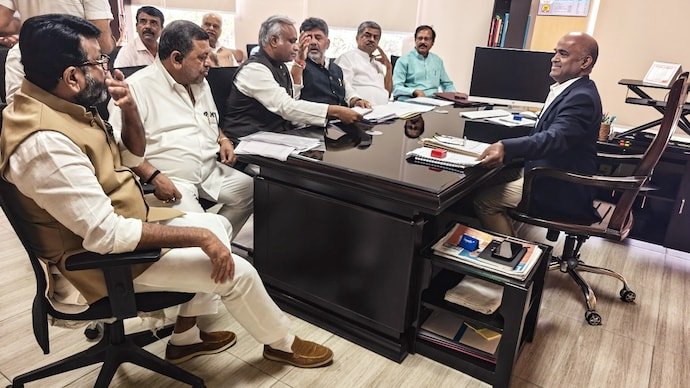
The Karnataka Form 7 controversy has intensified after Chief Minister DK Shivakumar staged a five-hour protest outside the office of Chief Electoral Officer V Anbukkumar, alleging that the electoral revision process was being misused to target genuine voters.
The Election Commission has now directed election officials to investigate complaints involving allegedly false Form 7 applications and take action where wrongdoing is established. At the same time, officials have been instructed to ensure that genuine voters are not removed from the electoral roll without proper verification.
EC Orders Strict Verification of Form 7 Applications
In an order issued amid the controversy, Karnataka CEO V Anbukkumar directed District Electoral Officers to thoroughly examine complaints involving fake or questionable Form 7 applications before taking legal action.
The instruction comes as election authorities face allegations that unusually large numbers of objections seeking voter deletions were submitted in several parts of the state.
The Election Commission has also directed Electoral Registration Officers to take strict legal action against anyone WHO knowingly submits false statements or false objections through Forms 6, 6A, 7 and 8 relating to voter registration.
The directive makes clear that filing an objection does not automatically result in deletion. Claims must be examined, and objections that do not have valid grounds are to be rejected.
What Is Form 7 and Why Is It at the Centre of the Row?
Form 7 is used to file an objection to the proposed inclusion of a name or to seek deletion of a name from an existing electoral roll. Because the form can be used to raise objections concerning voter entries, its use during a large-scale revision of electoral rolls has significant implications for eligible electors.
The Karnataka controversy centres on allegations that Form 7 applications were being filed in bulk and, in some cases, allegedly contained information that had been prepared before the forms were submitted.
Shivakumar has alleged that some applications contained the names, EPIC numbers and other particulars of voters proposed for deletion in pre-printed form, with the objectors’ details being filled in later.
These are allegations raised by the Chief Minister and require verification by election authorities. The EC’s latest order focuses precisely on that verification process and on establishing whether any applicant knowingly submitted false information.
High Number of Deletion Applications Raises Concern
The Election Commission has identified several areas where officials have received unusually high numbers of applications seeking deletion of voters.
These include Vijayanagar, Vijayapura, Mudigere in Chikmagalur, Belagavi and Bidar. Officials in these areas have been asked to remain particularly vigilant and personally verify the claims made in the deletion applications.
The emphasis on personal verification is intended to distinguish legitimate objections from applications that may have been filed without a valid basis.
The poll body has also clarified that objections submitted without valid grounds will be rejected. If an applicant is found to have knowingly made false statements or declarations, the person can face punitive legal action under the applicable provisions.
DK Shivakumar Holds Five-Hour Protest
The EC’s latest directions followed Shivakumar’s protest outside the office of the Karnataka Chief Electoral Officer.
The Chief Minister first held a meeting with Anbukkumar that lasted around two-and-a-half hours. He then began a sit-in protest that continued for approximately five hours.
Several of his Cabinet colleagues, congress MLAs and state party president BK Hariprasad joined the demonstration.
Shivakumar had also put a Cabinet meeting on hold to participate in the protest. He ended the demonstration after the CEO directed election officials to initiate action against applicants found to have knowingly submitted false statements or declarations in electoral forms.
The assurance regarding action over Form 7 objections became a central point in the resolution of the protest.
Shivakumar Alleges Attempt to Delete 4.5 Million Voters
During the dispute, Shivakumar alleged that pre-printed Form 7 applications were being submitted in bulk as part of an attempt to remove the names of around 4.5 million eligible voters from Karnataka’s electoral rolls.
He alleged that the affected voters could include people from minority communities, Scheduled Castes, Scheduled Tribes and Other Backward Classes.
These claims are allegations made by Shivakumar and have not been established as fact merely because complaints have been filed. The Election Commission’s decision to order verification is therefore significant because the investigation is intended to determine whether the alleged irregularities occurred and whether any applications were deliberately submitted using false information.
Shivakumar demanded an immediate, impartial and time-bound investigation into the alleged bulk filing of Form 7 applications.
Why September 22 to 24 Became a Focus
In his memorandum to the CEO, Shivakumar said he had been informed that a large number of Form 7 objections were filed in bulk, particularly on September 22, 23 and 24, toward the end of the claims and objections period.
He asked election authorities to examine the filing pattern during those dates and determine whether the applications were connected or part of a coordinated effort.
The requested investigation would involve examining the applications constituency by constituency and booth by booth. Shivakumar also sought identification of individuals who submitted unusually large numbers of Form 7 applications.
Such an examination could help election officials establish whether large-scale filings represented legitimate individual objections or whether the same people were submitting unusually high numbers of objections concerning voters with whom they had no apparent connection.
Chief Minister Seeks Examination of Voter Data
Shivakumar specifically asked officials to investigate the source of voter information used in the allegedly pre-printed forms.
His memorandum sought an examination of the names, EPIC numbers and other particulars appearing on the applications and asked officials to determine how that information had been obtained.
He also sought details about the relationship between people submitting Form 7 objections and the voters whose names they sought to have removed.
The purpose of the proposed examination, according to the Chief Minister’s memorandum, would be to establish whether the filing pattern showed evidence of coordinated activity and, if so, who was responsible.
Political Involvement Also Raised as a Question
Another part of Shivakumar’s complaint concerns the possible involvement of political functionaries.
He asked the Election Commission to investigate whether political functionaries were involved in, directing or aware of the alleged bulk filings. He also called for responsibility to be established on the basis of evidence rather than assumptions.
Where officials establish that an offence has occurred, Shivakumar sought the registration of FIRs against those responsible.
The Election Commission’s direction to investigate false statements and objections provides a formal route for such allegations to be examined. Whether criminal proceedings follow will depend on the findings of the verification and investigation process.
EC Emphasises Protection of Genuine Voters
While ordering action against false filings, the election authorities have simultaneously stressed the need to protect genuine voters from wrongful deletion.
District Electoral Officers have been instructed to thoroughly investigate complaints before legal action is initiated, with particular attention to areas where unusually large numbers of deletion applications have been received.
This distinction is important because the electoral roll revision process involves both correcting inaccurate entries and ensuring that eligible citizens are not wrongly removed.
An objection seeking deletion therefore has to be assessed on its merits. The EC’s instructions indicate that unsupported or invalid objections should not result in the removal of a voter’s name.
Forms 6, 6A, 7 and 8 Under Scrutiny
The Election Commission’s order does not apply only to Form 7. It has directed Electoral Registration Officers to take strict legal action against those who knowingly submit false statements or objections through Forms 6, 6A, 7 and 8.
These forms are part of the electoral registration framework and are used for different types of applications and objections concerning voter records.
The broader direction underlines that election officials are expected to verify information submitted during the revision process and act against deliberate false declarations.
For the Karnataka Form 7 row, however, Form 7 remains the main focus because the current dispute concerns allegations of large-scale objections seeking deletion of voters from the electoral rolls.
What the Investigation Will Need to Establish
The controversy now moves from political allegations and protests toward verification by election officials.
Among the questions raised by Shivakumar are whether unusually large numbers of Form 7 applications were submitted by the same individuals, whether the applications were connected to particular voters, how voter and EPIC information was obtained, and whether any political workers or functionaries were involved.
The election authorities’ investigation will determine whether the complaints are supported by evidence and whether any applicants knowingly submitted false information.
The outcome will also determine whether any cases meet the threshold for legal or criminal action.
Karnataka SIR Row Enters a Critical Phase
The dispute over Form 7 applications has added another layer to the political and administrative debate surrounding Karnataka’s electoral roll revision.
For the Election Commission, the immediate task is to verify the deletion objections while preventing legitimate voters from being removed without proper grounds. For the state government, the focus is on ensuring that allegations of organised or fraudulent deletion attempts are investigated and acted upon where evidence supports them.
Shivakumar has said that protecting the rights of every eligible voter is his responsibility and that the revision process must remain free, fair, transparent and legally compliant.
The EC’s latest order now puts the emphasis on verification, particularly in constituencies and districts where unusually high numbers of Form 7 applications have been received. Whether the allegations of coordinated or fraudulent filings are ultimately established will depend on the evidence gathered by election officials.
For voters, the central issue remains straightforward: an eligible citizen’s name should not be removed from the electoral roll on the basis of a false or unsupported objection. The ongoing verification process will determine how the disputed Form 7 applications in Karnataka are resolved.
For breaking news and live news updates, like us on Facebook or follow us on Twitter and Instagram. Read more on Latest India on thefoxdaily.com.





COMMENTS 0