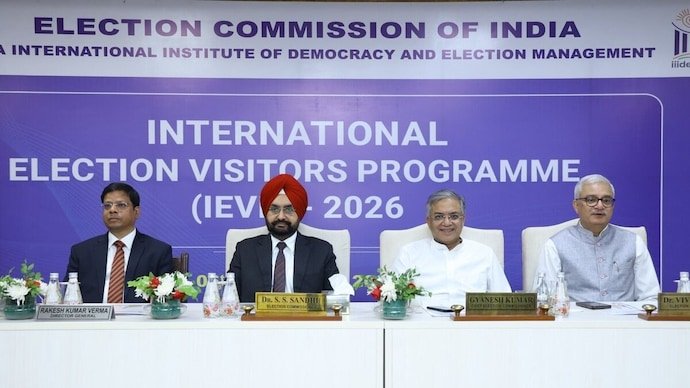
The Election Commission on Saturday said its order for conducting the Special Intensive Revision (SIR) of Electoral Rolls across all states and Union territories was approved unanimously by all three members of the poll panel, Chief Election Commissioner Gyanesh Kumar and Election Commissioners Sukhbir Singh Sandhu and Vivek Joshi.
The clarification came amid reports of differences within the three-member Election Commission over decisions linked to voter-roll revision, Form 6, electoral data and the functioning of the poll body.
In a statement approved by the full Commission, the Election Commission also said the declaration associated with Form 6 for the SIR process had been upheld by the Supreme Court. The poll panel said the existing statutory Form 6 would continue to be used outside the SIR period under the applicable electoral-registration rules.
Election Commission Says All SIR Orders Were Unanimous
The Election Commission said several important decisions had been taken in recent months concerning the nationwide electoral-roll revision exercise and that these decisions had received the approval of all three commissioners.
According to the poll panel, the original order dated June 24, 2025, for conducting the SIR across all states and Union territories was issued with the unanimous approval of Gyanesh Kumar, Sukhbir Singh Sandhu and Vivek Joshi.
The exercise began with Bihar and was subsequently extended to West Bengal and other states and Union territories.
The Commission said the Supreme Court upheld the SIR order in its May 27, 2026, decision, providing judicial backing for the exercise.
The poll panel further said the SIR schedule for 12 states and Union territories, issued on October 27, 2025, had also received unanimous approval. The schedule for another 19 states and Union territories, issued on May 14, 2026, was likewise approved by all three commissioners.
The Election Commission said the final nationwide number of electors would become clear only after the electoral rolls are finally published in the remaining 12 states covered under Phase III of the exercise.
Form 6 Clarification Comes Amid Internal Differences
Form 6 has emerged as one of the central issues in the recent controversy surrounding the Election Commission.
The form is used by people seeking inclusion in electoral rolls. Reports had raised questions over the addition of SIR-related requirements connected with the form and whether the changes had received the necessary approval.
The Election Commission said the declaration attached to Form 6 for the SIR process had been upheld by the Supreme Court.
The poll panel also clarified that the Form 6 used during the non-SIR period would continue to follow the Registration of Electors Rules, 1960.
The distinction is important because the Commission maintains that the statutory Form 6 itself was not altered. Instead, an additional declaration was required alongside the existing form for the SIR process.
The clarification followed reports that Election Commissioners Sandhu and Joshi had raised objections over aspects of the Form 6 process. The Indian Express had reported that the revised procedure included questions connected with the previous SIR.
What the EC Says About the Cabinet Secretary Letters
The Election Commission also addressed letters reportedly sent by Sandhu and Joshi to the Cabinet Secretary.
The Commission said the letters were not connected with any policy decision of the poll body or its IT division. According to the EC, they concerned the functioning of an officer on deputation to the Election Commission.
The poll panel said the officer concerned had issued orders redistributing certain work, but those orders were not implemented after intervention by the two Election Commissioners.
The Commission also clarified that oversight of its IT division by the Deputy Election Commissioner had never actually been withdrawn.
The explanation came after reports that Sandhu and Joshi had raised objections on several occasions regarding decisions and orders connected with the SIR exercise and other aspects of the Election Commission’s functioning.
EC Introduces Measures for More Structured Meetings
Against the backdrop of reported differences within the poll panel, the Election Commission announced measures concerning how its meetings and directions would be handled.
The Commission said agendas for all future meetings would be circulated to members in advance and that minutes of the meetings would be issued.
It also said directions issued by commissioners to officers of the Election Commission would be followed meticulously.
The full Commission met on September 26 amid the controversy surrounding the reported objections of Sandhu and Joshi.
The Commission described differences of view, observations and discussions among its members as a normal part of institutional deliberations. At the same time, it maintained that the final decisions issued in the name of the Commission had full legal backing and followed the prescribed statutory procedure.
Goa Voters Left Out of Electoral Roll Get Follow-Up
The Election Commission also provided an update concerning voters WHO were left out of the electoral roll in Goa.
The Commission said the Chief Electoral Officer of Goa had directed Booth Level Officers to conduct house-to-house visits to collect the necessary forms from voters who had not been included in the electoral roll.
Of the 97 voters identified in the matter, 81 had already submitted Form 6 applications seeking inclusion in the electoral roll, according to the poll panel.
The development illustrates the role of local election officials in addressing cases where eligible voters are left out during the revision process.
The Commission has also clarified the procedure for people who receive notices during the SIR process.
Personal Hearings Not Required in Every SIR Notice Case
The Election Commission said individuals who had received notices during the SIR exercise would not ordinarily be required to appear personally before authorities.
According to the poll panel, a personal hearing would only be necessary in exceptional circumstances.
The clarification could reduce the procedural burden on voters who receive notices during the revision exercise, particularly in cases where documentary or other verification can be completed without requiring an in-person appearance.
The SIR process involves verification of electoral-roll entries and can result in notices being issued when officials identify discrepancies or require additional information. The Commission’s latest statement seeks to clarify how such cases should be handled.
Why the EC’s Unanimity Claim Matters
The Election Commission’s statement is significant because it directly addresses reports of internal disagreements among its three members.
Reports had alleged that Sandhu and Joshi recorded objections to several decisions over a period of months. The issues reportedly included voter deletions, additions to electoral rolls, changes connected with Form 6 and the handling of voter data.
The existence of objections or differences in views does not necessarily mean that a final Commission decision was divided. The Election Commission has emphasized this distinction, saying that individual observations and disagreements are part of institutional deliberations while decisions formally issued by the Commission were unanimous.
The latest statement therefore places particular emphasis on the difference between internal discussion and the final decision-making authority of the three-member body.
The Commission’s position is that the SIR orders were not issued solely on the authority of the Chief Election Commissioner but had the approval of all three commissioners.
Supreme Court Order Cited in SIR Dispute
The Election Commission has also repeatedly referred to the Supreme Court’s May 27, 2026, order in defending the SIR framework and the additional declaration associated with Form 6.
By citing the court’s decision, the poll panel has sought to establish that the relevant provisions of the SIR process have judicial backing.
At the same time, questions raised about the internal process of decision-making within the Commission remain part of the broader political and institutional debate.
The distinction between the legality of the SIR framework and disagreements over how particular administrative decisions were handled is important to understanding the current controversy.
Political Dispute Over Voter Rolls Continues
The Election Commission’s clarification comes as opposition parties continue to raise questions about the SIR exercise and the management of electoral rolls.
The dispute has become particularly political because voter-list revisions can affect who appears on electoral rolls and therefore who is eligible to vote in Elections after the applicable verification and registration procedures are completed.
Opposition parties have raised concerns about the deletion and addition of names and about the transparency of the process. The Election Commission, Meanwhile, has maintained that the revision is being carried out according to statutory provisions and established procedures.
The latest statement attempts to address one of the central questions raised by the controversy: whether major SIR decisions were made collectively by the three-member Commission.
According to the poll panel, the answer is yes. It says the nationwide SIR order, subsequent schedules and the relevant decisions concerning the exercise all received unanimous approval.
EC Seeks to Reinforce Institutional Process
Beyond the SIR itself, the Commission’s announcement about advance meeting agendas and the issuance of minutes indicates an effort to formalize internal procedures amid scrutiny of its functioning.
The Commission has said that differences of opinion are normal within an institution and that observations by individual members should be understood within that process.
At the same time, the poll panel has emphasized that its formal orders carry the authority of the full Commission and are issued in accordance with law.
The new emphasis on meeting agendas, minutes and implementation of directions could provide a clearer record of how future decisions are discussed and finalized.
Final Electoral Numbers Will Come After Phase III
The Election Commission has cautioned against treating the current voter figures as the final nationwide numbers.
It said the definitive number of electors will be known only after the final publication of electoral rolls in the remaining 12 states covered under Phase III of the SIR process.
This means that the nationwide picture will continue to develop as the remaining stages of revision, verification and final publication are completed.
The Goa update also shows that the process can involve follow-up action after omissions are identified, with Booth Level Officers instructed to contact affected voters and facilitate submission of the required forms.
EC’s Latest Statement Seeks to Close Questions Over SIR Decisions
The Election Commission’s latest statement is an effort to provide a detailed account of its position amid growing scrutiny over the SIR exercise and reports of differences among its members.
The poll panel has stated that the June 24, 2025, nationwide SIR order received unanimous approval from Gyanesh Kumar, Sukhbir Singh Sandhu and Vivek Joshi. It has made the same claim regarding subsequent SIR schedules covering different groups of states and Union territories.
It has also defended the declaration associated with Form 6 by pointing to the Supreme Court’s May 27, 2026, order and clarified that the statutory form applicable outside the SIR period remains governed by the Registration of Electors Rules, 1960.
At the institutional level, the Commission has announced advance circulation of meeting agendas and the issuance of minutes, while saying that differences of opinion are a normal part of deliberations.
The controversy over the Election Commission’s functioning and voter-roll revision is therefore continuing, but the poll panel’s latest position is clear: it says the formal SIR orders had the unanimous approval of all three commissioners and that the exercise has been conducted within the legal framework it is required to follow.
For breaking news and live news updates, like us on Facebook or follow us on Twitter and Instagram. Read more on Latest India on thefoxdaily.com.






COMMENTS 0