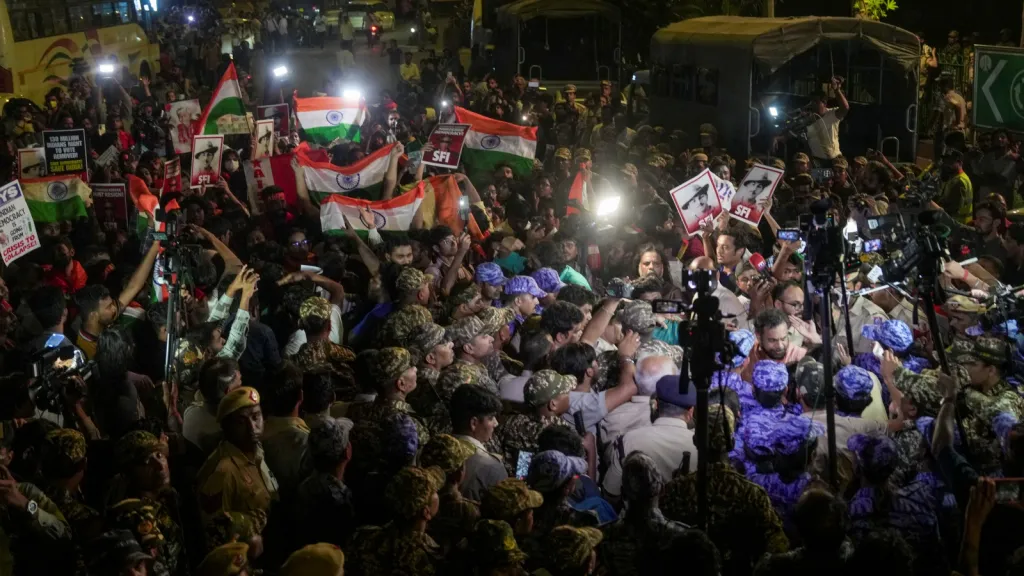
India’s history of mass protests offers a complex lesson in political power: some agitations have forced governments to reverse major decisions, others have reshaped electoral politics without achieving their original demands, and several have failed despite months of mobilisation. From the anti-Hindi agitation of 1965 and the Jayaprakash Narayan movement of the Emergency era to the farmers’ protests of 2020-21, street movements have repeatedly influenced the country’s political and social trajectory.
The latest protests by Opposition parties and the Cockroach Janta Party (CJP) against Chief Election Commissioner Gyanesh Kumar over the Special Intensive Revision (SIR) of electoral rolls have renewed questions about whether sustained public mobilisation can force the government to reconsider a contentious policy. The agitation follows CJP-led student and youth protests over the NEET paper leak, which the party linked to demands for accountability and the resignation of Union Education Minister Dharmendra Pradhan.
However, India’s experience shows that the size of a protest alone does not determine its success. Government responses, public support, electoral consequences, the constitutional framework and the ability of a movement to maintain pressure all influence its eventual outcome. Some movements have won immediate concessions, while others have left a lasting political legacy despite failing to secure their central demands.
Five major agitations illustrate how protests have compelled governments to retreat or produced significant political change. Five others demonstrate why even widespread mobilisation can fall short of its stated objectives.
Five Mass Agitations That Succeeded in India
1. Anti-Hindi Agitation of 1965: How Tamil Nadu Forced a National Language Compromise
Issue and objective: The anti-Hindi agitation emerged from opposition to making Hindi the sole official language of the Union after the 15-year transition period envisaged by Article 343 of the Constitution. As January 26, 1965, approached, fears grew in Madras State, now Tamil Nadu, that the transition would disadvantage people in non-Hindi-speaking regions and threaten the continued use of English in government administration.
Impact: Student demonstrations, strikes, processions and clashes with police spread across the state. Protesters targeted Hindi signboards and government property, while the unrest also involved deaths in police firing, self-immolations and other fatalities. The Dravida Munnetra Kazhagam (DMK) provided an important organisational base, although students also played a significant role independently.
Government response: Prime Minister Lal Bahadur Shastri initially supported the planned transition but faced mounting pressure as the agitation intensified. Tamil leaders, including members of the Congress, also pressed for assurances that English would continue to be used alongside Hindi.
Outcome: The Centre assured non-Hindi-speaking states that English would continue to be used for official purposes. The Official Languages Act, 1963, as amended in 1967, helped establish the framework for the continued use of English alongside Hindi. The agitation also strengthened the DMK, which won the 1967 Tamil Nadu Assembly election and ended Congress rule in the state.
What it showed: A movement does not need to spread uniformly across India to influence national policy. Sustained resistance in a strategically important state can force the Centre to accommodate regional concerns, particularly when language, identity and federal relations are involved.
2. JP Movement, 1974-75: From Student Protests to Opposition Unity
Issue and objective: The Jayaprakash Narayan movement began with student protests in Bihar against corruption, inflation, unemployment and poor governance. Veteran socialist leader Jayaprakash Narayan, widely known as JP, took up the cause and called for the dissolution of the Bihar Assembly before expanding his campaign into a wider movement for “Sampoorna Kranti”, or Total Revolution.
Impact: The agitation spread beyond Bihar and brought together socialists, Jana Sangh leaders, Congress dissidents and other opponents of Prime Minister Indira Gandhi. JP’s campaign gave disparate political groups a common platform and helped build an alternative to the Congress-led government.
Government response: The Bihar Assembly was not dissolved in response to the movement’s demand. The confrontation escalated, and Indira Gandhi declared a national Emergency on June 25-26, 1975. JP and numerous Opposition leaders were detained as civil liberties and political activity came under severe restrictions.
Outcome: The movement did not achieve all its immediate demands, but its emphasis on Opposition unity had far-reaching consequences. Several groups opposed to the Emergency came together under the Janata Party banner, which defeated the Congress in the 1977 Lok Sabha election. It was the first time the Congress lost power at the Centre in an election since Independence.
What it showed: A movement can achieve political success even when its initial demands are rejected. By uniting otherwise divided groups around a larger objective, the JP movement helped transform the political landscape and create an alternative to an entrenched ruling party.
3. India Against Corruption, 2011: A Protest That Reshaped National Politics
Issue and objective: The India Against Corruption movement demanded a strong Jan Lokpal law to establish an independent mechanism for investigating allegations of corruption involving public officials. Social activist Anna Hazare became its most prominent face through hunger strikes and public demonstrations.
Impact: The campaign drew large crowds to Delhi’s Ramlila Maidan and inspired solidarity rallies in cities across the country. Students, urban professionals, activists and civil society groups participated, while extensive television coverage helped turn the agitation into a national political event. Baba Ramdev’s parallel campaign against black money contributed to the wider atmosphere of public discontent.
Government response: The Congress-led United Progressive Alliance (UPA) government initially resisted several demands but eventually entered negotiations with the protesters. Parliament also discussed the proposed anti-corruption legislation as pressure mounted for a credible institutional response.
Outcome: The movement did not secure the Jan Lokpal framework in precisely the form demanded by Team Anna. Nevertheless, it intensified public scrutiny of corruption allegations and weakened the political standing of the UPA. It also helped create the political conditions in which the Aam Aadmi Party (AAP), led by Arvind Kejriwal, emerged as a major force in Delhi. Separately, Narendra Modi and the Bharatiya Janata Party (BJP) benefited from the broader anti-incumbency climate ahead of the 2014 Lok Sabha election, which gave the BJP its first single-party majority in the Lok Sabha.
What it showed: A protest can have a larger political impact than its original legislative demand suggests. By connecting several corruption controversies to a broader argument about governance and accountability, India Against Corruption helped change public debate and create opportunities for new political actors.
4. Nirbhaya Protests, 2012-13: Public Outrage Leads to Changes in Criminal Law
Issue and objective: The brutal gang rape and murder of a young woman in Delhi in December 2012 triggered widespread outrage. Protesters demanded justice for the victim, stronger laws against sexual violence and more effective measures to protect women.
Impact: Large, largely spontaneous crowds of young people gathered at India Gate, Raisina Hill and other public spaces in the national capital. Demonstrations spread to other cities, bringing women’s safety, policing and the treatment of sexual violence survivors to the forefront of national debate.
Government response: Police used barricades, water cannons and force to disperse demonstrators. At the same time, the government established the Justice J.S. Verma Committee to recommend changes to laws dealing with sexual offences. The committee submitted its report in January 2013 after receiving extensive public representations.
Outcome: Parliament passed the Criminal Law (Amendment) Act, 2013, expanding the legal definition of rape and introducing or strengthening provisions covering offences such as stalking, voyeurism, acid attacks and sexual harassment. The legislation represented a substantial response to public demands for stronger legal protection, although implementation and the prevention of sexual violence have remained major challenges.
What it showed: Public outrage can produce legislative action when a case exposes serious concerns about justice and personal safety. The protests also demonstrated how sustained public attention can make it politically difficult for governments to ignore demands for legal reform.
5. Farmers’ Protest, 2020-21: The Agitation That Forced Repeal of Three Farm Laws
Issue and objective: Farmers, particularly from Punjab, Haryana and western Uttar Pradesh, mobilised against three central farm laws enacted in 2020. Protesters argued that the measures could undermine existing agricultural safeguards and demanded the laws’ repeal. They also sought a legal guarantee for minimum support prices (MSP) for agricultural produce.
Impact: Farmers established large protest sites at Singhu, Tikri and Ghazipur on the outskirts of Delhi. The movement continued for more than a year despite cold weather, the Covid-19 pandemic and repeated confrontations with authorities. Farmer unions coordinated demonstrations, negotiations and mobilisation across several states.
Government response: The Centre held multiple rounds of talks with farmer representatives, offered amendments and proposed suspending the laws for 18 months. However, the negotiations failed to produce a settlement acceptable to the protesting unions.
Outcome: Prime Minister Narendra Modi announced in November 2021 that the government would repeal the three farm laws. Parliament subsequently passed the Farm Laws Repeal Act, 2021. The separate demand for a statutory guarantee of MSP was not resolved through that repeal.
What it showed: A sustained movement can force a government to reverse a major policy when protesters maintain organisational unity and public pressure over an extended period. The outcome also showed that governments may withdraw a contested policy without accepting every demand raised by the movement.
Five Mass Agitations That Failed to Achieve Their Main Objectives
1. Cow-Protection Agitation, 1966: Why Massive Mobilisation Failed to Secure a Nationwide Ban
Issue and objective: The cow-protection agitation of 1966 sought a nationwide prohibition on cow slaughter. The demand had strong religious and political significance for its supporters, including sadhus, cow-protection organisations and activists associated with the Bharatiya Jana Sangh.
Impact: On November 7, 1966, a massive crowd marched towards Parliament in New Delhi. The demonstration turned violent, with clashes between protesters and police, attacks on vehicles and public property, and attempts to breach security barricades. Police opened fire, killing several people. The violence prompted Home Minister Gulzarilal Nanda to resign.
Government response: Prime Minister Indira Gandhi’s government refused to introduce a blanket nationwide prohibition on cow slaughter. It established a committee to examine the issue, but this did not result in the central legislation demanded by protesters.
Outcome: The principal demand for a uniform nationwide ban was not achieved. The agitation nevertheless gave cow protection greater political visibility and helped the Jana Sangh strengthen its profile among supporters of the cause. The constitutional division of responsibilities also mattered: animal preservation falls within the State List, and laws on cow slaughter have consequently varied across states.
What it showed: Even a large demonstration cannot automatically overcome constitutional constraints and differences between states. A movement can increase political visibility and influence party mobilisation without securing the specific national policy it seeks.
2. All-India Railway Strike, 1974: A Massive Industrial Action Ends Without a Settlement
Issue and objective: The 1974 railway strike was organised by railway workers seeking better wages, improved working conditions and changes to working-hour arrangements. Led by trade unionist George Fernandes, the movement sought to address long-standing grievances among employees of one of India’s largest public-sector employers.
Impact: Beginning on May 8, 1974, the strike involved an estimated 1.7 million railway employees and disrupted passenger and freight services across the country. The scale of the action made it one of the most significant industrial disputes in independent India, affecting transport, commerce and the movement of essential goods.
Government response: Prime Minister Indira Gandhi’s government adopted a hard line. Union leaders were arrested, workers were detained, and some employees and their families faced eviction from railway housing. Authorities used disciplinary measures and other forms of pressure to weaken the strike.
Outcome: The strike was called off after roughly three weeks without securing its principal demands. Many workers faced disciplinary action, and the immediate campaign for better wages and working conditions failed to achieve the settlement sought by the unions.
What it showed: Economic disruption does not always translate into bargaining power. When the state controls employment, salaries, housing and disciplinary procedures, it can sustain a confrontation even when industrial action causes substantial disruption. The strike’s failure also illustrated the vulnerability of workers when negotiations break down and institutional support proves insufficient.
3. Anti-Mandal Agitation, 1990: Protests Fail to Stop OBC Reservation
Issue and objective: The anti-Mandal agitation erupted after Prime Minister V.P. Singh’s government announced its decision to implement the Mandal Commission’s recommendation for 27% reservation in central government jobs for Other Backward Classes (OBCs). Opponents, including sections of the student community, demanded that the decision be withdrawn.
Impact: Demonstrations, strikes and road blockades spread across parts of northern India. Student protests became particularly intense in Delhi and other urban centres. The attempted self-immolation of Delhi University student Rajiv Goswami in September 1990 became one of the defining images of the agitation and triggered further protests.
Government response: V.P. Singh refused to reverse the reservation decision despite the growing unrest. His government maintained that the measure was intended to address the historical exclusion of socially and educationally disadvantaged communities from public employment.
Outcome: The anti-Mandal movement failed to stop the implementation of OBC reservations in central government employment. The Supreme Court subsequently upheld the constitutional validity of the central OBC reservation framework in its 1992 Indra Sawhney judgment, while establishing important conditions, including the exclusion of the creamy layer.
What it showed: The intensity of street protests does not necessarily reflect the preferences of the wider electorate. The agitation also demonstrated that opposing movements can fail to reverse a policy while the underlying issue transforms politics. The Mandal controversy strengthened debates about social justice, representation and caste-based inequality, reshaping political alignments across northern India.
4. Narmada Bachao Andolan: Decades of Resistance Fail to Stop the Sardar Sarovar Dam
Issue and objective: The Narmada Bachao Andolan (NBA), associated prominently with activist Medha Patkar and communities affected by dam projects, challenged the social and environmental costs of large dams in the Narmada valley. The movement focused on displacement, rehabilitation, environmental damage and the rights of people whose homes and livelihoods were threatened by projects including the Sardar Sarovar dam.
Impact: From the 1980s onwards, the movement organised village-level campaigns, marches, hunger strikes, legal challenges and international advocacy. It brought the displacement of tribal communities and other residents into national and international debates about development. Its campaign also contributed to an independent World Bank review of the Sardar Sarovar project, which identified serious problems with resettlement and environmental compliance.
Government response: India requested the cancellation of the remaining World Bank loan for the project in 1993. However, the withdrawal of World Bank financing did not end construction. The project continued through domestic funding and political support, while court proceedings addressed questions involving construction, rehabilitation and environmental safeguards.
Outcome: The NBA did not achieve its central objective of stopping the Sardar Sarovar dam. In 2000, the Supreme Court allowed construction to proceed in stages, subject to rehabilitation and other conditions. The dam eventually reached its full height of 138.68 metres. Nevertheless, the movement brought displacement and rehabilitation failures into public debate and influenced wider discussions about development policy and environmental justice.
What it showed: Stopping a major infrastructure project becomes increasingly difficult when substantial financial commitments, construction work and political interests accumulate. A movement may influence public scrutiny, institutional procedures and international opinion without preventing the project it opposes. The NBA’s experience also highlights the distinction between stopping a project and securing safeguards for affected communities.
5. Anti-CAA Protests and Shaheen Bagh, 2019-20: A Mass Movement Fails to Secure Repeal
Issue and objective: Protests against the Citizenship (Amendment) Act (CAA) intensified in December 2019 following the passage of the legislation and amid concerns about its possible interaction with the proposed National Register of Citizens (NRC) and the National Population Register (NPR). Protesters demanded the repeal of the CAA and raised concerns about religion, citizenship and equal treatment under the law.
Impact: The demonstrations brought together students, civil society organisations, activists and citizens across several states. Shaheen Bagh in Delhi became a prominent centre of protest, where predominantly Muslim women maintained a sit-in for approximately 101 days. The demonstration inspired similar occupations and public gatherings in other parts of India, making the movement one of the most visible protest campaigns of the period.
Government response: The Narendra Modi government refused to repeal the CAA. Protests were accompanied by clashes between police and demonstrators in several locations. Uttar Pradesh witnessed deadly violence during the unrest, while communal violence in northeast Delhi in February 2020 killed more than 50 people. The Covid-19 pandemic and the restrictions introduced in March 2020 brought the Shaheen Bagh occupation to an end.
Outcome: The CAA remained in force, and the government notified its implementing rules in March 2024. The movement did not achieve its central demand for repeal. The proposed nationwide NRC, however, was not implemented as part of a nationwide exercise during this period, and the government did not proceed with the nationwide citizenship register that protesters feared.
What it showed: Large crowds and sustained mobilisation do not guarantee a policy reversal when the government considers the issue central to its political agenda. The outcome also demonstrated the importance of electoral calculations, the organisation of protest coalitions and the ability of movements to maintain public support. Although the agitation did not secure repeal, it placed questions about citizenship, constitutional equality and religious identity at the centre of national debate.
What India’s History of Mass Protests Reveals
The ten agitations illustrate that protest movements cannot be judged solely by whether a government accepts their original demands. Some secure direct policy reversals, others change political alignments, and several influence public debate without delivering the outcomes their organisers seek.
The anti-Hindi agitation and the farmers’ movement offer clear examples of governments retreating under sustained pressure. In the first case, regional mobilisation forced the Centre to accommodate demands concerning language policy. In the second, a prolonged campaign led to the repeal of three major agricultural laws. Both movements maintained a strong focus on specific demands and developed the organisational capacity needed to sustain pressure.
The JP movement and India Against Corruption demonstrate a different route to political influence. Neither achieved every immediate objective, but both helped reshape the political environment. The JP movement contributed to Opposition unity that defeated the Congress in 1977, while the anti-corruption agitation weakened the UPA’s political narrative and helped create space for the AAP and other political developments.
The Nirbhaya protests show how a moment of widespread public outrage can lead to legislative change. However, legal reform does not automatically resolve the social and institutional problems behind a movement. The effectiveness of new laws depends on implementation, policing, access to justice and wider changes in public attitudes.
By contrast, the railway strike, anti-Mandal agitation, cow-protection movement, Narmada Bachao Andolan and anti-CAA protests illustrate different reasons why movements may fail to achieve their principal demands. Government coercion, constitutional constraints, competing political interests, established policy commitments and the limits of public mobilisation can all shape outcomes.
Can the CJP-Led Protests Force a Government Response?
The protests involving the Cockroach Janta Party and Opposition groups must be assessed against these historical experiences rather than through the size of demonstrations alone. The current agitation over the Special Intensive Revision of electoral rolls raises questions about electoral transparency, voter eligibility, administrative procedures and the relationship between election authorities and political parties.
The outcome will depend on the movement’s ability to articulate specific demands, build support beyond its existing political base and sustain public engagement. It will also depend on whether its concerns lead to concrete legal, administrative or political pressure. Unlike a protest over a single law, a dispute involving electoral rolls and the Election Commission may require scrutiny of procedures, evidence and constitutional responsibilities.
The earlier NEET paper leak protests provide another point of comparison. Student mobilisation can attract national attention and increase pressure on political leaders, but a resignation or other high-profile political development does not, by itself, establish that every demand of a movement has been met. The long-term test is whether the agitation produces meaningful accountability and changes to the systems under criticism.
India’s protest history therefore offers neither a guarantee of success nor proof that demonstrations are futile. Movements can compel governments to reverse decisions, bring neglected issues into the political mainstream and create new political organisations. They can also lose momentum, encounter state resistance or fail when their demands conflict with a government’s priorities.
The central lesson is that mass mobilisation becomes politically consequential when public pressure translates into institutional change, electoral consequences or a lasting shift in public opinion. For the CJP and the Opposition, the challenge is not merely to assemble crowds but to demonstrate that the agitation can sustain public confidence and deliver an outcome that extends beyond the immediate spectacle of protest.
For breaking news and live news updates, like us on Facebook or follow us on Twitter and Instagram. Read more on Latest India on thefoxdaily.com.






COMMENTS 0