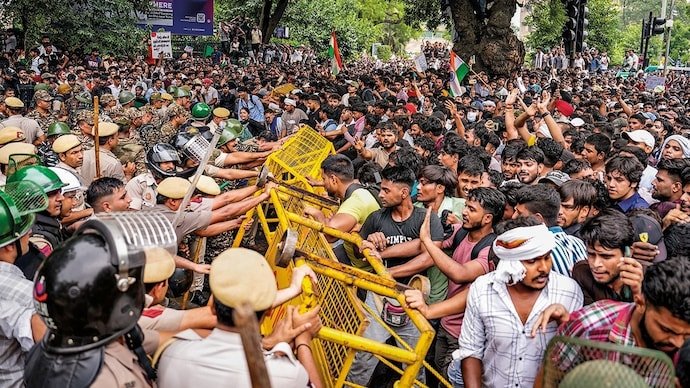
The Supreme Court of India has delivered one of its most significant orders in the ongoing aftermath of the NEET paper leak controversy and nationwide student protests. In a decision that could shape how future demonstrations are handled across the country, the court directed authorities to release minors and protesters without criminal antecedents who were arrested during the agitation, while also ordering that no coercive action be taken against students named in protest-related FIRs.
The ruling comes amid heightened national debate over student rights, police powers, public protests, and government accountability. Beyond immediate relief for thousands of protesters and their families, the court’s observations suggest a broader examination of how democratic societies balance public order with constitutional freedoms.
Importantly, the court made it clear that its protection would not extend to individuals with established criminal backgrounds, signaling an attempt to distinguish peaceful protesters from those who may have engaged in unlawful conduct.
What Did the Supreme Court Order?
A three-judge bench led by Chief Justice Surya Kant issued a series of interim directions while hearing petitions related to police action during student protests held across multiple states.
The court ordered that:
- All protesters below the age of 18 be released.
- Individuals without criminal antecedents be released from detention.
- No coercive action be taken in connection with protest-related FIRs involving students.
- Authorities preserve CCTV footage, drone recordings, body camera footage, wireless communications, and PCR logs.
- Personal information and digital data of protesters should not be publicly disclosed.
- Governments and police authorities respond to notices issued by the court.
These directions represent one of the strongest judicial interventions in a protest-related matter in recent years.
Why the Case Reached the Supreme Court
The petitions before the court arose from allegations of excessive police action during demonstrations linked to the NEET examination controversy. Protesters alleged that law enforcement agencies used disproportionate force while attempting to disperse crowds in Delhi and several other states.
The July 20 march toward Parliament became a focal point of controversy after clashes occurred between protesters and police personnel. The incident led to multiple arrests, injuries, and competing claims regarding the conduct of both demonstrators and security forces.
Petitioners argued that constitutional rights were violated during the crackdown and sought judicial intervention to protect students from further action.
Timeline of Key Events
| Date / Stage | Major Development |
|---|---|
| NEET Controversy Emerges | Examination irregularity allegations trigger nationwide anger. |
| Student Demonstrations Begin | Protests spread across multiple states. |
| July 20 Protest | March toward Parliament leads to clashes with police. |
| Arrests and FIRs | Multiple cases registered against protesters. |
| Petitions Filed | Supreme Court approached over alleged police excesses. |
| July 28 Hearing | Supreme Court grants interim relief and issues directions. |
| August 3 | Next hearing scheduled. |
The Constitutional Question at the Heart of the Case
The case extends far beyond the immediate controversy surrounding examination irregularities. At its core lies a fundamental constitutional issue: how should democratic governments respond when citizens, particularly students, gather to protest public policy failures?
The Supreme Court reiterated an important principle that has shaped Indian constitutional jurisprudence for decades—the right to peaceful and lawful protest is a protected democratic freedom.
While governments possess the authority to maintain public order, courts have consistently held that such powers must be exercised proportionately and responsibly.
Possible Independent Probe Into Police Conduct
One of the most consequential aspects of the hearing was the court’s indication that it may establish or direct a high-powered independent investigation into allegations of misconduct.
The proposed inquiry could examine:
- Claims of excessive force against protesters.
- Allegations involving crowd-control weapons.
- Actions of individual police personnel.
- Claims of violence against law enforcement officers.
- Whether operational protocols were properly followed.
The court emphasized that accountability must apply equally to all sides involved in the confrontation.
Why Evidence Preservation Is So Important
The Supreme Court’s direction to preserve CCTV footage, drone recordings, body-camera videos, communication logs, and emergency response records may prove critical in determining what actually occurred during the protests.
Modern protest investigations increasingly rely on digital evidence because it provides an objective record that can either support or contradict competing narratives.
By securing these records early, the court is attempting to ensure that future investigations are based on verifiable evidence rather than political claims or selective accounts.
Data Privacy Emerges as a Key Issue
One often-overlooked aspect of the order involves the protection of protesters’ personal information.
The court directed authorities not to publish personal details or digital data connected to individuals who participated in demonstrations.
This reflects a growing global concern regarding privacy rights during public protests. In an era of digital surveillance, courts increasingly recognize that public disclosure of personal information can discourage citizens from exercising democratic freedoms.
Government’s Position: Concerns Over Violence and Infiltration
Government representatives argued before the court that the situation was more complex than a simple confrontation between students and police.
Authorities highlighted injuries suffered by police personnel during the clashes and raised concerns that individuals with criminal backgrounds may have infiltrated the protests.
The government’s position underscores an important challenge faced by law enforcement agencies worldwide: distinguishing peaceful demonstrators from those who may exploit large gatherings for unlawful activities.
This issue is likely to play a major role in future hearings.
Comparison: Peaceful Protesters vs Individuals Facing Criminal Allegations
| Category | Court’s Interim Approach |
|---|---|
| Minors | Release directed. |
| Students without criminal antecedents | Protection from coercive action. |
| Individuals with criminal backgrounds | Protection not automatically extended. |
| Alleged perpetrators of violence | Subject to further investigation. |
A Major Observation: India May Need a National Protest Policing Protocol
Perhaps the most important long-term implication of the hearing is the court’s suggestion that India requires a standardized protocol for handling protests.
Currently, crowd-control practices can vary significantly between states and agencies. This often leads to inconsistent responses, confusion, and allegations of excessive force.
A uniform national framework could potentially establish:
- Clear escalation guidelines.
- Approved crowd-control techniques.
- Rules governing the use of force.
- Standards for documentation and transparency.
- Independent review mechanisms.
Such reforms could become one of the most lasting outcomes of the entire controversy.
Why This Case Matters Beyond NEET
Although the current proceedings emerged from the NEET examination controversy, the legal principles involved extend far beyond education policy.
The court’s decisions could influence future responses to demonstrations involving labor rights, environmental issues, economic policies, social movements, and other public causes.
In effect, the case is becoming a broader examination of democratic participation and state accountability.
Potential Impact on Students and Civil Society
The immediate beneficiaries of the order are students who faced uncertainty regarding arrests, legal proceedings, and future educational opportunities.
For civil society organizations, the ruling sends a signal that courts remain willing to scrutinize allegations of excessive force while also insisting that unlawful conduct by protesters be investigated.
This balanced approach may help reinforce public confidence in judicial oversight during politically sensitive situations.
What Happens Next?
The matter will return to the Supreme Court for further hearing on August 3. By then, governments and police authorities are expected to respond to the court’s notices and provide information regarding the incidents under examination.
The court may then decide whether a formal independent probe should be established and what additional safeguards or reforms may be necessary.
The preserved evidence, government submissions, and responses from petitioners will likely shape the next phase of proceedings.
Conclusion
The Supreme Court’s order represents a significant moment in the intersection of constitutional rights, student activism, and law enforcement accountability. By directing the release of minors and first-time offenders, protecting students from coercive action, preserving critical evidence, and considering an independent probe, the court has sought to balance public order with democratic freedoms.
While the immediate focus remains on the NEET-related protests, the broader implications may reshape how authorities manage demonstrations across India in the future. If the court ultimately establishes clearer standards for protest policing and accountability, this case could become a landmark precedent in strengthening both democratic rights and institutional responsibility.
For breaking news and live news updates, like us on Facebook or follow us on Twitter and Instagram. Read more on Latest India on thefoxdaily.com.





COMMENTS 0